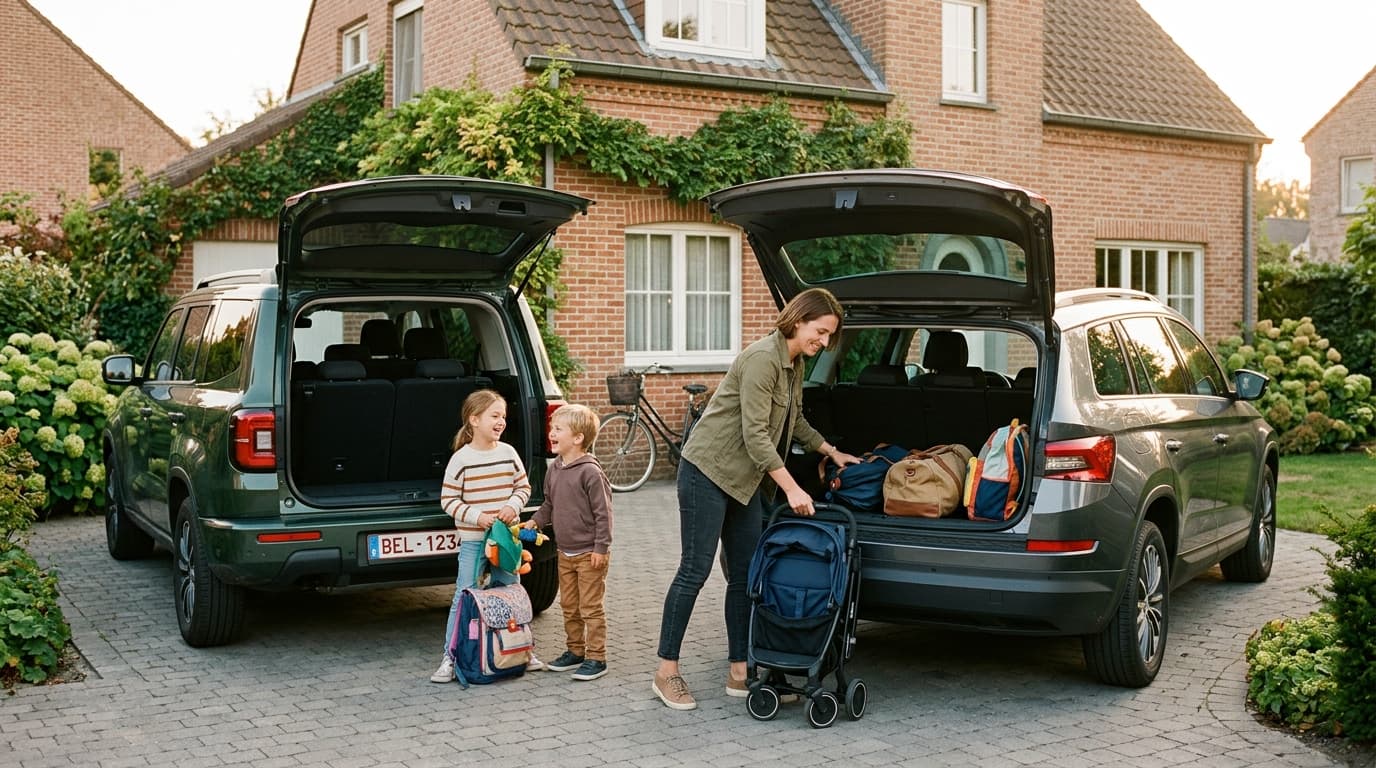
Choosing between the Hyundai Santa Fe and the Kia Sorento means splitting hairs between two cousins: same group, same platform, often the same engines. So the real question for a family isn't "which is better," but "which fits your use and your budget."
Bottom line: if you want maximum space, a big boot and an easy-access third row, the new-generation Santa Fe edges ahead. If you prefer slightly more engaging driving and more consensual styling, the Sorento is a safe bet. Mechanically, they're very close.
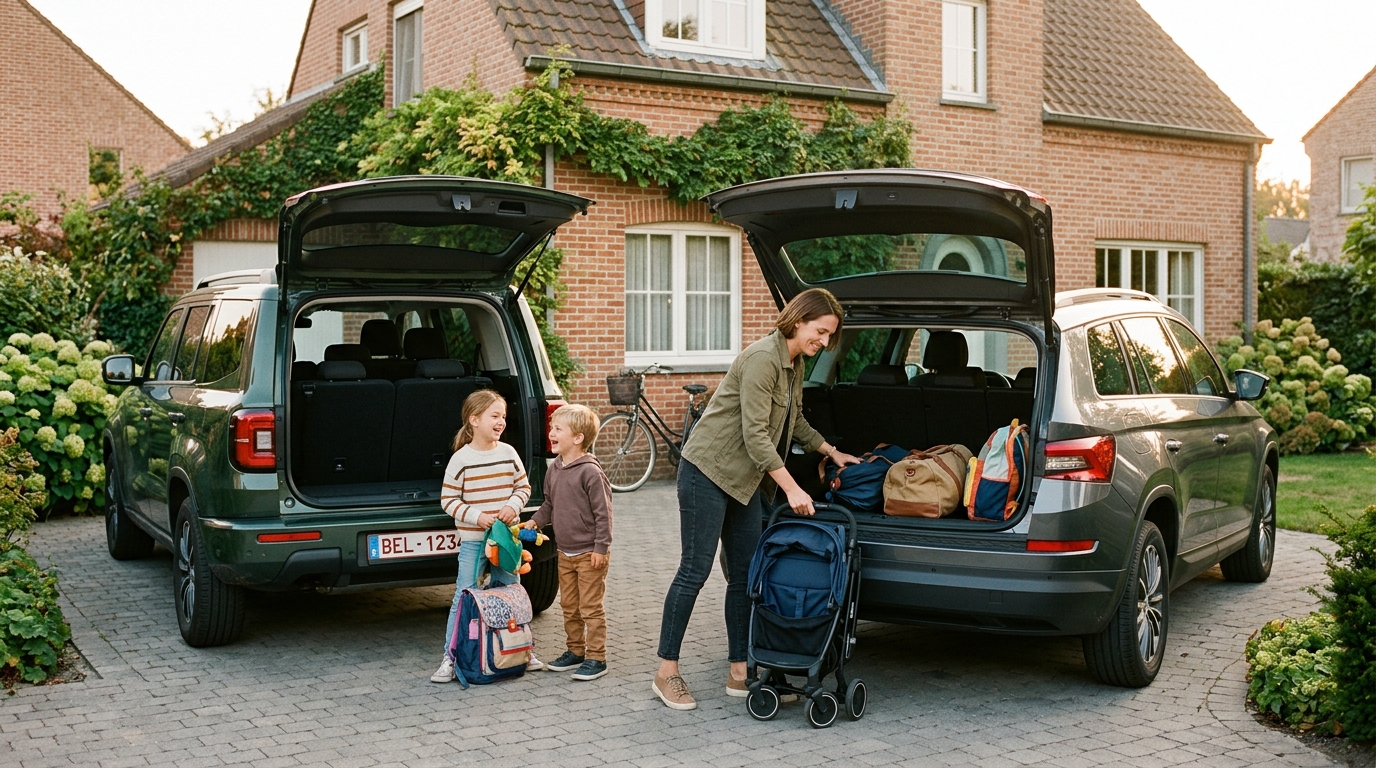
Hyundai Santa Fe or Kia Sorento: which to choose?
For a large Belgian family that covers big miles, the Santa Fe is the "space and practicality" pick, the Sorento the "driving and style" pick. Because they share the mechanicals, everything comes down to the body, the packaging and the negotiated price.
Both are large SUVs of around 4.80 m, homologated as 7-seaters, with a sliding second row and a folding third row. The latest Santa Fe adopted a very angular, almost cubic rear: it can divide opinion on looks, but it frees up headroom and a wide tailgate, very handy for loading. The Sorento keeps more classic lines and a slightly more sober cabin.
In practice, with children: go and test both on the same day, with your own child seats. On cars this identical, the difference that matters often ends up being perceived comfort at the wheel and the dealer's current offer.
Are they really identical under the skin?
Largely, yes. The Santa Fe and Sorento both belong to Hyundai Motor Group and share the platform and powertrains. The differences are about tuning, not design.
In concrete terms, both use the same 1.6 T-GDi hybrid (turbo petrol block paired with an electric motor) of about 215 hp system, and the same PHEV plug-in hybrid of about 253 hp. Gearboxes, batteries and management electronics are common. Hyundai and Kia then calibrate their own suspension and insulation to suit each brand's positioning, hence a Sorento reputed to be a touch firmer and a comfort-oriented Santa Fe.
The number that matters: when two cars share 90% of their components, the expected reliability gap is small. Both brands offer a long warranty in Belgium (up to 7 years Kia, 5 years Hyundai, terms apply) — a real argument for a family that keeps a car for years.
Should you go for the hybrid (HEV) or plug-in (PHEV)?
The PHEV only makes sense if you charge every day. Otherwise, the plain hybrid (HEV) is lighter, cheaper and enough. That's the first call to make, even before choosing the brand.
The Sorento PHEV claims 60 to 68 km of electric range (WLTP); in the real world expect 50 to 60 km in summer and 40 to 50 km in winter, when heating draws on the battery. Charged nightly, it turns the home-school-work run into near-pure electric. Uncharged, it lugs around the weight of its battery and uses more than an HEV — the worst of both worlds. The Santa Fe PHEV follows the same logic with a similar electric range.
In practice, with children: without a home wallbox, take the HEV. At around 6.9 to 7.5 L/100 km in mixed use, it stays economical for a near-two-tonne vehicle, with no cable to worry about. Keep the PHEV for households with a wallbox or a dedicated garage socket.
Is the third row usable every day?
For children, yes, on both. For adults, the third row is a backup. It's the limit common to every SUV this size, vans aside.
On both models, the second row slides to balance space between rows. The Santa Fe, taller and squarer, makes access to the back a little easier and offers better headroom — a real plus for strapping a child in without contorting. The Sorento copes well too, but with a more tapered roofline.
The honest test is to sit an adult in the back for a real trip before you sign. On an hour of motorway, a teenager is fine; a 1.80 m adult will find knees high and space tight. To carry seven adults every day, neither of these SUVs replaces a true van like the Volkswagen Multivan.
How much boot is left with all 7 seats in use?
Little, as always: between about 190 and 330 L depending on model and powertrain once the third row is up. In five-seat mode, by contrast, both offer a very large boot.
This is where the Santa Fe's square body pays off: its volume behind the third row is among the most generous in the segment, and its wide tailgate swallows a stroller easily. The Sorento stays decent, with a five-seat boot climbing to about 700 L in hybrid form. In both cases, once all seven seats are in use, you're back to "folded stroller plus two bags."
In practice, with children: if you run five-up during the week and seven-up at weekends, these two SUVs are perfect, because the third row folds to free a big boot. To leave seven-up on holiday with all the luggage, plan on a roof box — advice that holds for any 7-seat SUV.
How much do they cost in Belgium in 2026?
Both play in the same range. Budget from about €48,000 to €52,000 for a well-equipped plain hybrid, and €55,000 to €63,000 for a PHEV. The gap between the two brands is thin; the dealer discount weighs more.
For reference, the Santa Fe hybrid opens its list price around €42,000 in neighbouring markets in entry-level two-wheel drive, but a family typically aims for a mid trim with all-wheel drive and the price climbs fast. The Sorento sits at the same level. On the Belgian market, both models are clearly at the top of the family segment, above a Skoda Kodiaq or a Peugeot 5008.
The classic mistake is comparing one brand's entry price with the other's top-spec version. Compare like-for-like on trim and powertrain, options included, before concluding. These list prices are indicative and change: check them with the dealer at purchase.
Which is smarter as a company car?
Neither, if you look only at 2026 taxation. Since Belgian deductibility tightened, only 0 g CO₂ models — so fully electric — stay entirely deductible.
A Santa Fe or Sorento PHEV keeps a transitional advantage as long as it is genuinely charged and meets the emissions thresholds, but that advantage shrinks year on year. A plain hybrid is taxed like a combustion car: of little interest as a company car. For a self-employed person or an SME, the equation often tilts toward a 7-seat EV.
The number that matters: once deductibility is factored in, a large electric SUV like the Kia EV9 can end up cheaper net than an equivalent Santa Fe or Sorento PHEV. Work it out precisely with your accountant for your situation — it's the only calculation that counts.
Santa Fe vs Sorento comparison table
| Criterion | Hyundai Santa Fe | Kia Sorento |
|---|---|---|
| Platform / group | Hyundai Motor Group | Hyundai Motor Group (identical) |
| Powertrains | HEV 1.6 T-GDi ~215 hp · PHEV ~253 hp | HEV 1.6 T-GDi ~215 hp · PHEV ~253 hp |
| PHEV electric range (WLTP) | ~54-58 km | ~60-68 km |
| HEV economy (mixed) | ~6.9-7.5 L/100 km | ~6.9-7.5 L/100 km |
| Third row | Children / short trips (easy access) | Children / short trips |
| 5-seat boot | Among the largest in the segment | Up to ~700 L (HEV) |
| Styling | Very square, cubic | Classic, consensual |
| Price Belgium 2026 (indicative) | from ~€48,000-52,000 (HEV) | from ~€48,000-52,000 (HEV) |
| Warranty BE | 5 years | Up to 7 years |
Verdict
Space and practicality: Hyundai Santa Fe — square body, big boot, easier third-row access and a wide tailgate. The better pick for a family that loads a lot and often carries seven.
Driving and style: Kia Sorento — a touch more engaging, more consensual lines and a reassuring warranty of up to 7 years.
HEV or PHEV: take the PHEV only with a home wallbox; otherwise the plain hybrid is the rational choice. And if the car goes through a company, seriously compare it with a 7-seat EV before signing.
To place these two Koreans in the wider market, see our comparison of the best 7-seater cars in Belgium in 2026. And if full electric tempts you, compare the Hyundai Ioniq 9 against the Kia EV9.
Sources: manufacturer configurators and Belgian list prices 2026 (hyundai.com/be, kia.com/be), prices and specs from moniteurautomobile.be, used listings on AutoScout24.be, 2026 manufacturer WLTP figures (Sorento PHEV range 60-68 km, HEV economy ~6.9 L/100 km). Data as of 01/07/2026. List prices are indicative, excluding options and promotions; powertrains and tax deductibility to be confirmed with the dealer and your accountant. Fit your own child seats before buying.
SUV 7 places comparator
Compare all suv 7 places side by side.
Compare now →
Frequently asked questions
Sophie teste des voitures familiales depuis 2013, d’abord pour la presse auto belge, aujourd’hui en indépendante depuis le Brabant wallon. Mère de trois enfants, elle juge une 7 places sur ce qui compte vraiment au quotidien : trois sièges-auto qui rentrent de front, le coffre une fois la 3e rangée dépliée, et la hauteur de seuil quand on charge une poussette. Sa règle : un essai sans enfants à bord ne vaut rien.