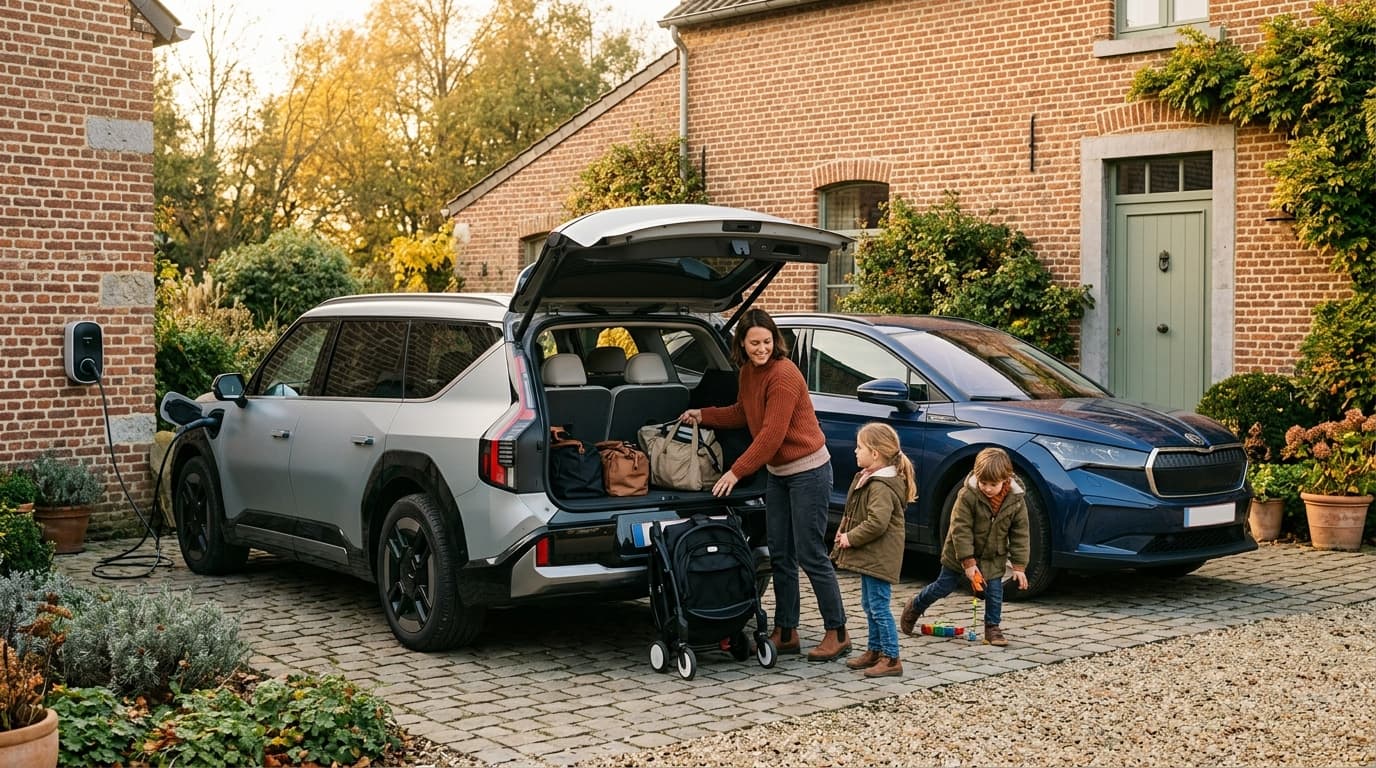
The only two genuine electric 7-seaters you can actually order at a Belgian dealer in 2026 are the Kia EV9 and the Peugeot e-5008. On paper they play in the same class; in practice almost €18,000 and 22 cm of length separate them. So the question isn't which is best, but which fits your family.
Bottom line: take the Peugeot e-5008 if budget rules and the third row is mostly for children. Take the Kia EV9 if you often carry adults at the back and drive a lot on the motorway.
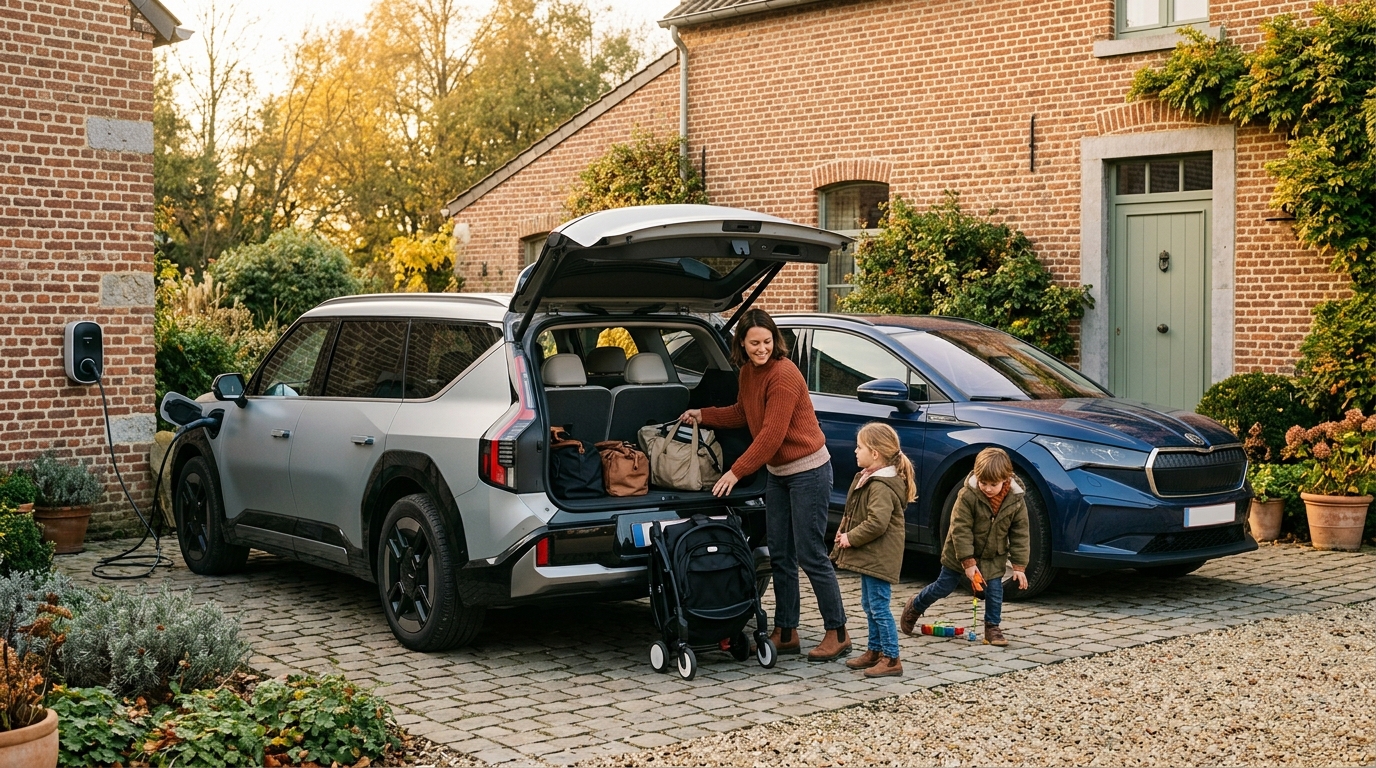
Kia EV9 or Peugeot e-5008: which to choose in 2026?
The Peugeot e-5008 is the rational choice for most Belgian families: it starts around €51,900 versus roughly €70,000 for the Kia EV9, for a very similar 7-seat experience day to day.
The price gap is no detail. At nearly €18,000 apart, the e-5008 pays for a home charger, several years of electricity, and stays under the psychological threshold of large electric SUVs. The Kia EV9 plays a class above: 5.01 m long, a flagship presence and a third row where an adult genuinely fits.
In practice, with children: if your rear passengers are two kids on boosters for the school run, the e-5008 does the job without paying for the EV9's footprint. If you regularly carry grandparents and tall teenagers on long trips, the EV9 earns its price in space and on-board comfort.
What is the real range in Belgium, winter included?
The Kia EV9 keeps the edge on real-world range, but the Peugeot e-5008 Long Range nearly closes the gap. Expect around 390 to 440 km for the EV9 and 340 to 390 km for the base e-5008 in Belgian conditions.
The WLTP figures (563 km for the EV9, 502 km for the standard e-5008) are lab values. On a Belgian motorway in cold weather you have to subtract 20 to 30%, plus a winter loss from heating. A heavy, tall 7-seater uses more than a saloon: that's the price of the format.
The number that matters: Peugeot offers an e-5008 Long Range with a 97 kWh battery rated up to 668 km WLTP. This version catches or beats the EV9 on long trips, but climbs in price and narrows the budget gap that makes the e-5008 attractive in the first place. Weigh it against your motorway mileage.
Which 7-seater EV charges fastest?
The Kia EV9 charges clearly faster thanks to its 800-volt architecture: a 210 kW peak and 10-80% in about 24 minutes, versus 160 kW and 20-80% in about 30 minutes for the e-5008 on 400 volts.
For daily life with a home charger this difference is invisible: both top up overnight in a few hours. It becomes real on a long family trip, when you stop at a motorway services with three impatient children. The EV9 recovers enough to get going again in the time of a toilet break and a coffee.
In practice, on a run from Brussels to the south of France in summer, the EV9 needs one short, efficient charging stop; the base e-5008, with its lower real range and slightly slower charging, forces a longer stop, or even two on a really long trip. For mostly urban and suburban use, the gap disappears.
Is the third row usable with children?
Both take children at the back without issue; for adults over the long haul, only the Kia EV9 really goes the distance. That's the direct consequence of the 22 cm length difference.
The real test is the boot once all 7 seats are in use. On the Peugeot e-5008 the volume drops to 259 L with the third row up — enough for a few soft bags, not the suitcases of a 7-up holiday departure. The EV9, longer and with a flat floor, keeps more boot space and easier third-row access.
Three child seats abreast, yes or no? On the second row both manage it with compact i-Size seats, the EV9 with a little more margin. For a family genuinely travelling 7-up every day, the EV9 is the honest choice; for an occasional third row reserved for children and weekends, the e-5008 is enough and costs far less. If the third-row question matters beyond electric, our best 7-seater cars in Belgium comparison widens the field to SUVs, MPVs and hybrids.
What do they really cost for a Belgian company?
To buy, the e-5008 starts nearly €18,000 ahead. But as a company car, both enjoy the same tax window in 2026: 100% deductibility because they are 0 g CO₂.
This is the Belgian point not to miss. The 100% deductibility of electric vehicles for companies is guaranteed until 31 December 2026, then falls to 95% in 2027 and 90% in 2028. Ordering an electric 7-seater before that deadline locks in the most favourable terms. Benefit-in-kind also stays low on electric, and running costs are no contest against a diesel.
The number that matters: a home charge of the EV9 (10-80% of its 99.8 kWh battery) costs about €18-20 at home, versus €70 to €90 of diesel to cover the same distance in a large diesel SUV. Over 20,000 km a year, the fuel gap alone covers a good part of the monthly payment. Work it out with your accountant for your situation.
Comparison table: Kia EV9 vs Peugeot e-5008
| Criterion | Kia EV9 | Peugeot e-5008 |
|---|---|---|
| Belgium price 2026 | from ~€70,000 | from ~€51,900 |
| Length | 5.01 m | 4.79 m |
| Battery | 99.8 kWh | 73 kWh (97 kWh in Long Range) |
| WLTP range | 541-563 km | 502 km (up to 668 km LR) |
| Real BE range (winter) | ~390-440 km | ~340-390 km |
| DC charging | 800 V, up to 210 kW (10-80% ≈ 24 min) | 400 V, up to 160 kW (20-80% ≈ 30 min) |
| Boot with 7 seats up | generous, flat floor | 259 L |
| Third row | adults OK (short trips) | children / teens |
| Company deductibility 2026 | 100% | 100% |
Verdict
Budget and typical family pick: Peugeot e-5008 — a genuine electric 7-seater from ~€51,900, third row for children, decent range. The best price/use ratio in the segment in 2026.
Space and long-trip pick: Kia EV9 — third row for adults, fast 800 V charging, higher real range. Justified if you often travel 6-7 up and eat motorway miles.
Company car: both 100% deductible until 31 December 2026 — ordering before that date secures the benefit. Beyond pure electric, compare with the 7-seater SUVs on the Belgian market.
Sources: 2026 manufacturer specifications (Kia Belgium, Peugeot), charging and WLTP range data, EV Database and Automobile-Propre (EV9 tests and Supertest), Belgian 7-seater EV segment data. List prices exclude options as of 22/06/2026 and may change — check with the dealer. Deductibility: Belgian company-car tax regime 2026-2028, to be confirmed with your accountant.
7 places électriques comparator
Compare all 7 places électriques side by side.
Compare now →
Frequently asked questions
Sophie teste des voitures familiales depuis 2013, d’abord pour la presse auto belge, aujourd’hui en indépendante depuis le Brabant wallon. Mère de trois enfants, elle juge une 7 places sur ce qui compte vraiment au quotidien : trois sièges-auto qui rentrent de front, le coffre une fois la 3e rangée dépliée, et la hauteur de seuil quand on charge une poussette. Sa règle : un essai sans enfants à bord ne vaut rien.