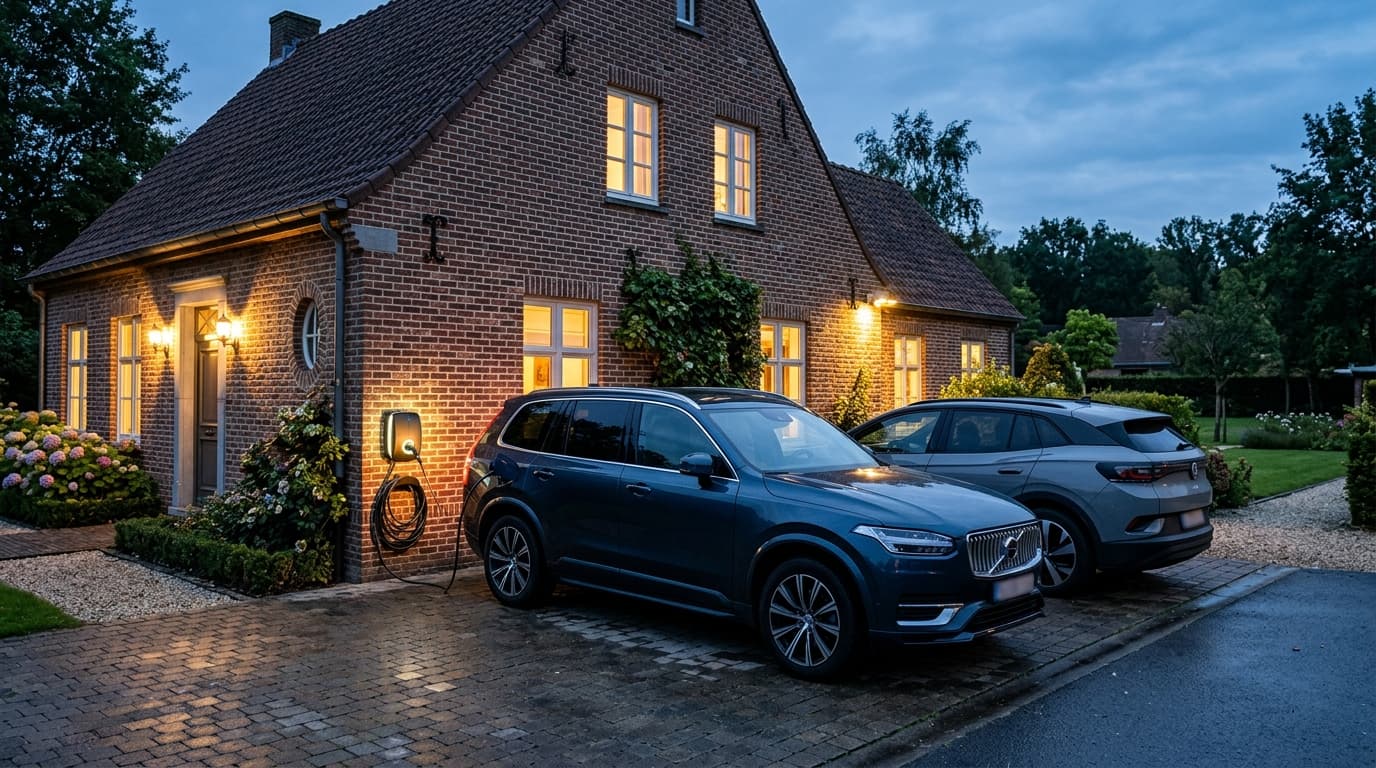
Two large electric SUVs over five metres long, seven genuine seats, a Belgian family and a home charger: the Volvo EX90 and the Hyundai Ioniq 9 answer the same brief. The first sells safety and Scandinavian design, the second space and Korean value.
Bottom line: take the Hyundai Ioniq 9 if budget matters, if you tow, or if a five-year warranty reassures you — it starts €12,500 lower. Take the Volvo EX90 for the finish, the faster charging of the pair and a slightly more generous boot with all seven seats in use.
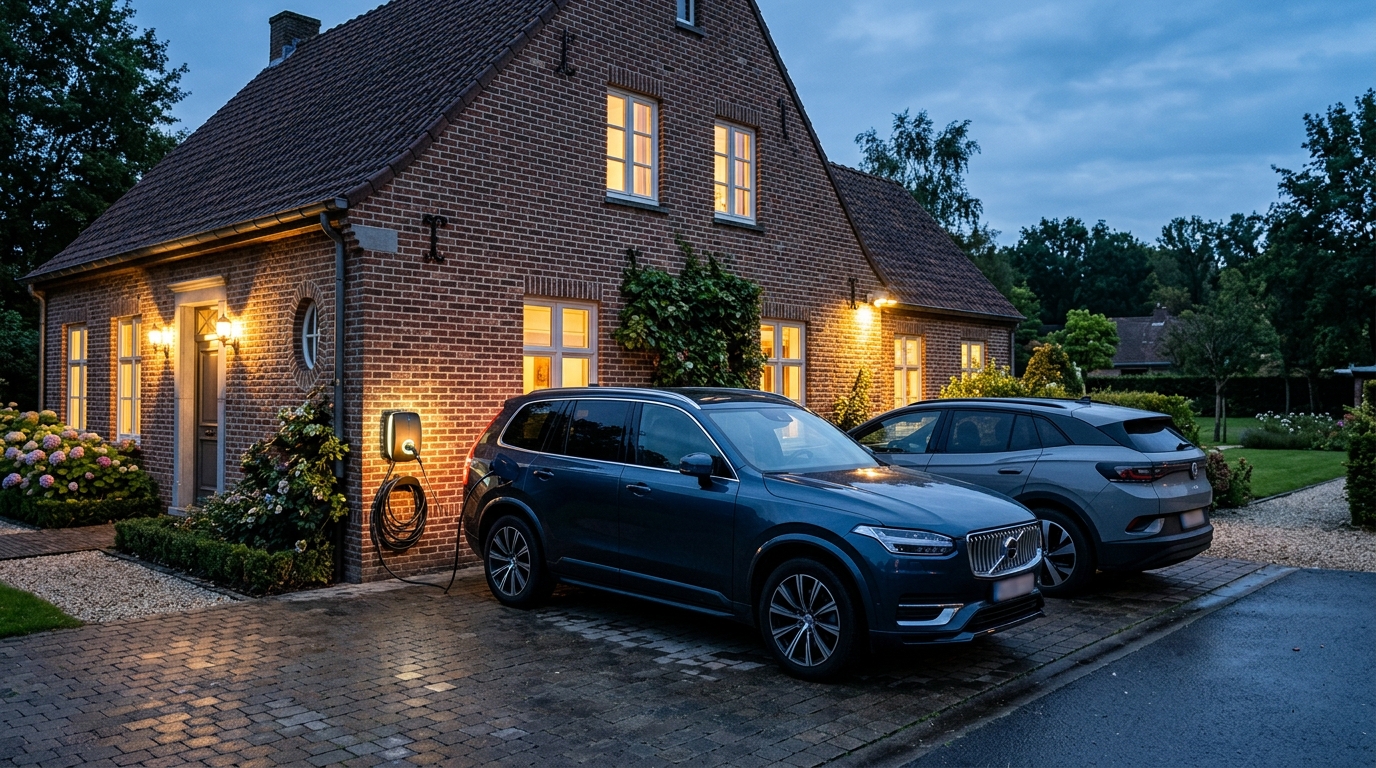
Volvo EX90 or Hyundai Ioniq 9: which to choose in Belgium?
For most families the Hyundai Ioniq 9 is the rational pick: same footprint, same promise of seven habitable seats, but a clearly lower entry price and a warranty twice as long. The Volvo EX90 earns its place if finish and fast charging come before price.
The two cars are technically very close. An 800-volt architecture, a battery above 90 kWh, more than 5 metres of length, six or seven seats depending on configuration. The Ioniq 9 measures 5.06 m long and 1.98 m wide and sits on the E-GMP platform, the same one as the Kia EV9. The EX90 is 5.037 m long and 1.964 m wide, and opens Volvo's new software-defined generation with its roof-mounted lidar.
Where they diverge is commercial philosophy. Hyundai attacks from below and piles on standard equipment; Volvo owns a premium position and charges for the Plus and Ultra trims. In practice, with children, that difference shows mainly when you sign the order form — not in the cabin, where both play in the same league.
What do they really cost in Belgium in 2026?
The Hyundai Ioniq 9 lists from €71,995 to €89,495 in Belgium. The Volvo EX90 starts at €84,490 and climbs to €107,490 in Twin Motor Performance form. The gap at entry level is over €12,500.
In detail, the Ioniq 9 opens with a 218 hp rear-wheel-drive version, moves on to 307 hp HTRAC all-wheel drive, and tops out with the 428 hp, 700 Nm Dual Motor Performance. All versions share the same 110.3 kWh battery, which is rare and simplifies the choice: you don't pay for range, you pay for power and equipment.
Volvo goes the other way. The €84,490 Single Motor is a 333 hp rear-driver with a 92 kWh battery; the €89,990 Twin Motor moves to 456 hp and 106 kWh; the 680 hp Twin Motor Performance asks €107,490. In other words, the most affordable Volvo is also the one with the smallest battery and the lowest towing capacity.
The number that matters: at a comparable specification — all-wheel drive, large battery — expect around €90,000 for the EX90 Twin Motor against a well-equipped Ioniq 9 HTRAC under €85,000. The gap narrows, but it still favours the Korean.
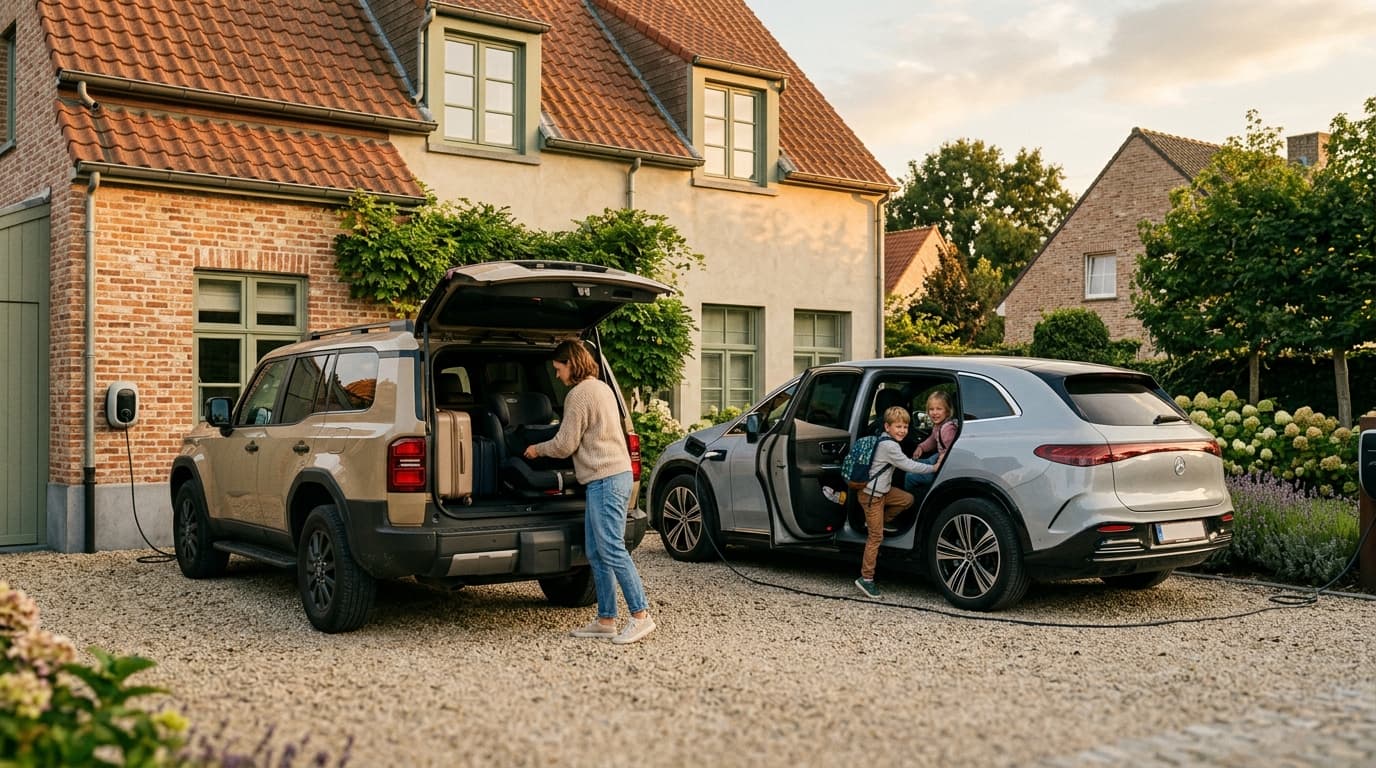
What is the real range in a Belgian winter?
A draw on paper: 625 km WLTP for the EX90 Twin Motor, 620 km for the Ioniq 9. In real Belgian conditions, heating included, reckon on 465 to 470 km — and 430 km for the EX90 Single Motor, with its smaller battery.
WLTP figures are laboratory values. From November to March, between 0 and 10 °C, with the heating on, seven people aboard and a roof box, subtract about 25%. On a 300 km Brussels-Ardennes round trip both make it without stopping; on a Brussels-Lyon run seven-up you will need two stops.
The field figure worth more than a spec sheet: a 360 km test mixing back roads and motorway in equal parts recorded 22.4 kWh/100 km on the Ioniq 9, or roughly 490 km of theoretical range in those conditions. That is consistent with its homologated 20.6 kWh/100 km and a long way from the segment's optimistic claims. The EX90 Twin Motor is rated at 19.4 kWh/100 km WLTP and the Single Motor at 18.6 kWh/100 km: the Volvo is slightly more frugal, mainly thanks to its smaller battery and lower weight in rear-drive form.
One detail nobody mentions: the EX90 weighs 2,585 kg empty as a Single Motor and 2,765 kg as a Twin Motor. On Belgian cobbles and speed bumps those masses tell under braking and on tyres, which wear fast in 21 or 22 inches.
Which charges faster on a long trip?
The Volvo EX90, on paper: 10 to 80% in 22 minutes on a 350 kW DC charger. The Hyundai Ioniq 9 peaks around 233 kW despite its 800 V architecture, and needs closer to 24 minutes for the same job.
Two minutes apart is very little — and it never shows day to day. With a home charger, both refill completely overnight: 9 hours for the EX90 Single Motor on 16 A three-phase, 10 hours for the Twin Motor. You leave every morning at 100% and DC power never enters the conversation.
It does on the motorway, with three impatient children at Wanlin or Hoogstraten. There, the real variable is not peak power but the charging curve and the availability of 350 kW chargers on the Belgian network, still uneven away from the main corridors. In practice, with children, a twenty-minute stop is a twenty-minute stop anyway: by the time everyone is out, the toilets are done and you are back in, the car has finished.
What boot space is left with all seven seats up?
384 L at most for the Volvo EX90 (324 L in standard loading under the parcel shelf), 338 L for the Hyundai Ioniq 9. Both beat combustion 7-seater SUVs, which fall to 250-260 L, but you are still far from a holiday departure with seven aboard.
The real test is the boot once all seven seats are in use, and this is where these two big bodies justify their length. A combustion Volvo XC90 or a Land Rover Discovery make do with around 260 L in the same configuration; here you gain a third more volume. The EX90 adds two practical assets: 72 L of closed under-floor storage, where the charging cables live without cluttering the footwells, and a 46 L front boot.
With every row folded, the Ioniq 9 wins comfortably: 2,419 L against 2,135 L for the EX90. In other words, the Hyundai is the better remover of the two, the Volvo the better seven-up carrier. It is up to you to decide which use comes round more often in your life.
Honestly, in both cases, leaving seven-up with the luggage calls for a roof box or a trailer. No electric 7-seater solves that in 2026, and it should be said plainly.
Is the third row usable by adults?
Yes, on a medium trip, in both cars — and that is exactly what you buy when you move past five metres. The Hyundai Ioniq 9 has the edge thanks to its 1.98 m width and a completely flat floor.
This is the real difference with the compact 7-seaters on the Belgian market, where the third row is for children only. Here, the EX90's 2,985 mm wheelbase and the Ioniq 9's stretched E-GMP platform free up credible legroom at the back. An average-height adult sits without folding their knees up to their chin, provided the second row slides forward.
The Ioniq 9 goes one step further: its completely flat floor, with no transmission tunnel, lets you move between rows and makes it easier to seat an adult in the third row on a long trip. The EX90 answers with seat finish and sound insulation, where Volvo remains a benchmark.
Can you fit three child seats across?
On the second row, the width of both cars — 1.96 m for the EX90, 1.98 m for the Ioniq 9 — leaves genuine margin for three narrow i-Size shells. This is one of the rare segments where the answer is yes without contortion, provided you pick compact seats.
One practical caveat: both come in a six-seat version with separate captain's chairs, very comfortable but which rules out three children on the middle row. Check that box when you order, because it cannot be fixed afterwards. And as always, bring your own shells before signing: the centimetres on a spec sheet say nothing about the shape of your child seat.
Which tows a caravan or a horse box?
The Hyundai Ioniq 9, rated up to 2,500 kg. The Volvo EX90 stops at 2,200 kg in Twin Motor form and only 1,500 kg in Single Motor rear-wheel drive: if you tow, the entry-level EX90 is out.
This is the criterion international comparisons systematically forget, and it is decisive for Belgian families who camp, ride, or pull a boat towards Zeeland. A loaded family caravan runs 1,600 to 1,900 kg; a two-horse box easily passes 2,000 kg. At 1,500 kg, the €84,490 EX90 Single Motor covers neither.
Be warned about another reality: while towing, an electric SUV's range drops by 30 to 40%. Off the Ioniq 9's 465 real km, a caravan brings you back to around 300 km between charges — and few Belgian fast chargers let you plug in without unhitching. For heavy towing, a large combustion or hybrid SUV remains simpler to live with, even though it is no longer deductible for a company.
Are they deductible as company cars in 2026?
Yes, both, at 100%. The EX90 and the Ioniq 9 emit 0 g of CO₂ WLTP, which places them in the only category still fully deductible for Belgian corporate income tax in 2026.
The point not to miss is the order date. The deductibility rate is locked at the moment the order is signed and follows the vehicle for its whole holding period. For fully electric cars ordered from 1 January 2027, the taper starts: 95% in 2027, 90% in 2028, 82.5% in 2029, 75% in 2030, then 67.5% from 2031. An order signed before 31 December 2026 therefore locks 100% for the life of the contract.
On an €85,000 vehicle, five lost percentage points represent several thousand euros over a lease. That kind of arbitrage weighs more than the choice between the two models. Run the numbers past your accountant, but if your company is considering an electric 7-seater, the year-end deadline is not a sales pitch: it is a dated tax rule.
One last thing not to confuse: deductibility concerns the company, benefit-in-kind concerns the driver. On electric, benefit-in-kind stays low thanks to the minimum CO₂ coefficient, but it is calculated on the list price — and at €85,000, it is not zero.
Comparison table: Volvo EX90 vs Hyundai Ioniq 9
| Criterion | Volvo EX90 | Hyundai Ioniq 9 |
|---|---|---|
| Belgium price 2026 | €84,490 to €107,490 | €71,995 to €89,495 |
| Length × width | 5.04 m × 1.96 m | 5.06 m × 1.98 m |
| Battery | 92 kWh (Single) / 106 kWh (Twin) | 110.3 kWh (all versions) |
| Power | 333 / 456 / 680 hp | 218 / 307 / 428 hp |
| WLTP range | 571 to 625 km | 620 km |
| Real BE winter range | ~430 to 470 km | ~465 km |
| WLTP consumption | 18.6 to 19.5 kWh/100 km | 20.6 kWh/100 km |
| DC charging | 10-80% in 22 min (350 kW) | ~233 kW peak, 10-80% in ~24 min |
| Boot with 7 seats up | 324 L (max 384 L) + 72 L + 46 L front | 338 L |
| Boot all rows folded | 2,135 L | 2,419 L |
| Braked towing | 1,500 kg (Single) / 2,200 kg (Twin) | 2,500 kg |
| Warranty | 3 years / 100,000 km | 5 years |
| Company deductibility 2026 | 100% | 100% |
Verdict
Budget, towing and peace of mind: Hyundai Ioniq 9. It starts €12,500 lower, carries the bigger battery of the pair across every version, tows 2,500 kg, offers the largest volume with all rows folded and comes with five years of warranty. For a large family moving to electric without wanting to think twice, it is the obvious pick.
Finish, charging and boot with seven aboard: Volvo EX90. Better volume once all seven seats are in use, slightly faster charging, and the insulation and safety you expect from a Volvo. It earns its price if you often travel seven-up over long distances and perceived quality counts as much as the spec sheet. Avoid the Single Motor if you tow.
Company car: both at 100% deductibility, provided you order before 1 January 2027. After that the rate drops to 95% and keeps falling every year.
To widen the comparison, read our Hyundai Ioniq 9 versus Kia EV9 duel, its platform cousin, and our round-up of cheap electric 7-seaters. To place these two SUVs in the wider family offer, all powertrains included, see the best 7-seater cars in Belgium.
Sources: Volvo EX90 Belgian specifications and prices recorded on volvocars.com/fr-be on 31/07/2026 (Single Motor €84,490, Twin Motor €89,990, Twin Motor Performance €107,490, VAT included; ranges 571/625/615 km WLTP; boot 324-384 L with seven seats up, 2,135 L all rows folded; towing 1,500 and 2,200 kg; warranty 3 years / 100,000 km). Hyundai Ioniq 9 price, range, battery and boot from moniteurautomobile.be (€71,995 to €89,495, 620 km WLTP, 20.6 kWh/100 km, 110.3 kWh, 338 L with seven seats up, 2,419 L all rows folded) and hyundai.com/be/fr (2,500 kg towing). Real consumption measured over 360 km (22.4 kWh/100 km) from the Automobile-Propre road test. Belgian company-car deductibility schedule 2026-2031 from Moniteur Automobile and Belgian payroll-agency analyses. List prices exclude options and promotions and may change — check with the dealer. Confirm tax treatment with your accountant. Install your own child seats before buying.
7 places électriques comparator
Compare all 7 places électriques side by side.
Compare now →
Frequently asked questions
Sophie teste des voitures familiales depuis 2013, d’abord pour la presse auto belge, aujourd’hui en indépendante depuis le Brabant wallon. Mère de trois enfants, elle juge une 7 places sur ce qui compte vraiment au quotidien : trois sièges-auto qui rentrent de front, le coffre une fois la 3e rangée dépliée, et la hauteur de seuil quand on charge une poussette. Sa règle : un essai sans enfants à bord ne vaut rien.