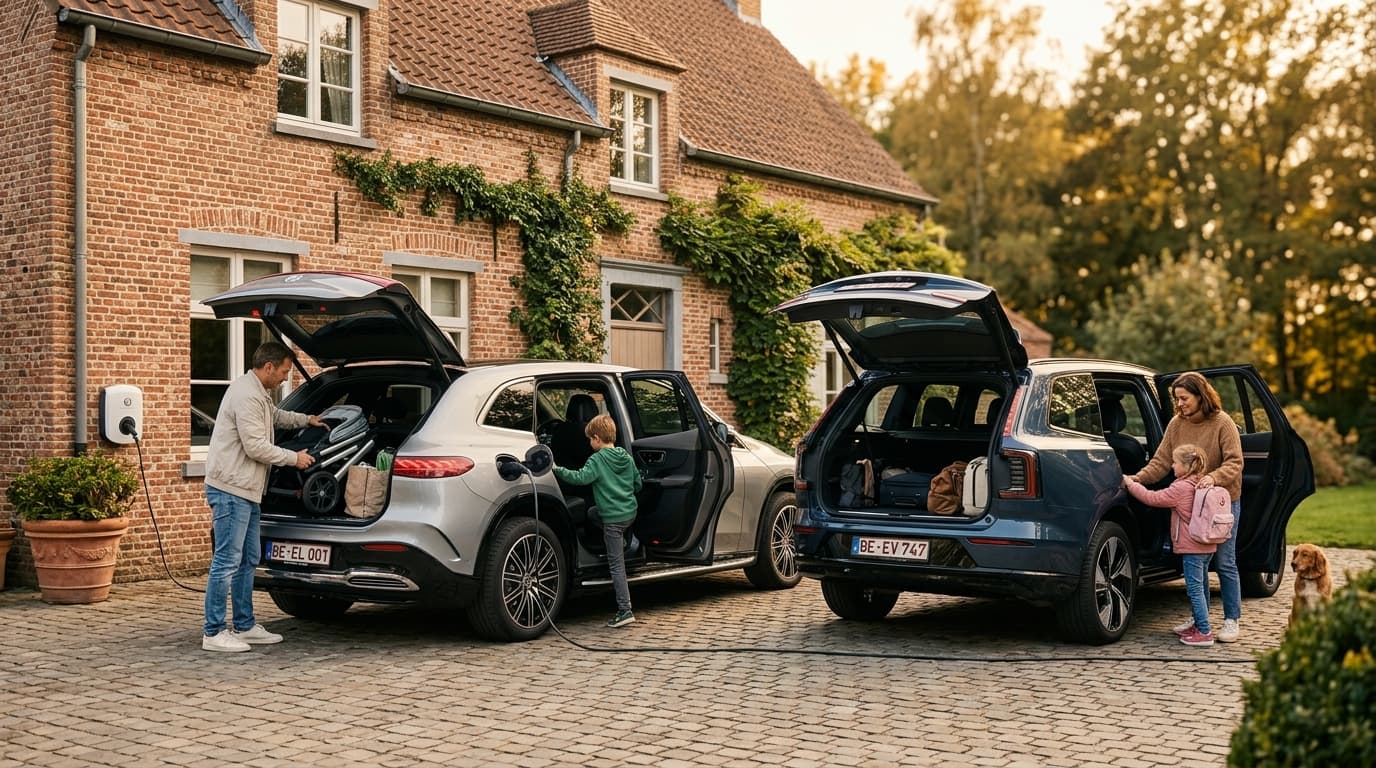
You want a fully electric 7-seat SUV for the family, and you're torn between the Mercedes badge and the Peugeot's larger footprint? The Mercedes EQB and the Peugeot e-5008 answer the same brief in opposite ways: one bets on compactness and premium finish, the other on space and range.
Bottom line: take the Peugeot e-5008 if you want a genuine 7-seater to carry three children every day, with more boot space, more range and faster charging for the lower price. Take the Mercedes EQB if the compact size, the cabin finish and the badge come first, and the third row is only an occasional seat.
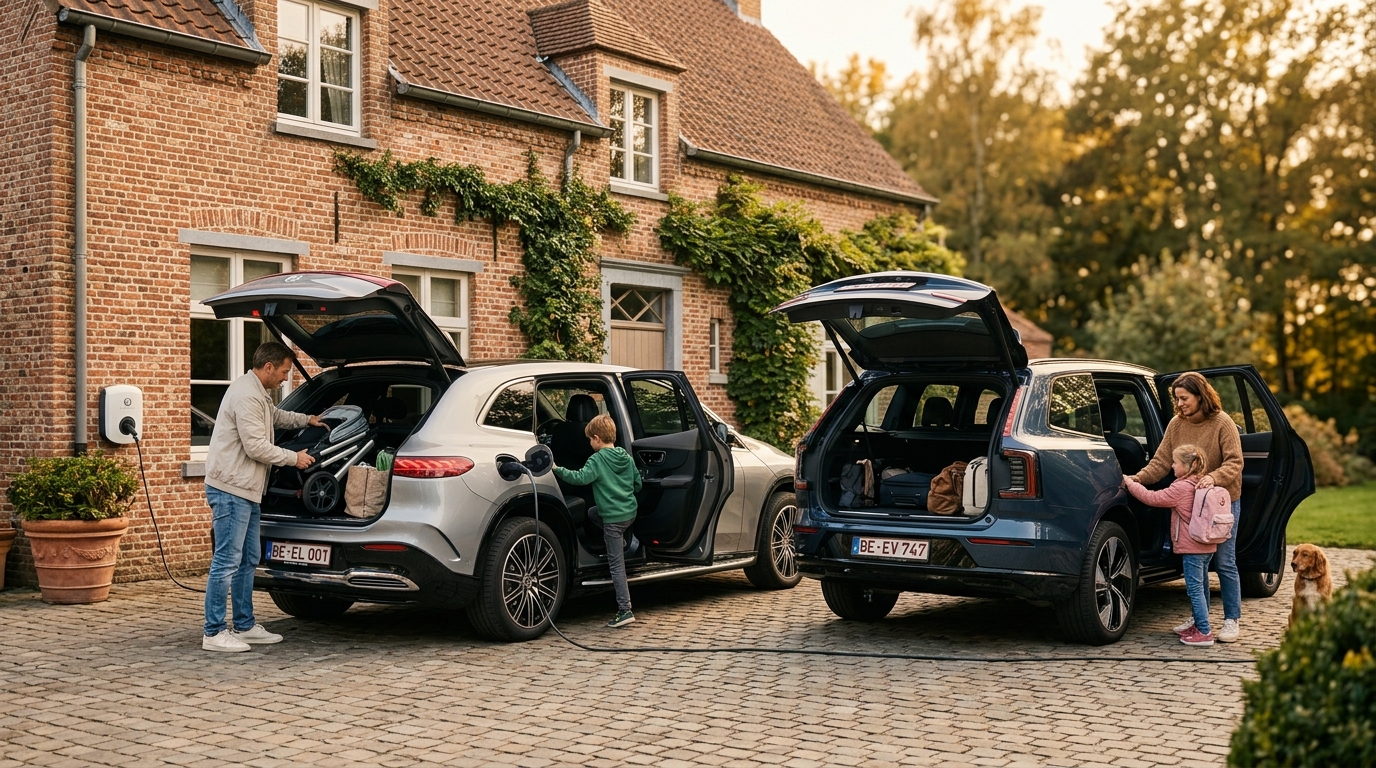
Mercedes EQB or Peugeot e-5008: which to choose in 2026?
For most Belgian families genuinely moving up to seven seats, the Peugeot e-5008 is the rational pick: larger, better thought-out for the third row and boot, and cheaper than a comparable EQB.
Both share the same brief: an electric SUV that can seat seven, a home charger and daily family use. But their philosophy diverges. The Mercedes EQB is the most compact 7-seater EV on the market at 4.68 m: a "5+2" where the rear pair of seats helps out young children. The Peugeot e-5008 measures 4.79 m on Stellantis's STLA Medium platform and owns a genuine large-7-seater status.
In practice, with children: the EQB is easier to park in town and feels premium inside, but its rear and boot quickly show their limits; the e-5008 takes three child seats and a 7-up holiday departure where the EQB gives up.
What do the EQB and e-5008 cost in Belgium?
The Peugeot e-5008 is clearly more affordable: it starts around €51,900 in Belgium, while a well-equipped Mercedes EQB comfortably exceeds €58,000.
The price gap is no detail. One common version, the EQB 250+ Business Star Edition, lists at €58,685 in Belgium (Moniteur Automobile); entry trims sit a little below, but the 7-seat option (the 5+2 pack) costs extra and pushes the ticket up. The e-5008 fits the third row as standard on most trims, which simplifies the comparison.
The number that matters: at an equivalent 7-seat configuration, the EQB costs several thousand euros more. That sum pays for a home charger and several years of electricity on the e-5008. The budget argument leans clearly toward the Peugeot, provided you accept a less lavish dashboard than the Mercedes.
Which has the better real range in Belgium?
The Peugeot e-5008 keeps the edge on range, especially in Long Range form. Expect around 340 to 390 real km for the base e-5008 and 330 to 380 km for the Mercedes EQB in Belgian conditions, winter included.
The type-approval figures (up to 535 km WLTP for the EQB 250+, 502 km for the standard e-5008) are lab values. On a Belgian motorway in cold weather you subtract 20 to 30%, plus the heating load. A tall, heavy SUV uses more than a saloon: that's the price of the 7-seat format.
The real gap opens up with the Long Range. Peugeot offers a 97 kWh e-5008 rated up to 668 km WLTP, which clearly beats the EQB on long trips — at a higher price that eats into the budget advantage. For mostly urban and suburban use the compact EQB is enough; for the motorway high-mileage driver, the e-5008 Long Range is the more reassuring of the two.
Which charges fastest on a long trip?
The Peugeot e-5008 charges faster on DC: up to 160 kW, meaning 20-80% in about thirty minutes, versus around 100 kW for the Mercedes EQB (10-80% in ~32 min).
Day to day, with a home charger, this difference is invisible: both top up overnight in a few hours. It becomes real on a long family trip, when you stop at a motorway services with three impatient children. The e-5008 recovers a little more energy in the same time, which shortens the break.
In practice, on a Brussels-to-southern-France run in summer, the e-5008 Long Range needs one short, efficient stop; the EQB, less capable and capped at ~100 kW, forces more frequent stops. This is the EQB's historic weak point against recent electric SUVs: its charging power has stayed modest.
Is the third row really usable with a family?
In both cases the third row is meant for children, not adults over the long haul. The shorter Mercedes EQB is noticeably tighter there than the Peugeot e-5008.
On the EQB, the "5+2" is an admitted stopgap: Mercedes officially limits the two rear seats to passengers up to 1.65 m. On 4.68 m, access is narrow and legroom soon runs out. The e-5008, with its extra 11 cm and taller body, offers a more tolerable third row for children and young teens on medium trips — without turning it into a lounge either.
The real test is the boot once all 7 seats are in use. The e-5008 keeps 259 L with the third row up, enough for a folded pushchair and two bags. The EQB offers 465 L in 5-seat mode but almost nothing behind the raised rear seats. To travel 7-up with luggage, plan a roof box in both cases — but the e-5008 starts with a length advantage.
Three child seats across: yes or no?
On the second row, the Peugeot e-5008 takes three compact i-Size child seats across. The narrower Mercedes EQB usually fits only two comfortably.
This is the decisive point for a large family, and the one generic comparisons almost always skip. The e-5008's cabin width lets it line up three narrow shells, provided you pick the right models and work the anchors. The EQB, whose compact body shows here, often forces the third seat to the very back, on a fiddly-to-strap occasional seat.
In practice, with children: if you strap in three child seats every morning, the e-5008 makes your life easier. The only reliable method is to come with your own shells and test before signing — manufacturer dimensions never replace a real fit in the dealer's car park.
Are they deductible for a Belgian company in 2026?
Yes, both, at the full rate. The Mercedes EQB and the Peugeot e-5008 are 100% electric (0 g CO₂), so 100% deductible for corporate income tax in 2026.
This is the Belgian point not to miss, and it favours electric over hybrids. The 100% deductibility of electric company cars is guaranteed until 31 December 2026, then falls to 95% in 2027 and 90% in 2028. Ordering an electric 7-seater before that deadline locks in the most favourable terms. Benefit-in-kind also stays low on electric, and running costs bear no comparison with diesel.
The number that matters: a full home charge costs about fifteen euros, versus €70 to €90 of diesel to cover the same distance in a large combustion SUV. Over 20,000 km a year, the fuel gap alone covers a good part of the monthly payment. Work it out with your accountant, but on tax both the EQB and the e-5008 tick the right box.
Comparison table: Mercedes EQB vs Peugeot e-5008
| Criterion | Mercedes EQB | Peugeot e-5008 |
|---|---|---|
| Belgium price 2026 | EQB 250+ at €58,685 (7-seat option extra) | from ~€51,900 (third row standard) |
| Length | 4.68 m | 4.79 m |
| Configuration | 5+2 (occasional rear seats) | genuine 7-seater |
| Battery | ~70.5 kWh (EQB 250+) | 73 kWh (97 kWh in Long Range) |
| WLTP range | up to ~535 km | 502 km (up to 668 km LR) |
| Real BE range (winter) | ~330-380 km | ~340-390 km |
| DC charging | ~100 kW (10-80% ≈ 32 min) | up to 160 kW (20-80% ≈ 30 min) |
| Boot with 7 seats up | almost none (465 L in 5-seat) | 259 L |
| Three child seats across | usually 2 | 3 possible (compact i-Size) |
| Third row | Young children (≤ 1.65 m) | Children / young teens |
| Company deductibility 2026 | 100% | 100% |
Verdict
Family and daily use: Peugeot e-5008. A genuine 7-seater, three child seats across possible, more boot, better range and faster charging, from ~€51,900. The best price-to-use ratio in the duel for a household that really travels seven-up.
Compact and premium: Mercedes EQB. Shorter, easier to park and better finished inside, with the star on the nose. The right choice if the third row is only an occasional seat for young children and you value finish over volume.
Company car: both 100% until 31 December 2026. Ordering before the deadline secures the tax benefit. To place these two in the wider electric offer, see our Kia EV9 vs Peugeot e-5008 comparison and our round-up of cheap electric 7-seaters. To widen the field to SUVs, MPVs and hybrids, read the best 7-seater cars in Belgium in 2026.
Sources: 2026 manufacturer specs and prices (mercedes-benz.be, peugeot.be), Mercedes EQB 250+ Business Star Edition price (€58,685) and technical data on moniteurautomobile.be, Peugeot e-5008 price and range (502 km WLTP, up to 668 km Long Range, boot 259 L at 7 seats / 748 L / 1,815 L) from peugeot.be and Automobile-Propre, charging and real-range data from EV Database and Automobile-Propre, 2026-2028 Belgian company-car deductibility from the Belgian reform. List prices exclude options as of 23/07/2026 and may change — check with the dealer. Install your own child seats before buying.
7 places électriques comparator
Compare all 7 places électriques side by side.
Compare now →
Frequently asked questions
Sophie teste des voitures familiales depuis 2013, d’abord pour la presse auto belge, aujourd’hui en indépendante depuis le Brabant wallon. Mère de trois enfants, elle juge une 7 places sur ce qui compte vraiment au quotidien : trois sièges-auto qui rentrent de front, le coffre une fois la 3e rangée dépliée, et la hauteur de seuil quand on charge une poussette. Sa règle : un essai sans enfants à bord ne vaut rien.