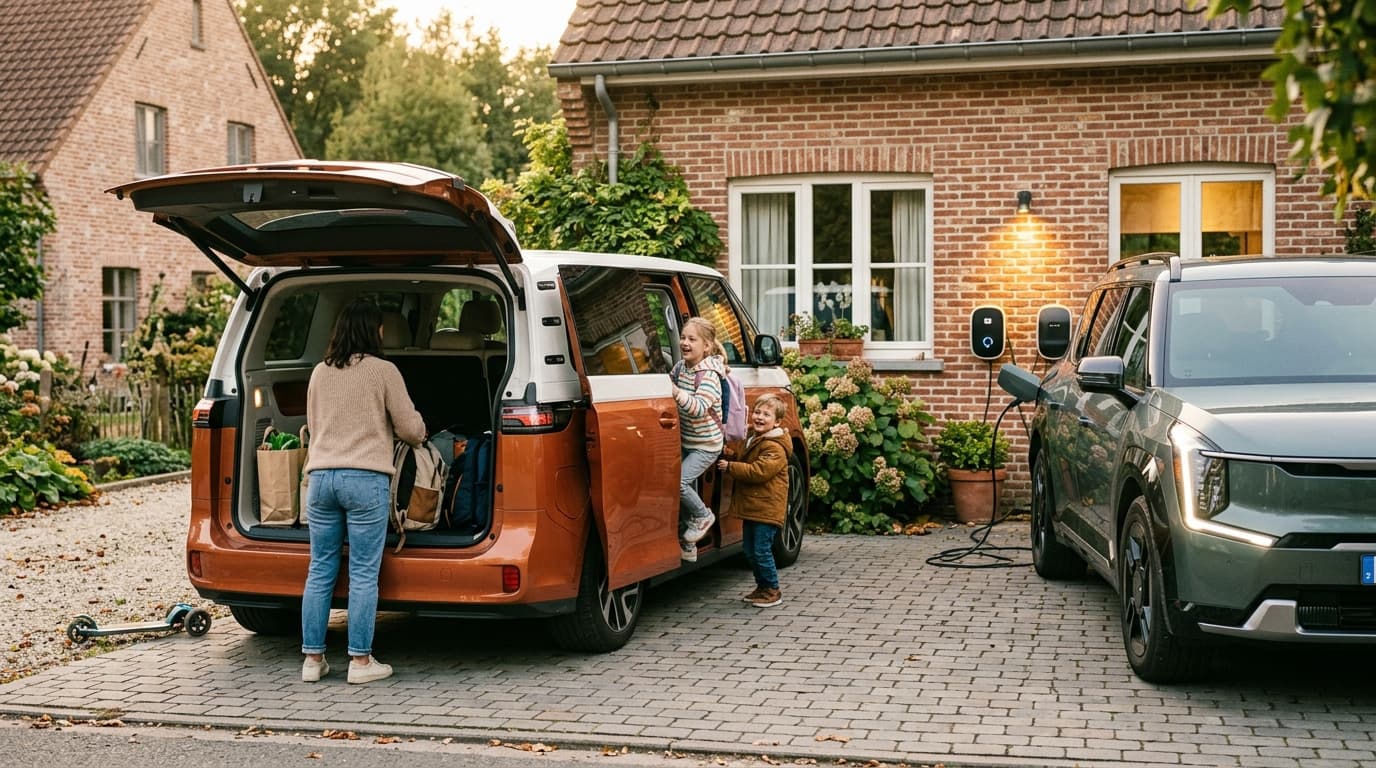
On the Belgian market you can count the genuine electric 7-seaters on one hand, and two of them play opposite styles: the Volkswagen ID. Buzz, an unapologetic van with sliding doors, and the Kia EV9, a large 5-metre SUV. Same mission, two philosophies. So the question isn't which is best, but which fits your family.
Bottom line: take the ID. Buzz if you want a family van with sliding doors, a style of its own and the lowest entry price. Take the Kia EV9 if you eat motorway miles and often carry adults at the back: faster charging, higher real-world range.
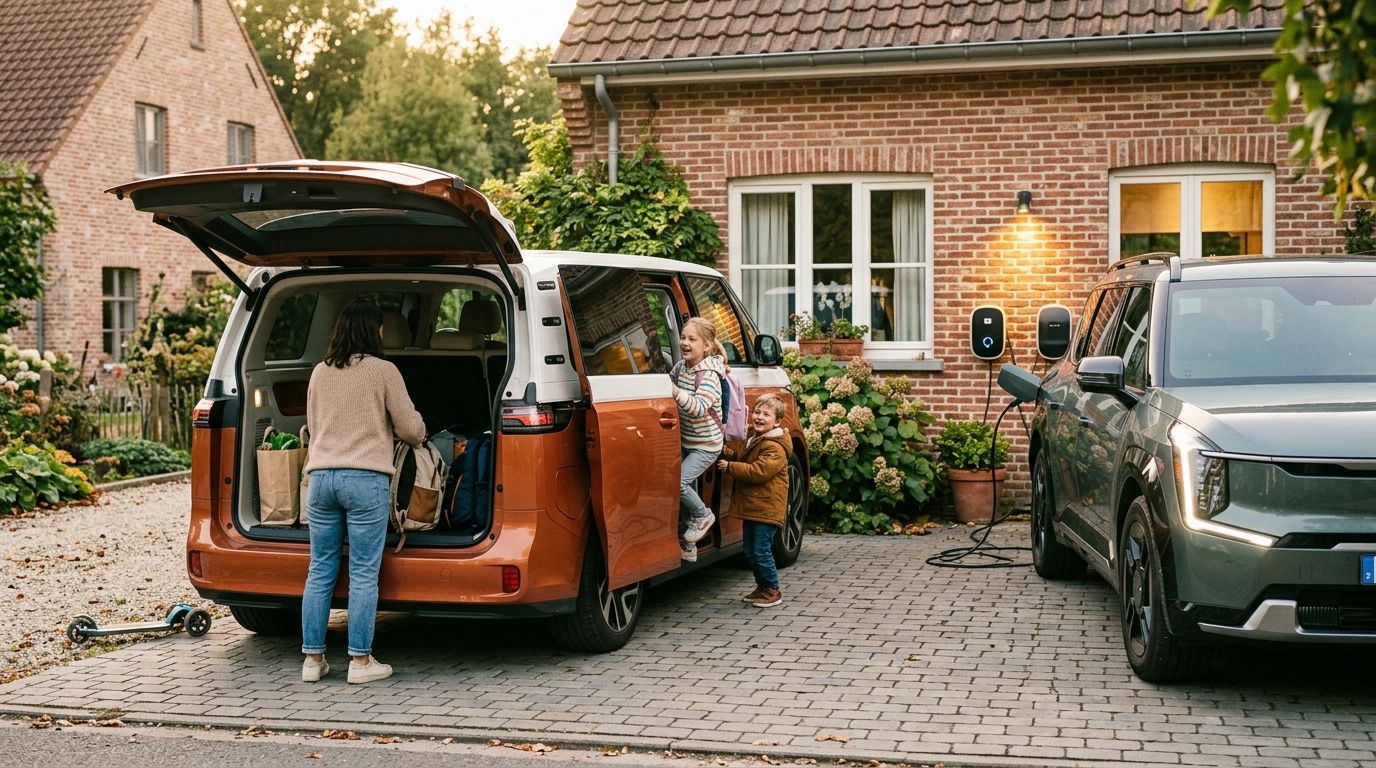
Volkswagen ID. Buzz or Kia EV9: which to choose in 2026?
The Volkswagen ID. Buzz is the heart-and-urban-practicality pick; the Kia EV9 is the road-and-space pick. With similar entry prices (from ~€61,900 versus €62,390), everything comes down to use.
The ID. Buzz plays its van card: sliding doors on both sides, height that eases loading children, a high driving position and a look like nothing else in a school car park. You need the LWB version (long wheelbase, 4.96 m) to get 7 seats — the short version stays a 5-seater. The Kia EV9 is a classic SUV in silhouette but outsized in scale: 5.01 m, a flagship presence and a third row designed from the start for real passengers.
In practice, with children, the trade-off is clear. For mostly urban and suburban life, with child seats to fit every morning, the ID. Buzz's sliding doors change daily life in a tight parking bay. For families who drive a lot and travel far, the EV9's relative efficiency and charging matter more than the van's charm.
Van or electric SUV: which body style for your family?
The van (ID. Buzz) wins on access, modularity and interior volume; the SUV (EV9) wins on refinement, road holding and motorway range. Neither body style is "better" in absolute terms.
A van like the ID. Buzz is a useful box: flat floor, high roof, doors that slide instead of swinging wide. You load three children without contorting, and the second-row bench slides to trade legroom against boot space. The downside is a large frontal area: on the motorway in cold weather, a tall van uses more than a SUV with a low bonnet, which eats into real range.
The number that matters: the ID. Buzz LWB offers up to 2,469 L of volume with the benches folded, versus 823 L for the EV9 in 5-seat mode. The van is unbeatable for bulky loads — bikes, furniture, sports-club kit. The EV9 SUV takes the lead on the road: better insulated, more stable at motorway speed, less tiring on a long family trip.
What is the real range in Belgium, winter included?
The Kia EV9 keeps the edge on real-world range. Expect around 390 to 440 km for the EV9 99.8 kWh and 350 to 400 km for the ID. Buzz LWB in Belgian conditions, winter included.
The WLTP figures (563 km for the EV9 99.8 kWh, 476 km for the ID. Buzz LWB) are lab values. On a Belgian motorway in cold weather you have to subtract 20 to 30%, plus heating. Two heavy, tall vehicles pay for their format: the ID. Buzz, as a van, is the most penalised by wind resistance above 110 km/h.
In practice, with children, this changes holiday logistics. On a summer Brussels-to-southern-France run, the EV9 needs a short, efficient charging stop; the ID. Buzz, with its lower real range and van shape, forces a longer stop, or even a second on a very long trip. For commuting and the school run, both get through the week without charging if you plug in at home.
Which one charges fastest?
The Kia EV9 charges a little faster and, above all, more steadily, thanks to its 800-volt architecture: 10-80% in about 24 minutes versus about 26 minutes for the ID. Buzz on 400 volts.
On paper the peak gap is thin (210 kW for the EV9, 200 kW for the ID. Buzz). The real difference lies elsewhere: the Kia's 800 V holds its power longer and exploits very fast chargers (350 kW) better, whereas the ID. Buzz, on 400 V, tapers off earlier in the curve. Day to day with a home charger this difference is invisible: both top up overnight in a few hours.
The real test is the boot once all 7 seats are in use — but for charging, it's the motorway stop that decides. With three impatient children at a services, ten minutes saved is no detail. The EV9 recovers in the time of a toilet break and a coffee; the ID. Buzz asks for a touch more patience. For mostly urban use, the gap disappears completely.
Three child seats abreast: ID. Buzz or EV9?
Both take three child seats abreast on the second row with narrow i-Size models; the ID. Buzz helps with its three-seat bench, the EV9 with its body width. Neither guarantees it without a test.
Three child seats abreast, yes or no? That's the question that eliminates half of the electric 7-seaters. The ID. Buzz LWB gets a three-seat bench with Isofix on the second row, on a flat floor and a wide van body — favourable for three seats. The Kia EV9 can be ordered with a three-seat bench (or two captain chairs depending on trim): as a bench, its width allows three narrow i-Size bases, but access to the central anchors tightens once the outer ones are fitted.
In practice, with children, the only reliable method is to bring your three child seats and fit them before signing. Two slim seats fit almost anywhere; three bulky ones jam even in a wide van. Beware the third row too: it's habitable for children, even adults on a short trip, but fitting a rear-facing seat right at the back stays awkward in both.
What do they cost for a Belgian company in 2026?
To buy, the ID. Buzz starts slightly cheaper (€61,900) than the EV9 99.8 kWh (€68,390). As a company car, both enjoy the same tax window: 100% deductibility, because they emit 0 g CO₂.
This is the Belgian point not to miss. The 100% deductibility of electric vehicles for companies is guaranteed until 31 December 2026, then falls to 95% in 2027 and 90% in 2028. Ordering an electric 7-seater before that deadline locks in the most favourable terms. Benefit-in-kind also stays low on electric, and running costs are no contest against a diesel.
The number that matters: a home charge (10-80%) costs about €15-20 on either car, versus €70 to €90 of diesel to cover the same distance in a large diesel SUV. Over 20,000 km a year, the fuel gap alone covers a good part of the lease payment. Work it out with your accountant for your situation.
Comparison table: ID. Buzz vs Kia EV9
| Criterion | Volkswagen ID. Buzz LWB | Kia EV9 |
|---|---|---|
| Belgium price 2026 | from ~€61,900 (Pro LWB) | €62,390 (76.1 kWh) to ~€68,390 (99.8 kWh) |
| Body style | Van, sliding doors | SUV |
| Length | 4.96 m | 5.01 m |
| Battery (net) | 86 kWh | 76.1 or 99.8 kWh |
| WLTP range | ~476 km | 443 km (76.1) / 512-563 km (99.8) |
| Real BE range (winter) | ~350-400 km | ~390-440 km (99.8 kWh) |
| DC charging | 400 V, up to 200 kW (10-80% ≈ 26 min) | 800 V, up to 210 kW (10-80% ≈ 24 min) |
| Boot with 7 seats up | 306 L | ~330 L |
| Third row | adults (short/medium trips) | adults (short/medium trips) |
| Company deductibility 2026 | 100% | 100% |
Verdict
Van and urban-life pick: Volkswagen ID. Buzz LWB — sliding doors, unique style, record interior volume and the lowest entry price of the pair. The right choice for a mostly urban family that wants character and modularity.
Road and space pick: Kia EV9 — faster 800 V charging, higher real-world range, a welcoming third row and a large boot in 5-seat mode. Justified as soon as you drive a lot and travel far six or seven up.
Company car: both are 100% deductible until 31 December 2026 — ordering before that date secures the tax benefit. Low benefit-in-kind and negligible charging costs reinforce the electric case.
To place these two against the other electric 7-seaters, read our Kia EV9 vs Peugeot e-5008 comparison and the Hyundai Ioniq 9 vs Kia EV9 duel. If you're still weighing body styles and powertrains, our guide to the best 7-seater cars in Belgium in 2026 widens the field.
Sources: 2026 manufacturer specifications and prices (kia.com/be, volkswagen.be, moniteurautomobile.be), Kia EV9 and VW ID. Buzz price lists as of 01/01/2026, WLTP range and charging data (EV Database, Automobile-Propre), VW ID. Buzz LWB spec (3.24 m wheelbase, 306 L boot in 7-seat mode, up to 2,469 L). List prices incl. VAT, excluding options, as of 04/07/2026 and may change — check with the dealer. Deductibility: Belgian company-car tax regime 2026-2028, to be confirmed with your accountant. Fit your own child seats before any purchase.
7 places électriques comparator
Compare all 7 places électriques side by side.
Compare now →
Frequently asked questions
Sophie teste des voitures familiales depuis 2013, d’abord pour la presse auto belge, aujourd’hui en indépendante depuis le Brabant wallon. Mère de trois enfants, elle juge une 7 places sur ce qui compte vraiment au quotidien : trois sièges-auto qui rentrent de front, le coffre une fois la 3e rangée dépliée, et la hauteur de seuil quand on charge une poussette. Sa règle : un essai sans enfants à bord ne vaut rien.