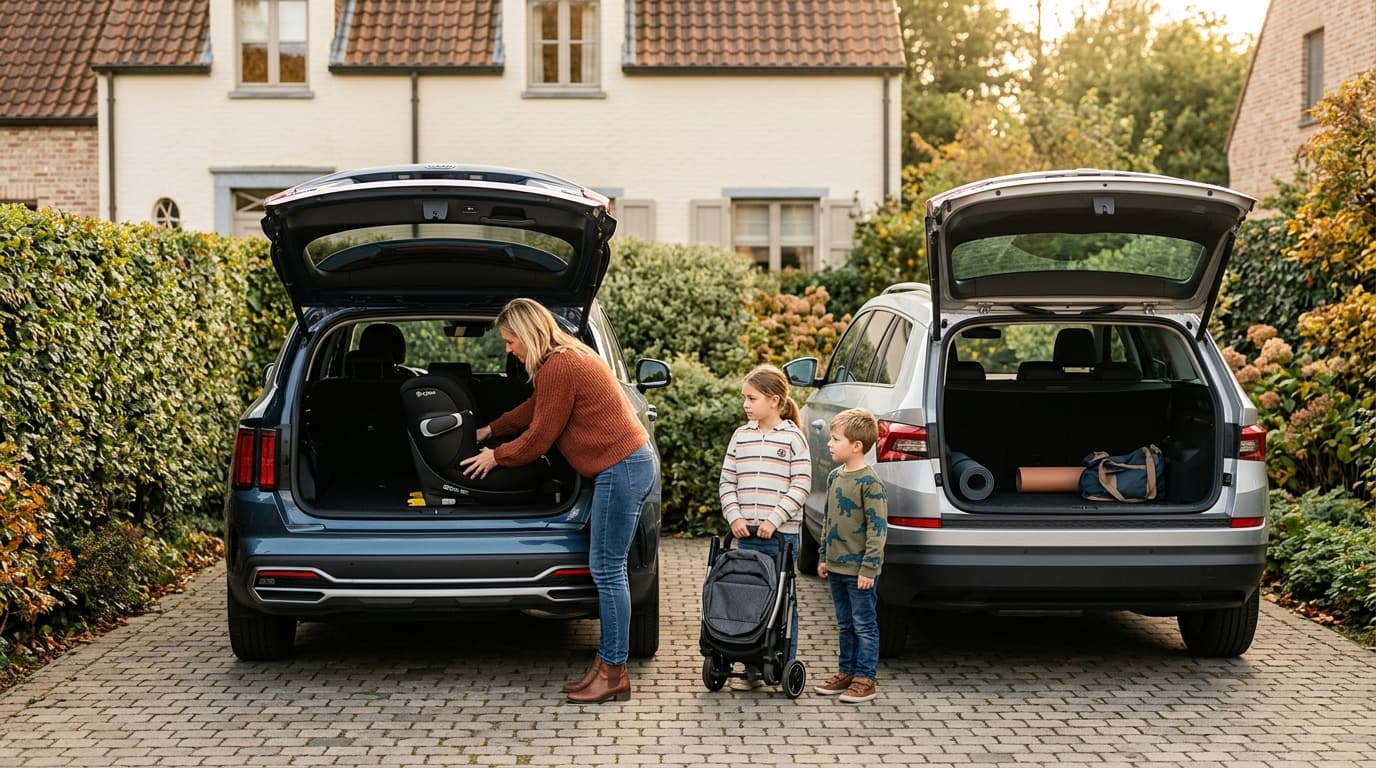
When a Belgian family goes shopping for a large 7-seat SUV, the Kia Sorento and the Skoda Kodiaq almost always end up on the shortlist. On paper they target the same use. In practice, with children, they play different games: one sells its standard seven seats and long warranty, the other its price and its boot. I compared them on what actually matters day to day.
Bottom line: pick the Kia Sorento if you often run seven-up and want seven seats as standard with a slightly more forgiving third row. Pick the Skoda Kodiaq if you mostly run five-up, watch the budget and want the bigger boot — as long as you accept that its seven seats are a paid option.
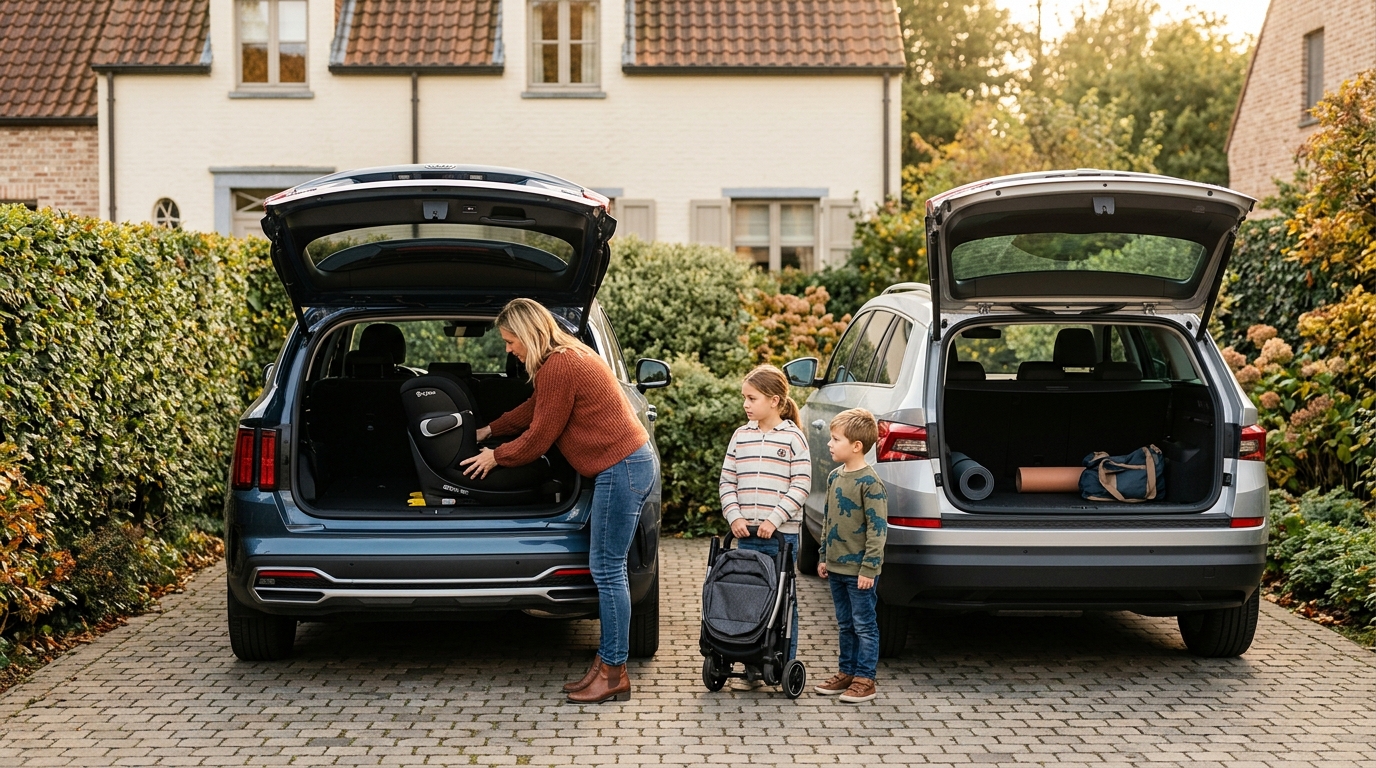
Kia Sorento or Skoda Kodiaq: which to choose?
The Kia Sorento is the pick for families who use the third row for real, because seven seats come standard and are slightly better finished at the back. The Skoda Kodiaq is the rational pick for budget-conscious families who only need seven seats now and then.
Both are around 4.80 m (4.81 m for the Sorento, 4.76 m for the Kodiaq) and look similar on the spec sheet: family SUV, sliding second row, folding third row. The difference lies elsewhere. The Sorento arrives with its seven seats included, a plush cabin and a warranty that can run up to 7 years. The Kodiaq counters with a far lower entry price, a wider engine choice (diesel included) and the largest five-seat boot in the class.
In practice, with children: if your third row serves the daily school run or the grandparents, the Sorento skips the option box and disappoints less at the back. If it only comes out for weekend cousins, the Kodiaq does the same job for far less. To place these two SUVs against the wider market, start from our comparison of the best 7-seater cars in Belgium in 2026.
Which one has a genuinely usable third row?
The Kia Sorento offers a slightly more welcoming third row day to day, with seven seats designed in from the start. The Skoda Kodiaq copes well for a shorter adult on a short trip, but only if you ticked the option.
In both SUVs the back is a backup zone: knee room shrinks as soon as a tall passenger sits ahead, and access is via tipping the second row. The Sorento, whose cabin was drawn around the seven-seat constraint, offers a rear cushion that sits a touch straighter and access better suited to strapping in a child without contorting. The Kodiaq claims a third row tolerable up to about 1.75 m on short trips, which is honest for the class.
The Belgian detail that changes everything: on the Kodiaq the third row is a paid option (around €2,500 to €3,500), available only on TSI petrol and TDI diesel. The plug-in hybrid iV is strictly five seats — its battery takes up the rear floor. If you wanted a plug-in Kodiaq with seven seats, it doesn't exist. The Sorento offers seven seats across the whole hybrid range.
Three child seats across: Sorento or Kodiaq?
The Kia Sorento copes a little better with three child seats across, thanks to a wide, flat second row. The Skoda Kodiaq takes two seats without trouble, but its central tunnel hampers the middle position.
Three child seats across, yes or no? It's the question that eliminates half the segment. On the Sorento, the wide bench and low tunnel leave a bit more room to fit a third seat in the centre. On the Kodiaq, the middle seat, narrower and more contoured, takes a bulky shell poorly, even if two outer child seats fit anywhere.
In practice, with children: if you fit two child seats and a booster, both SUVs do the job. If you have to fit three bulky shells for closely spaced babies, measure your own seats and test them at the dealer before signing. A test without children on board is worthless: the answer depends as much on the shape of your seats as on the car.
How much boot is left with all seven seats in use?
This is where the gap opens up: the Skoda Kodiaq keeps about 340 L behind the raised third row, versus only ~187 L for the Kia Sorento. Almost double.
The honest test is the boot once all seven seats are in use, and the Kodiaq answers it better despite its shorter length: its squarer rear body preserves usable volume where the more tapered Sorento shrinks to a shopping bag. In concrete terms, the Kodiaq swallows a folded stroller and a few bags behind the occupied third row; the Sorento struggles with the same stroller. For a family running seven-up with gear, that figure carries real weight.
In five-seat mode the gap narrows but still favours the Kodiaq: up to ~910 L, among the biggest in the class, versus ~800 L on the Sorento hybrid. The number that matters: 340 L in seven-seat mode is the difference between a weekend away for seven with the stroller and having to fit a roof box. If you're seven every day with schoolbags and a stroller, this point settles it more surely than styling.
Which powertrain: Sorento hybrid or Kodiaq diesel?
It depends on your mileage. The Kia Sorento bets on hybrid (HEV) and plug-in hybrid (PHEV); the Skoda Kodiaq keeps a 2.0 TDI diesel, unbeatable for high-mileage drivers and towing.
The Sorento comes as a 1.6 T-GDi hybrid (turbo petrol block paired with an electric motor, around 215 hp system) and a plug-in hybrid claiming 60 to 68 km of electric range WLTP, or 40 to 60 km in the real world depending on the season. The 2.2 CRDi diesel has all but disappeared from new versions. The Kodiaq still covers the whole range: TSI petrol, 2.0 TDI diesel (around 6 L/100 km on the motorway) and the iV plug-in hybrid — but that last one is limited to five seats.
The number that matters: for 30,000 km a year with lots of motorway, the Kodiaq diesel stays the most frugal in use and the most at ease with a caravan. For mostly urban and suburban driving, the Sorento hybrid uses less in town and needs no plug, while its plug-in only pays off if you charge every night. If the plug-in route tempts you for the third row, I compare the Peugeot 5008 PHEV with the Kia Sorento PHEV.
Sorento or Kodiaq as a company car in 2026?
Neither is a smart tax call in 2026. Since Belgian deductibility tightened, only 0 g CO₂ models — so fully electric — stay entirely deductible.
The Kodiaq diesel suffers the tapering deductibility that hits combustion engines, and the Sorento plug-in hybrid ordered from 2026 loses most of its purchase advantage for a company: fossil-fuel costs are no longer deductible, only electricity stays at 100%. An order signed before 31 December 2025 keeps the transitional regime, but that train has left. Self-employed people taxed as individuals keep a partial fuel deduction, which softens the equation for them.
In practice: for private use and lots of motorway, the Kodiaq diesel defends itself on purchase price and economy. For a company car, a seven-seat EV like the Kia EV9 often works out cheaper net once taxation is factored in. Work it out with your accountant for your situation, and compare it with the Kia EV9 against the Peugeot e-5008.
How much do the Sorento and Kodiaq cost in Belgium?
The price gap is the Kodiaq's first argument: it starts around €40,000, where the Sorento hybrid opens at ~€61,990 and climbs to ~€68,990 depending on trim (list prices from Moniteur Automobile).
The Sorento charges dearly for its standard seven seats, plush finish and 7-year warranty: it's an unapologetic family flagship, above a Kodiaq or a Peugeot 5008. The Kodiaq plays the opposite card — an accessible entry price — but you have to add the seven-seat option (~€2,500-3,500) to compare like with like, which brings its real ticket to around €43,000-44,000 in a well-equipped seven-seat spec. Even then, the gap with the Sorento stays around €18,000-20,000.
The classic mistake of a rushed parent is comparing the five-seat Kodiaq's base price with a fully loaded seven-seat Sorento: that's not the same car. Compare like-for-like on powertrain and trim, seven-seat option included, before concluding. These prices are indicative and change: check them at the dealer before buying.
Kia Sorento vs Skoda Kodiaq comparison table
| Criterion | Kia Sorento | Skoda Kodiaq |
|---|---|---|
| Price Belgium 2026 | from ~€61,990 (up to ~€68,990) | from ~€40,000 (+ seven-seat option) |
| Length | 4.81 m | 4.76 m |
| Seven seats | Standard across the range | Option (~€2,500-3,500), TSI/TDI only |
| Second row | Wide, flat bench | Bench + central tunnel |
| Boot, seven seats up | ~187 L | ~340 L |
| Boot, five seats | ~800 L (HEV) | up to ~910 L |
| Powertrains | HEV 1.6 T-GDi, PHEV (60-68 km) | TSI petrol, 2.0 TDI diesel, iV PHEV (5 seats) |
| Diesel available | No (2.2 CRDi all but gone) | Yes (2.0 TDI, ~6 L/100 km) |
| Warranty Belgium | Up to 7 years | 2 years (extendable) |
| Company-car tax 2026 | HEV/PHEV: little deductible | Diesel: tapering deductibility |
Verdict
Families who often run seven-up: Kia Sorento — seven seats standard, a slightly more welcoming third row, a plush cabin and a warranty of up to 7 years. The reassuring pick if the back serves every week, as long as you accept the premium price and the small boot in full seven-seat mode.
Budget-conscious families, mostly five-seat use: Skoda Kodiaq — nearly €20,000 cheaper at base price, bigger five-seat boot, diesel for high-mileage drivers. The rational choice, as long as you don't forget to add the seven-seat option.
The trap to avoid: thinking a plug-in Kodiaq can take seven seats — the iV is five seats, full stop. And don't underestimate the boot gap in seven-seat mode (~187 L versus ~340 L), which decides more than one family holiday. To place these two SUVs against the wider market, start from the best 7-seater cars in Belgium, and if the two Koreans tempt you, read Hyundai Santa Fe vs Kia Sorento too.
Sources: manufacturer configurators and Belgian list prices 2026 (kia.com/be, skoda.be), Kia Sorento prices from moniteurautomobile.be (petrol hybrid €61,990 to €68,990, as of 03/07/2026), 2026 specs, boot volumes and powertrains (Le Moniteur Automobile, Sorento HEV test of 17/09/2024). Taxation: Belgian company-car regime 2026 (SPF Finances, BNP Paribas Fortis, Securex). Prices exclude options and promotions and may change — confirm with the dealer. Fit your own child seats before buying.
SUV 7 places comparator
Compare all suv 7 places side by side.
Compare now →
Frequently asked questions
Sophie teste des voitures familiales depuis 2013, d’abord pour la presse auto belge, aujourd’hui en indépendante depuis le Brabant wallon. Mère de trois enfants, elle juge une 7 places sur ce qui compte vraiment au quotidien : trois sièges-auto qui rentrent de front, le coffre une fois la 3e rangée dépliée, et la hauteur de seuil quand on charge une poussette. Sa règle : un essai sans enfants à bord ne vaut rien.