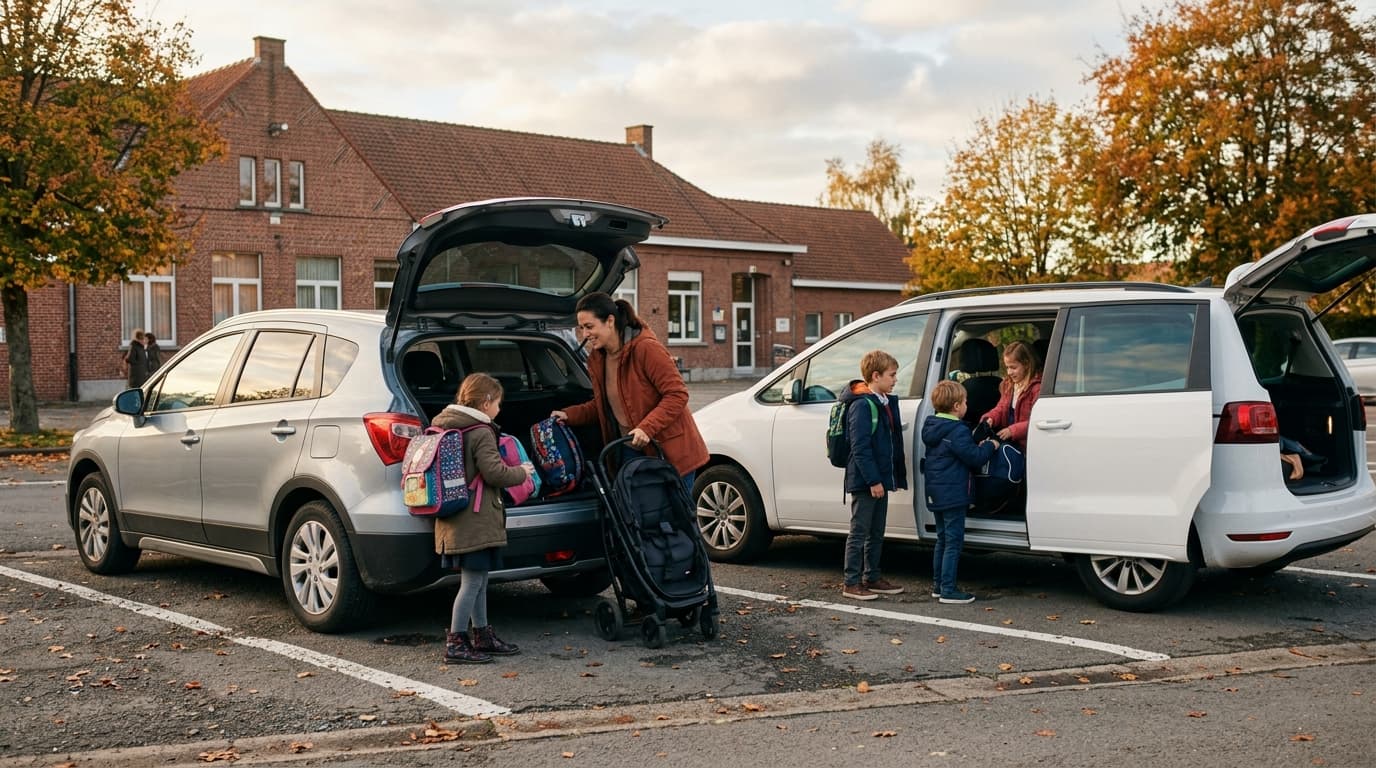
You want a new 7-seater without emptying the savings account, and two names come up everywhere in Belgium: the Dacia Jogger and the Citroën Berlingo. Between them sits a gap of €5,000 to €8,000 — and one number that settles the argument.
Bottom line: take the Dacia Jogger if budget rules and the third row is an occasional guest. Take the Citroën Berlingo XL if you really travel seven-up with luggage, or if you must fit three child seats across — that's where its €700 third-row option and its premium earn their keep.
What is the cheapest new 7-seater in Belgium?
The Dacia Jogger, with no serious rival. The TCe 110 is listed from about €20,700 in Expression trim, and the seven seats are standard — not a box to tick.
That detail is what opens the gap with the rest of the market. At Citroën, seven seats exist only on the long XL body, and the third row stays an option costing around €700. A properly engined Berlingo XL 7-seater therefore lands between €27,000 and €30,000 depending on trim. Same logic at the Stellantis cousins (Peugeot Rifter, Opel Combo Life): the entry price you see in the ads is a short, five-seat version.
The number that matters: at comparable trim and engine, the Jogger / Berlingo XL 7-seat gap runs to €6,000-7,000. For a family that counts, that's a full year of fuel and insurance. To place both models against the wider market, see our comparison of the best 7-seater cars in Belgium.
How much boot is left with all seven seats in use?
160 L in the Dacia Jogger, about 320 L in the Citroën Berlingo XL. That's the most decisive gap of this duel, and the one no brochure puts up front.
The honest test is the boot once all seven seats are in use. In the Jogger, those 160 L amount to a schoolbag and a sports bag, and that's it. A holiday for seven with suitcases is simply out of reach without a roof box. The Berlingo XL, 35 cm longer, climbs back to roughly 320 L: still modest, but a folded stroller and two bags go in, which changes daily life.
In five-seat mode the picture partly flips. The Jogger offers 607 L (up to 708 L if you fold rather than remove the bench) and reaches 1,819 L once the third row is taken out and the second folded. The Berlingo XL tops a thousand litres in five-seat form. Both are excellent carriers for five; only the Berlingo keeps real load space at seven.
In practice, with children, the question is simple: how often will you truly travel seven-up with luggage? If the answer is "two or three times a year", the Jogger plus a roof box settles it for €6,000 less.
Can you fit three child seats across?
Three child seats across, yes or no? In the Berlingo XL, yes. In the Jogger, it's tight — and often no.
The difference is structural. The Berlingo lines up three independent second-row seats, all with Isofix. Three standard-width shells clip in side by side without touching. The Jogger keeps a conventional bench with two outer Isofix points: the centre place exists, but it's narrow and lacks the same anchors. For a family with three young children, that's a deal-breaker.
The edge case worth knowing: if your three child seats are compact models without reinforced side protection, fitting them across can work in the Jogger. But no spec sheet guarantees it. The only reliable method is to bring your three shells to the dealer and fit them yourself before signing. I've seen too many parents discover the problem a week after delivery.
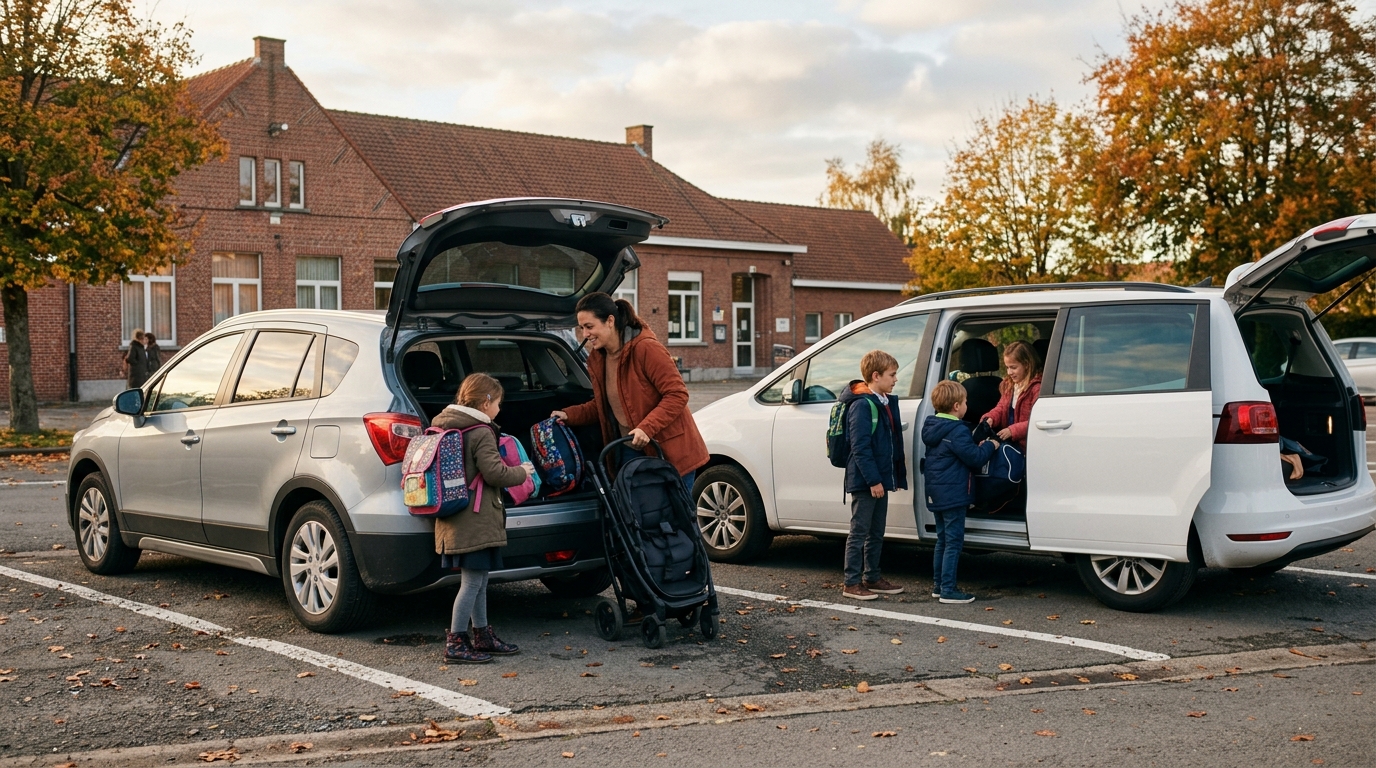
The Berlingo's sliding doors deserve a mention too: in a school or supermarket car park, the child getting out doesn't dent the car next door, and third-row access needs no contortion. The Jogger, with conventional hinged doors, wants more space and a little more agility.
Which engine to choose in 2026?
It depends on your mileage and your roads. On the Jogger, the TCe 110 petrol for a tight budget, the hybrid 155 for town, the Eco-G 120 (petrol/LPG) for high-mileage drivers. On the Berlingo, PureTech petrol in town, BlueHDi 130 on the motorway.
Dacia has refreshed the range: the Jogger hybrid 155 is on order from about €25,600 in Expression, and the Eco-G 120 bi-fuel gains an automatic gearbox in the first quarter of 2026. That LPG version stays the best-kept secret in the segment for a parent covering 25,000 km a year: the fuel costs far less per litre, and the extra tank doesn't eat into the boot on this body.
At Citroën, the 1.5 BlueHDi 130 returned to the catalogue in early 2026 and remains the most frugal on long runs — an argument for anyone commuting Brussels to the coast. The electric ë-Berlingo exists too, but its price (around €37,000) takes it out of the budget playing field we're on here.
The number that matters: the Jogger is lighter (1,268 kg against 1,476 kg for the Berlingo) and much quicker (0-100 km/h in 8.9 s in TCe 110, against 11.2 s for a petrol Berlingo). On a busy motorway slip road with seven aboard, you feel it.
Are the Jogger and the Berlingo deductible for a Belgian company?
No, except in fully electric form. Since 1 January 2026, a non-zero-emission company car is no longer deductible against Belgian corporate income tax.
That rules out at a stroke the Jogger TCe, the Jogger hybrid, the Jogger Eco-G and every combustion Berlingo. A hybrid without a plug remains, in the taxman's eyes, a combustion engine: its advertised frugality changes nothing. Only the electric ë-Berlingo keeps deductibility — and Dacia currently offers no electric Jogger.
The consequence is clear: both cars make sense as a private purchase, for a household paying for the car out of its own pocket. If you need a deductible 7-seater for your company, the playing field is elsewhere, on the electric side.
Jogger or Berlingo: which costs less to run?
The Jogger, in almost every scenario — though the gap narrows if you cover big motorway miles.
Three reasons. Its weight first: 200 kg less than a Berlingo, which shows directly at the pump. Its mechanicals next, deliberately simple and widely shared with the rest of the Renault-Dacia range, which drags parts and servicing costs down. Its purchase price last, which softens depreciation: you lose less money on a car bought at €21,000 than on one bought at €29,000.
The honest counter-argument: if you cover 30,000 km a year, mostly on motorways, the Berlingo's 1.5 BlueHDi drinks less than a TCe petrol at a steady cruise, and the running-cost gap offsets part of the purchase gap over five years. That calculation deserves to be run with your real mileage, not a brochure average.
Dacia Jogger vs Citroën Berlingo XL comparison table
| Criterion | Dacia Jogger | Citroën Berlingo XL |
|---|---|---|
| Entry price Belgium 2026 | from ~€20,700 (TCe 110 Expression) | ~€27,000-30,000 as XL 7-seater |
| Seven seats | Standard | ~€700 option, XL only |
| Boot, seven seats up | 160 L | ~320 L |
| Boot, five seats | 607 L (up to 708 L) | over 1,000 L |
| Maximum volume | 1,819 L | higher |
| Second row | Bench, 2 outer Isofix | 3 individual Isofix seats |
| Three child seats across | Tight, often no | Yes (standard width) |
| Rear doors | Hinged | Sliding, both sides |
| Length | 4.55 m | ~4.75 m (XL) |
| Kerb weight | 1,268 kg | 1,476 kg |
| 0-100 km/h (entry petrol) | 8.9 s | 11.2 s |
| Engines | TCe 110, hybrid 155, Eco-G 120 (LPG) | PureTech 110/130, BlueHDi 130, ë-Berlingo |
| Company-car deductible 2026 | No | No (except electric ë-Berlingo) |
| Cousins worth quoting | — | Peugeot Rifter XL, Opel Combo Life XL |
Verdict
Tight budget, occasional seven seats: the Dacia Jogger. Seven seats as standard for about €20,700, simple mechanicals, 200 kg less and genuine modularity (50/50 removable third row, up to 1,819 L). The right call if the third row serves the school run and the grandparents, not the holidays.
A genuinely large family: the Citroën Berlingo XL. Three individual Isofix seats across, sliding doors, and a boot of roughly 320 L that survives the third row being up. It costs €6,000-7,000 more, and it's worth it if you really travel seven-up with luggage.
The right move: get quotes on the Berlingo XL, the Peugeot Rifter XL and the Opel Combo Life XL on the same day, on the same trim — commercial terms move, and the cheapest isn't always the one you'd expect. Then come to the dealer with your child seats. That test decides it, not the spec sheet.
To go further, see our comparison Kia Sorento vs Skoda Kodiaq and, if used is an option, SEAT Tarraco vs Skoda Kodiaq used.
Sources: Dacia Jogger 2026 range and pricing (fr.dacia.be, media.dacia.com — TCe 110 from ~€20,700, hybrid 155 from ~€25,600, Eco-G 120 automatic in Q1 2026); Jogger boot volumes (160 L with seven seats, 607 L with five, 1,819 L maximum) from dacia.fr and larevueautomobile.com; Jogger dimensions (4,547 mm, 2.90 m wheelbase); Citroën Berlingo pricing and XL body (third-row option ~€700) from Citroën Belgium and L'Argus; comparative weight and performance (1,268 kg / 8.9 s against 1,476 kg / 11.2 s) from manufacturer specs; 2026 company-car deductibility from the Belgian reform. Recorded on 13/07/2026. Prices including VAT, excluding options and promotions, and liable to change — check with your dealer. Fit your own child seats before buying.
Budget & occasion comparator
Compare all budget & occasion side by side.
Compare now →
Frequently asked questions
Sophie teste des voitures familiales depuis 2013, d’abord pour la presse auto belge, aujourd’hui en indépendante depuis le Brabant wallon. Mère de trois enfants, elle juge une 7 places sur ce qui compte vraiment au quotidien : trois sièges-auto qui rentrent de front, le coffre une fois la 3e rangée dépliée, et la hauteur de seuil quand on charge une poussette. Sa règle : un essai sans enfants à bord ne vaut rien.