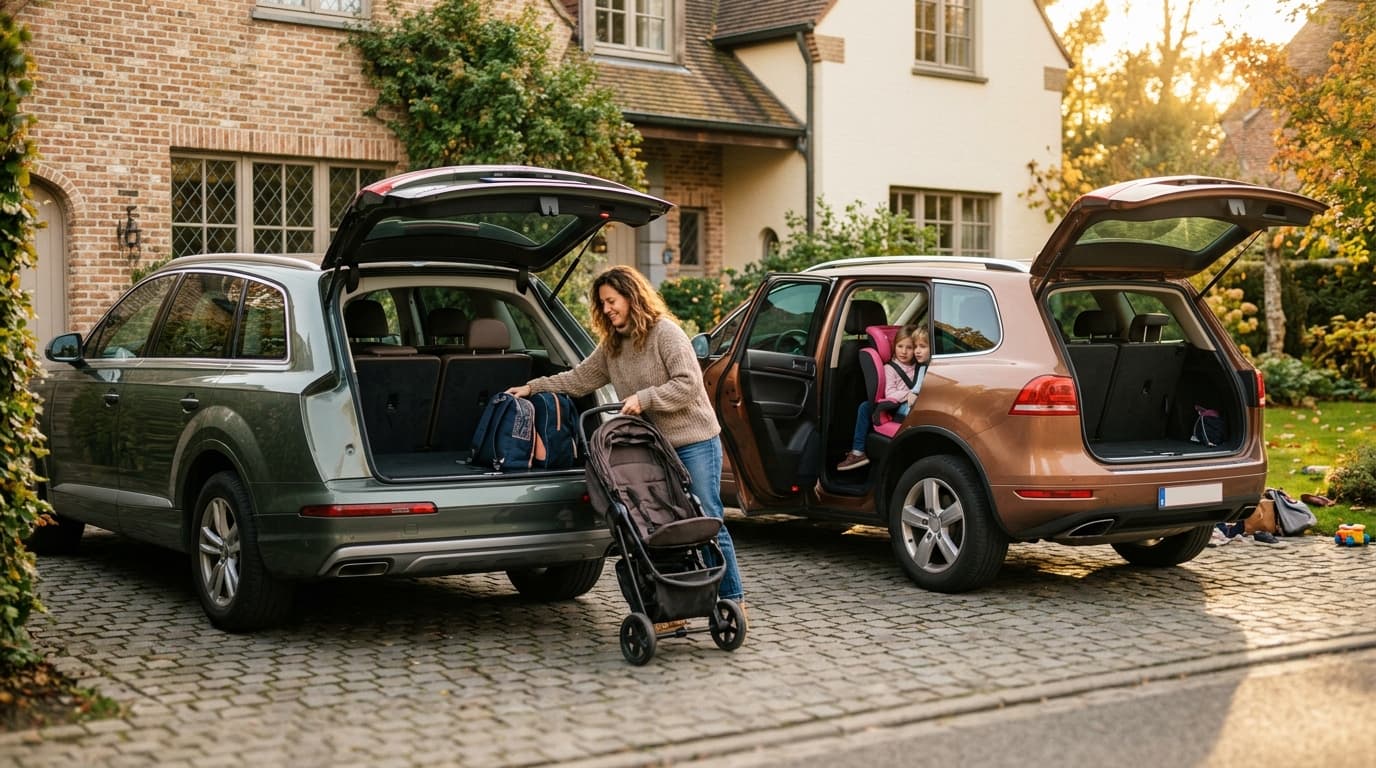
You're after a large used 7-seat SUV without paying new-car money, and you keep landing on two listings that look oddly alike: the SEAT Tarraco and the Skoda Kodiaq. No wonder — under the skin, it's almost the same car. The question is which one buys your money best.
Bottom line: used in Belgium, the Tarraco and the Kodiaq offer the same mechanicals and the same space. The Kodiaq keeps a small edge on boot and resale; the Tarraco often sells for €1,000 to €3,000 less for equal age and mileage. The Tarraco for the best deal, the Kodiaq for peace of mind at resale.
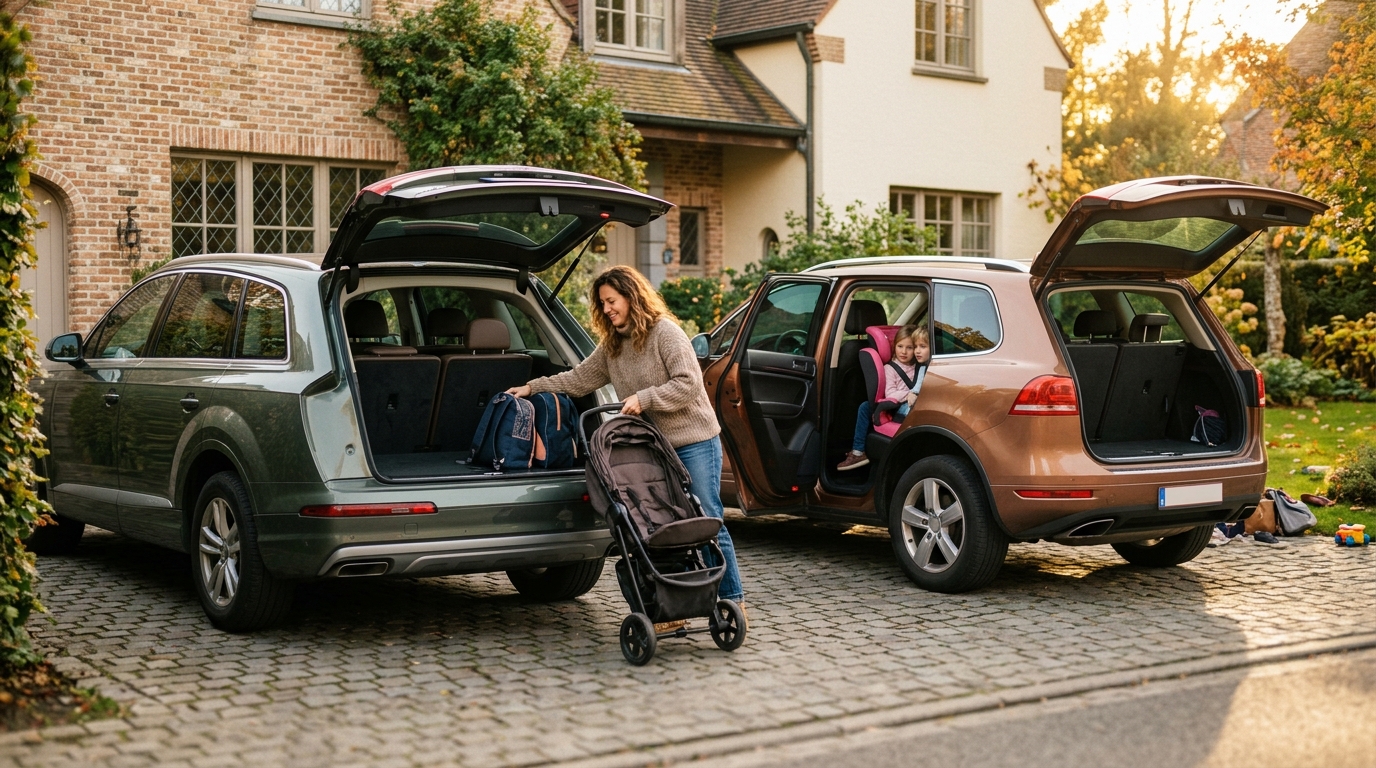
SEAT Tarraco or Skoda Kodiaq used: which to choose?
For a parent chasing seven seats without blowing the budget, the right pick is almost always the cheaper of the two at equal equipment — because they are, mechanically, twins. The Tarraco is the Spanish cousin of the Kodiaq.
Both SUVs share the Volkswagen Group MQB platform, the same wheelbase within a few millimetres, the same 1.4 / 1.5 TSI petrol and 2.0 TDI diesel engines, and the same manual or DSG gearboxes. The Kodiaq is 4.758 m long with a 2.791 m wheelbase, the Tarraco 4.735 m: in use, the difference is invisible. What sets them apart is mostly presentation — the Kodiaq with its "Simply Clever" tricks (umbrella in the door, door-edge protectors), the Tarraco with its slightly sportier styling and marginally softer suspension.
In practice, with children, this near-twinning is good news: it lets you buy on price, without sacrificing space or reliability. The number that matters: on the Belgian used market, the value gap between the two rarely exceeds €3,000 at equal model year, even though they offer the same cabin. In other words, compare condition and history first; the badge comes second.
Why is the used SEAT Tarraco often cheaper?
Because the Kodiaq arrived earlier, sold better and enjoys a reliability reputation that supports its value. The Tarraco depreciates a little faster — to your advantage at purchase.
The Kodiaq launched in Belgium back in 2017, the Tarraco only in 2019. Skoda benefits from an image of solidity and some of the lowest running costs in the class, which lifts its residual value. SEAT, a "younger" brand less established on the family beat, suffers sharper depreciation. The result: at comparable model year and mileage, the Tarraco often sits €1,000 to €3,000 below the Kodiaq.
The honest test is what you'll recover at resale. If you keep the car seven or eight years, as many families do, the purchase gap matters more than the resale gap: the Tarraco is then the more rational calculation. If you plan to change in two or three years, the Kodiaq protects your capital better. On the Belgian used market, an October 2020 Tarraco commonly trades around €18,000 to €19,000, while an equivalent Kodiaq readily climbs above €20,000.
Three child seats across: which copes better?
A dead heat, or nearly: both sit on the same body, so the same width at the back. Three child seats across, yes or no? Two shells fit easily, a third stays tight — on both, without exception.
This is the point technical comparisons always forget, obsessed with power and wheels. On the second row, the bench splits 60/40 (or 40/20/40 on some trims) and slides about 18 cm, which helps free up knee room or boot space as needed. But the usable width is that of a mid-size SUV: two bulky child seats coexist well, a third in the centre demands narrow shells and patience.
A detail that's crucial for a large family and rarely mentioned: the two third-row seats have no Isofix anchors. They suit children big enough for the belt, not the fitting of a child seat at the back. In short, all your child seats play out on the second row. In practice, with children: bring your three seats to the seller and fit them before signing. The spec sheet will never tell you whether your exact shells go in.
How much boot is left with all seven seats in use?
Very little, as on every 7-seat SUV: about 230 to 340 L depending on the bench position, once the third row is up. Room for a folded stroller and two bags, not the suitcases for a holiday for seven.
The honest test is the boot once all seven seats are in use, and it's the physical limit of the segment: when the back is occupied, the boot shrinks. The sliding bench plays its part here — slid fully back for legroom, you drop to the bottom of the range; slid forward, you claw back a few dozen litres. Fold the third row down, though, and both turn into genuine big estates: on the order of 700 to 835 L in five-seat mode, and over 2,000 L with the rear seats folded.
The number that matters, for a Belgian family running five-up during the week and seven at the weekend: you have an excellent five-seater most of the time, and a seven-seat backup to help out. For a holiday for seven with luggage, the only realistic solution stays the roof box or a small trailer — neither the Tarraco nor the Kodiaq transforms that exercise.
Which engines and gearbox to avoid used?
No engine to shun outright, but precise checkpoints. In petrol, beware the timing chain on the 1.4 and 1.5 TSI; on the DSG DQ381 automatic, demand proof of consistent servicing.
This is where the real difference between a good and a bad used car plays out, far more than between the two brands. The timing chain on the 1.4 and 1.5 TSI blocks can show wear from 60,000 to 80,000 km: a cold-start rattle should alert you, because the repair is costly. The early 1.5 TSI also suffered a cold "kangaroo" effect, fixed by a software update — check it was done. The DSG7 DQ381 gearbox needs an oil change every 60,000 km; its mechatronics and electric oil pump are its weak points when servicing has been neglected, with low-speed jerks as the symptom.
In practice, with children: the classic mistake of a rushed parent is buying the cheapest example in the listing. On these models, the price gap almost always reflects a real difference in maintenance. Demand a full service book, ask for the invoice of the last DSG oil change, and on a 2.0 TDI that lived in town, have the particulate filter checked. A well-kept diesel that eats motorway stays a safe bet; a poorly maintained petrol DSG can cost dearly in year two.
How much does a Tarraco or Kodiaq cost used in Belgium?
The entry ticket is around €14,000 for a 2017 Kodiaq, rising toward €25,000 for a recent, well-equipped example. The Tarraco generally sits a notch below at equal age.
On AutoScout24.be and 2ememain.be in 2026, a 2017 Kodiaq 7-seater in 1.4 TSI can be found from about €14,000, while a well-kept 2018-2020 trades more between €18,000 and €24,000, and a 2020 in 2.0 TDI readily tops €25,000. On the Tarraco side, younger to market, a 2020 example is frequently met around €18,000 to €19,000 — often the better seats-per-euro of the two.
The right move, in Belgium, is to compare the total cost over five years rather than the sticker alone: servicing, petrol or diesel, insurance and the registration tax depending on the region. A Tarraco a bit cheaper to buy but poorly kept can cost more than a spotless Kodiaq bought €2,000 dearer. The badge matters less than the history.
Tarraco vs Kodiaq used comparison table
| Criterion | SEAT Tarraco | Skoda Kodiaq |
|---|---|---|
| Platform | MQB (VW Group) | MQB (VW Group) |
| Length | 4.735 m | 4.758 m |
| Belgian launch | 2019 | 2017 |
| Engines | 1.5 TSI / 2.0 TDI / PHEV | 1.4-1.5 TSI / 2.0 TDI |
| Three child seats across | Tight (2nd row), no Isofix in 3rd | Tight (2nd row), no Isofix in 3rd |
| Boot, seven seats up | ~230-340 L (sliding bench) | ~230-340 L (sliding bench) |
| Boot, five seats | ~700-760 L | up to ~835 L |
| Resale value | Sharper depreciation | Well-held value |
| Used price BE 2026 (2020) | ~€18,000-19,000 | ~€20,000-24,000 |
Verdict
The best deal to buy: the SEAT Tarraco. Same platform, same cabin, same engines as the Kodiaq, but often €1,000 to €3,000 less at equal model year. The rational choice for a family that keeps its car a long time and watches the bill.
Peace of mind at resale: the Skoda Kodiaq. Its better-held value, slightly bigger boot and "Simply Clever" tricks make it more reassuring if you plan to resell in two or three years.
The real criterion, before the badge: the service history. On both, a full book, an up-to-date DSG oil change and a healthy timing chain are worth more than the logo on the bonnet. Always bring your three child seats, and have the gearbox and timing checked before signing.
To place these two cousins against the wider market, see our comparison of the best 7-seater cars in Belgium in 2026. If the Kodiaq against a Korean rival tempts you, read Kia Sorento vs Skoda Kodiaq or Hyundai Santa Fe vs Kia Sorento.
Sources: MQB platform and Tarraco / Kodiaq dimensions from manufacturer data (seat.be, skoda.be) and Le Moniteur Automobile (moniteurautomobile.be); used prices recorded on AutoScout24.be and 2ememain.be as of 06/07/2026 (Kodiaq 7-seater from ~€14,000, 2018-2020 examples €18,000 to €25,000; 2020 Tarraco around €18,000-19,000); reliability points on the 1.4 / 1.5 TSI timing chain and the DSG DQ381 gearbox from workshop feedback (fiches-auto.fr, auto-doc.fr); boot volumes from manufacturer specs. Used prices vary with mileage, trim and condition. Fit your own child seats before buying.
Budget & occasion comparator
Compare all budget & occasion side by side.
Compare now →
Frequently asked questions
Sophie teste des voitures familiales depuis 2013, d’abord pour la presse auto belge, aujourd’hui en indépendante depuis le Brabant wallon. Mère de trois enfants, elle juge une 7 places sur ce qui compte vraiment au quotidien : trois sièges-auto qui rentrent de front, le coffre une fois la 3e rangée dépliée, et la hauteur de seuil quand on charge une poussette. Sa règle : un essai sans enfants à bord ne vaut rien.