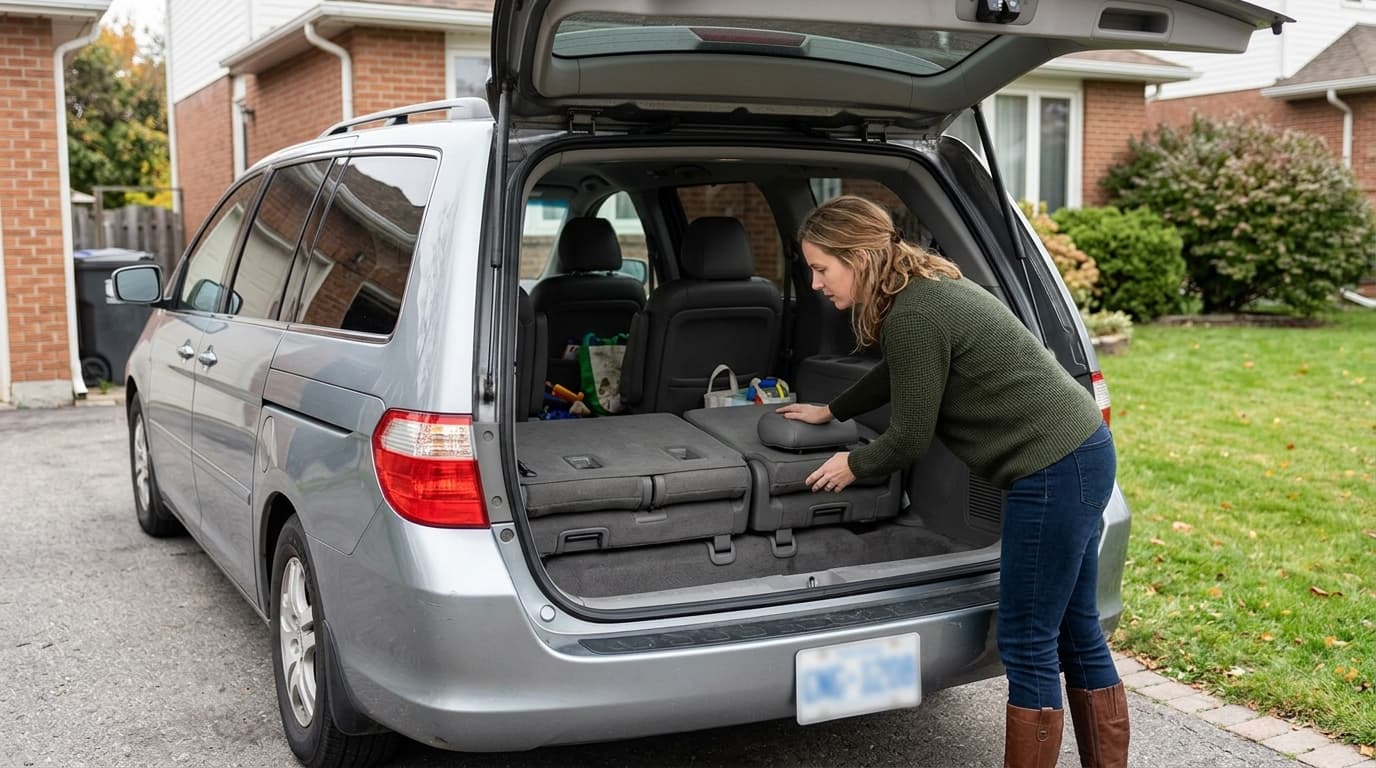
The seller opens the bonnet, hands over the service book and talks mileage. The third row stays folded for the whole viewing.
Short answer: on a used 7-seater, six checks decide what the car is worth and none of them involves the engine. Folding both rear seats, third-row belts, second-row rails, the floor under the boot, the Isofix points actually fitted, and the Car-Pass.
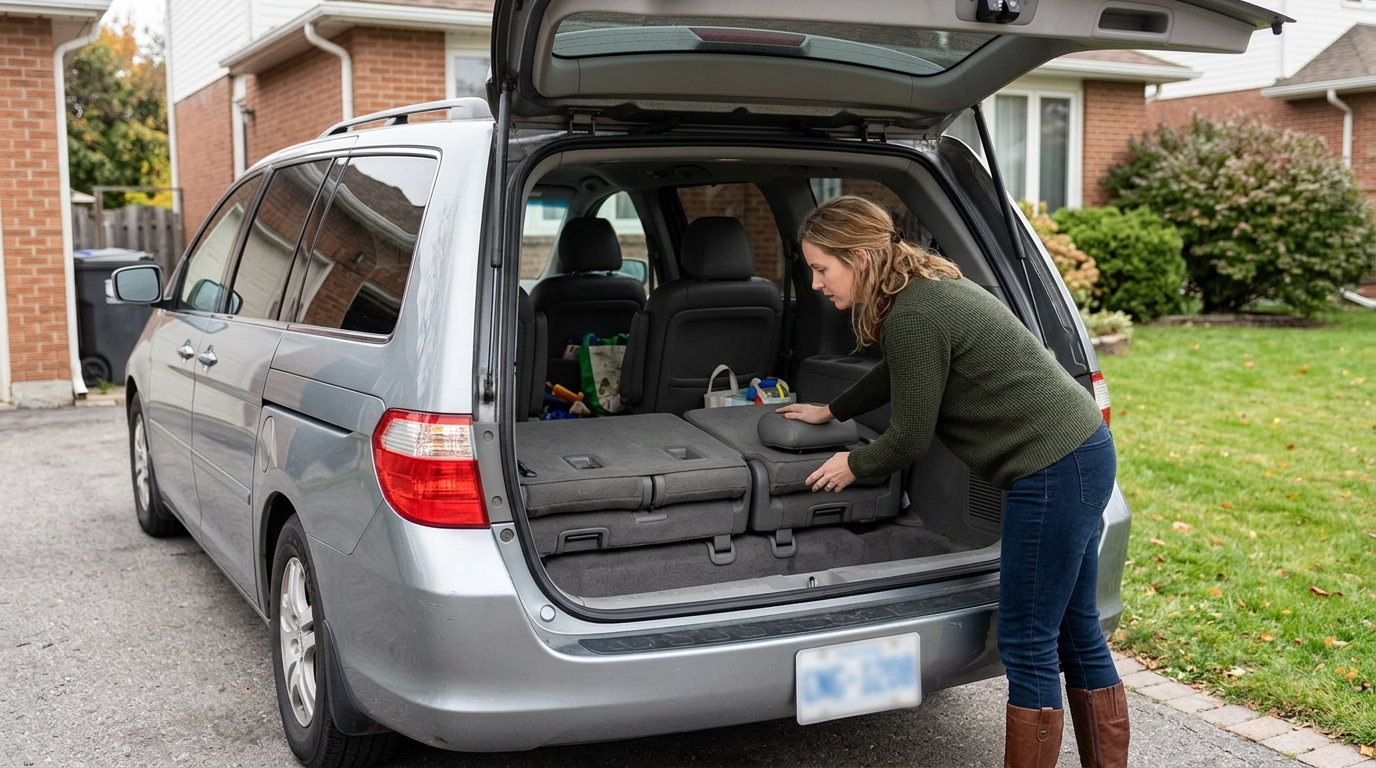
Where do you start on a 7-seater you have never seen?
At the back. Not under the bonnet.
A six or seven year old 7-seater has worked as a family van: school runs, Saturday shopping, two holiday trips a year, a third row folded fifty times and unfolded fifty times. The parts that give up on these cars are exactly the ones nobody looks at during a twenty-minute viewing, because they live under the boot mat or behind a backrest.
Do both third-row seats actually fold out?
Do it three times in a row, yourself, without letting the seller do it for you.
The tipping mechanism on a last row is a wear part, and it wears unevenly: the kerbside seat gets used twice as often as the other one, because that is where the children climb in. A backrest that rises without clicking, a slack strap, a seat sitting two centimetres proud of the floor: three symptoms, one likely diagnosis, a tired latch.
The test that settles it is one sentence long. Unfold, lock, then pull the top of the backrest towards you as hard as you can. It must not move.
Do the third-row belts retract all the way?
Pull each strap out to its full length, then let it go in one movement.
A belt that creeps back in, or that stops ten centimetres short of its housing, has taken damp or dust into its retractor. The point cuts two ways: it is a fail item on the Belgian roadworthiness test, since belt and anchorage condition is among the checks, and it is above all the first sign of water getting in through the tailgate.
Why lift the boot floor before you talk price?
Because modern third rows stow into the floor, and a floor well is a water trap.
On a 2015-generation Volkswagen Touran the five rear seats fold flat into the floor, so the boot goes from 137 litres in seven-seat mode to 834 litres once the last row is stowed. That is a 697-litre well, roughly 348 litres gained per stowed seat. The first-generation Škoda Kodiaq works the same way, with 270 litres in seven-seat mode against 630 with five seats, and a second row that slides over 18 centimetres. The well is there, it is deep, and it collects everything that finds its way past an ageing tailgate seal or a rear light refitted badly after a knock.
Lift the mat. Run your hand along the bottom, into the corners, into the hinge recesses. Your nose is as useful as your hand here. A whitish limescale mark, sodden sound-deadening foam, a cellar smell: those three signs cost real money, because corrosion starts under the rails and only shows up the day the seat stops locking. That check takes four minutes, and I have never once seen a seller offer it unprompted.
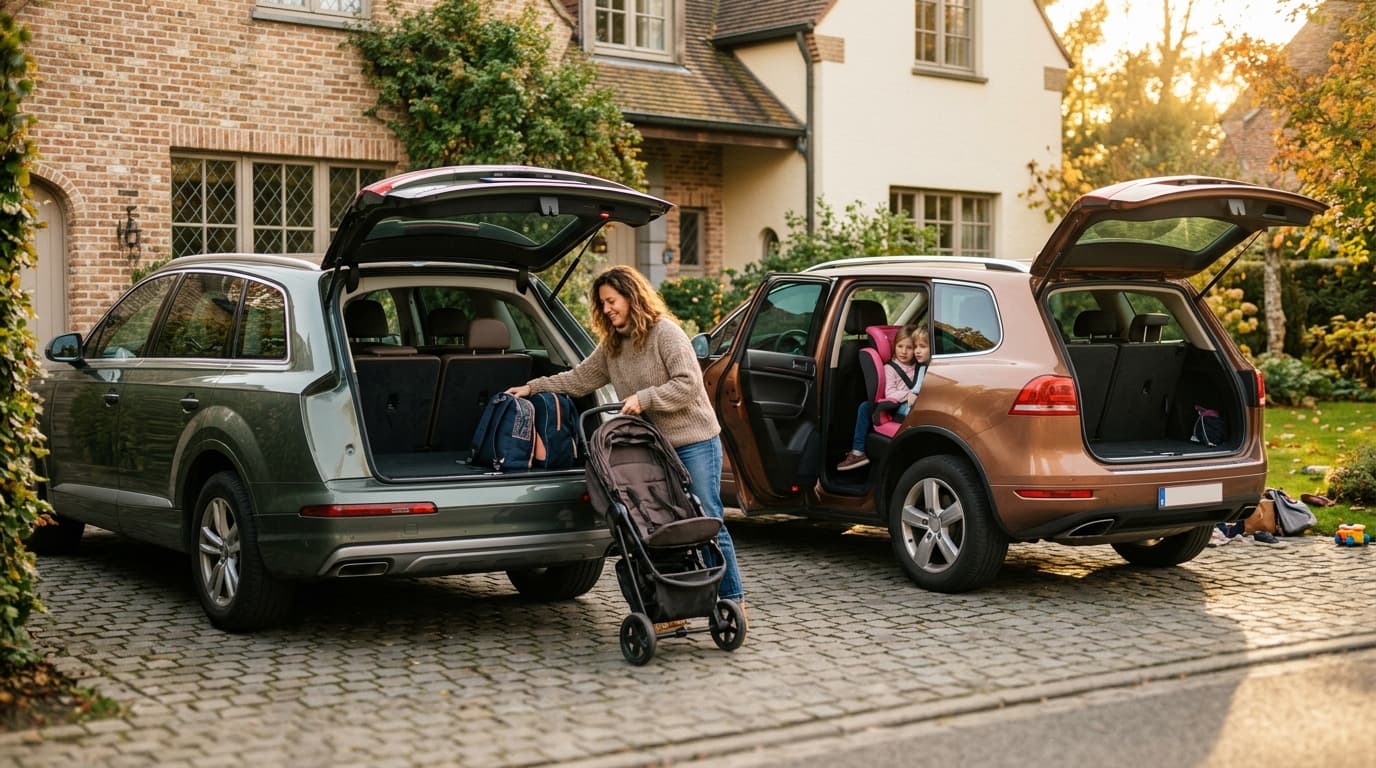
How many Isofix points, row by row?
Count them yourself: the advert almost never gets it right.
The Touran is the generous exception in this class, with Isofix anchorages on all five rear seats, three in the second row and two in the third. Many 7-seat SUVs stop at two positions in row 2 and none in row 3, which changes the whole seating plan for a family with three young children. Part the trim, and look for the top tether behind the rear backrest.
Seven third-row faults, and the call that goes with each
| Found on the spot | Likely diagnosis | Call |
|---|---|---|
| Backrest rises without clicking home | Tired backrest latch | Get a quote before offering, likely roadworthiness fail |
| Seat sits 2 cm proud once locked | Bent hinge or rail | Walk away until the cause is identified |
| Rear belt retracts slowly | Damp or dust in the retractor | Safety part, replace it, never improvise |
| Damp foam under the boot mat | Tailgate seal or rear light not watertight | Find the leak first, corrosion starts under the rails |
| Second-row rail slides in jerks | Crumbs, sand, general fouling | Full clean, worth haggling over, not serious |
| No top tether in the last row | Never fitted by the manufacturer | No top-strap child seat can go back there |
| Tailgate drops on its own | Struts at end of life | Common part, modest bargaining chip |
Does the pre-sale inspection cover the third row?
Only partly, and the certificate the seller hands you proves less than you think. A pass certificate guarantees none of the following:
- that both third-row seats unfold and lock normally;
- that the second-row rails travel their full length, 18 centimetres on a first-generation Kodiaq;
- that the floor under the boot is dry;
- that every advertised Isofix point is present and reachable;
- that the rear sockets and vents work;
- that the tailgate stays up on its own.
Roadworthiness testing has been a regional competence in Belgium since the sixth state reform: Wallonia, Brussels and Flanders each run their own organisation, centres and tariffs, with the approved bodies grouped under GOCA. The pre-sale inspection is required in all three regions, its certificate is valid for two months, and a fail means a retest within a short window, fifteen days in the usual case.
Is a Car-Pass enough to make the purchase safe?
No, and the confusion is common.
The Car-Pass certifies mileage, nothing else. It has been compulsory since the law of 11 June 2004 for every used vehicle sale, private or through a dealer, and a seller who fails to provide one faces a fine of 26 to 30,000 EUR once surcharges apply, with the buyer also able to ask for the sale to be cancelled. A spotless Car-Pass on a car whose last row is dead is still a spotless Car-Pass. Touring publishes a general checklist that covers bodywork and mechanicals well, and that stops where this article starts.
Verdict
Buying an MPV over six years old: the floor well comes before the engine. An old leak is paid for in corrosion under the rails, and it is hard to negotiate once the sale is done. The Seat Tarraco against the Škoda Kodiaq piece applies the same used-car checks to this pair.
Buying a 5+2 whose last row has never been used: be wary. A mechanism left idle for seven years seizes, and you will find out on moving day.
Carrying three children in child seats: count the Isofix points row by row before discussing price. Two 7-seaters at the same budget can differ completely on this.
Leaving on holiday with seven on board: add the residual payload and roof load calculation to your inspection.
The trap to avoid: believing that a pass certificate and a clean Car-Pass validate the third row. Neither one tests it. To settle the model before the example, start from the most reliable 7-seaters.
Sources: Car-Pass ASBL, legal framework of the law of 11 June 2004 and applicable penalties; GOCA, regional organisation of roadworthiness testing in Belgium and scope of the pre-sale inspection (seat mountings, belts and anchorages); Touring, "Buying a used car: what should I check?"; manufacturer technical data for the 2015-generation Volkswagen Touran (137 litres with seven seats, 834 litres with five, Isofix on all five rear seats, seats folding flat into the floor) and for the Škoda Kodiaq (270 litres with seven seats and 630 litres with five on the 2016-2024 first generation, 340 litres on the generation launched in 2024, second row sliding over 18 cm and split 60/40). Figures recorded on 24/08/2026; they vary by trim and model year, so read those of the car you are viewing. Retest deadlines and fees differ between Wallonia, Brussels and Flanders: check with the centre concerned. This article replaces neither a workshop quote nor legal advice.
Budget & occasion comparator
Compare all budget & occasion side by side.
Compare now →
Frequently asked questions
Sophie teste des voitures familiales depuis 2013, d’abord pour la presse auto belge, aujourd’hui en indépendante depuis le Brabant wallon. Mère de trois enfants, elle juge une 7 places sur ce qui compte vraiment au quotidien : trois sièges-auto qui rentrent de front, le coffre une fois la 3e rangée dépliée, et la hauteur de seuil quand on charge une poussette. Sa règle : un essai sans enfants à bord ne vaut rien.