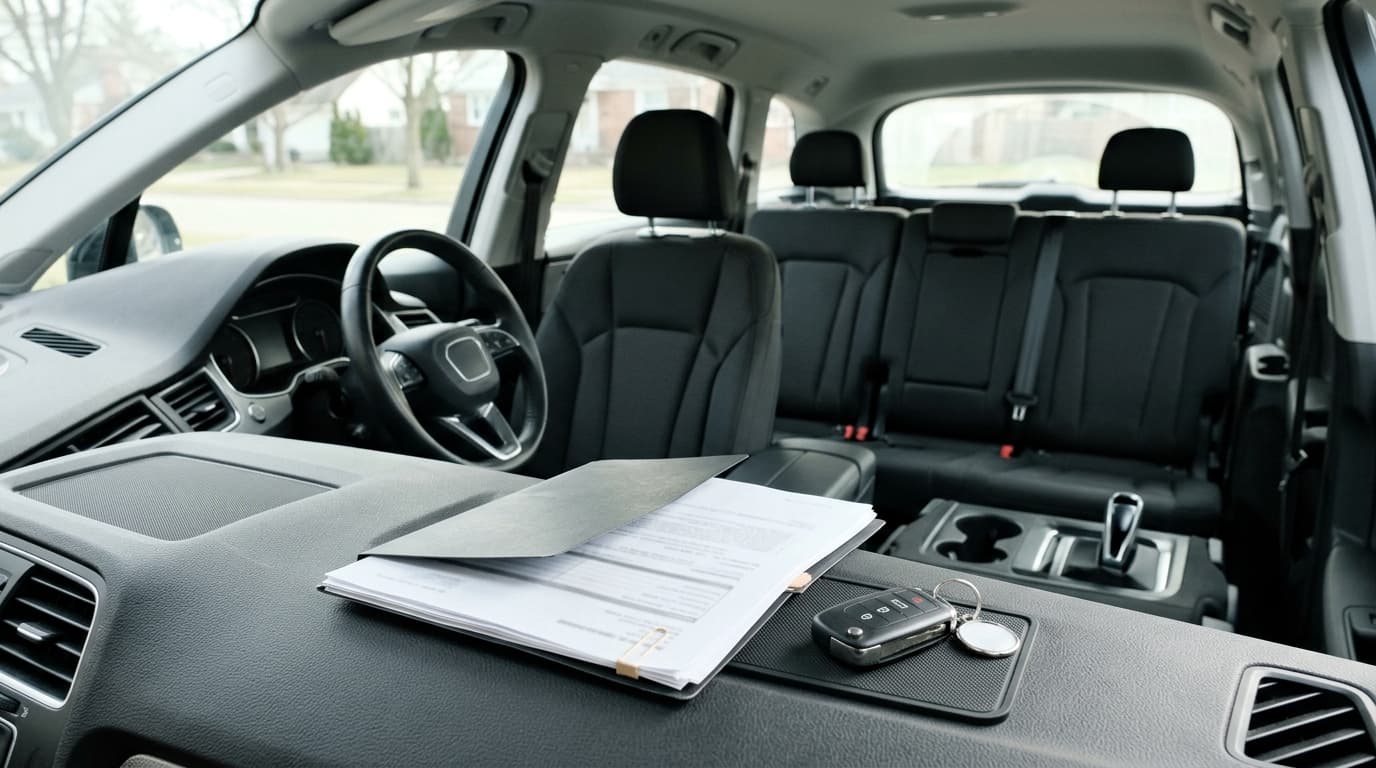
Five or seven: the answer is printed, not bolted in.
A car has the number of seats its manufacturer had approved, written on the certificate of conformity and copied into box S.1 of the Belgian registration certificate, driver included. Two seats added in the boot change nothing until a new approval recognises them, and that holds in Namur, Brussels and Ghent alike.
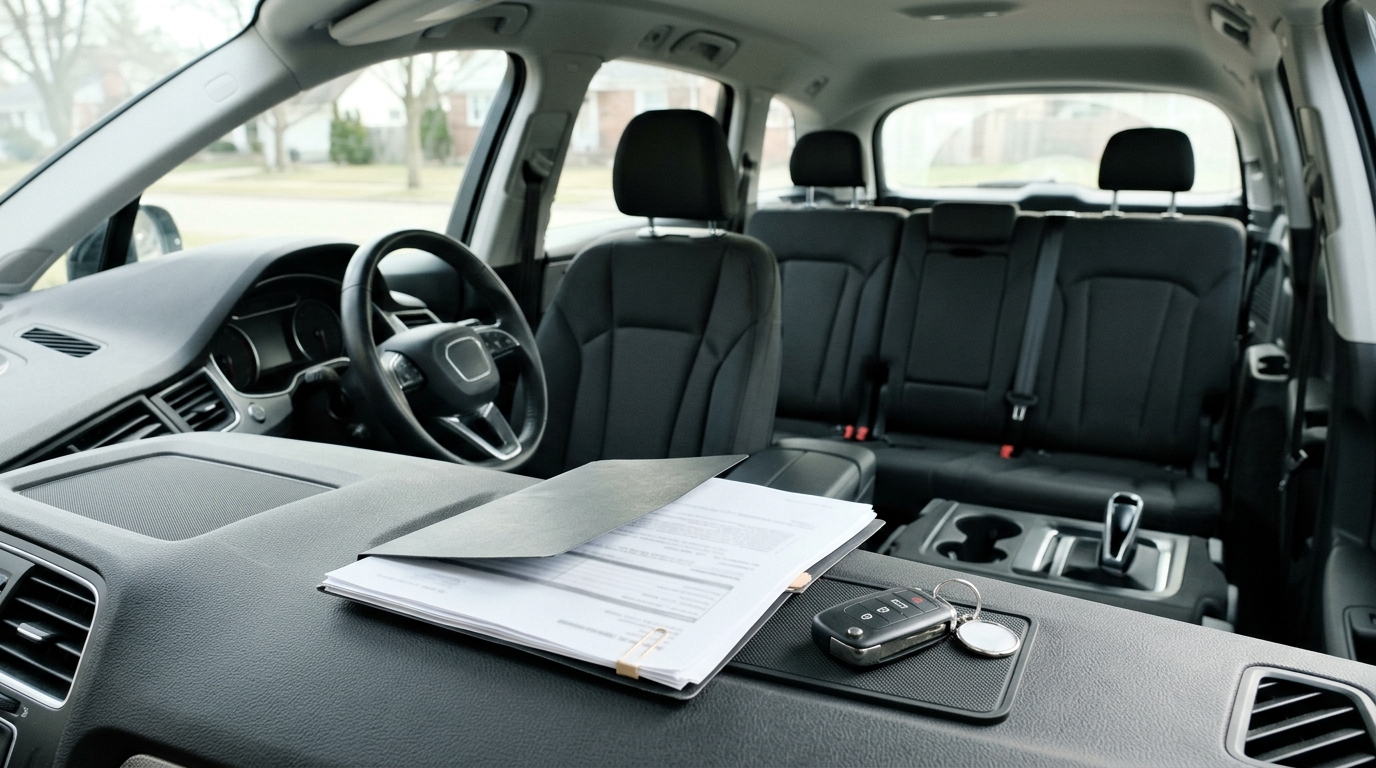
The figure that matters sits in the glovebox
Open your registration certificate at box S.1. The figure there is the number of approved seats, driver's seat included, and it is the only one the police, your insurer and the inspection centre know about.
That figure does not come from the DIV, Belgium's vehicle registration service. The DIV copies it. It comes from the certificate of conformity, the document the manufacturer issues for every car leaving the factory, stating that this particular vehicle, identified by its chassis number, matches an approved type. Box K of the same registration certificate gives the type-approval number: a European one starts with a lower-case "e" followed by the number of the issuing state, 6 for Belgium.
My argument fits in one sentence, and the rest of this piece tests it: in a seven-seater, seats are counted on paper, never in the cabin.
What is a car's certificate of conformity?
A manufacturer's declaration: the car was built in line with the approved type, described in detail, masses, emissions, power and seating capacity included. The European model, known as the COC, is almost identical across the Union, which is why a car bought in Germany can be registered here without a new approval.
It comes free with a new car. It never expires, unless the vehicle is modified.
Three documents overlap here, and they are often confused.
| Document | Issued by | Seat count | When it is used |
|---|---|---|---|
| Certificate of conformity | Manufacturer or importer | Seating capacity entry | Registering a new or imported vehicle, duplicates |
| Registration certificate | The DIV, part of the Federal Mobility Service | Box S.1, driver included | Roadside checks, inspection, claims |
| Individual approval record | The region, through a technical service | Description of the converted vehicle | After an accepted conversion |
A 5-seat Kodiaq and a 7-seat Kodiaq are not the same car
The second-generation Škoda Kodiaq is sold with five or seven seats, the same 150 hp 1.5 TSI engine and the same seven-speed DSG. Same body, same 4,758 mm length, a little over €1,100 apart on the reference price list I used. On paper, though, they are two separately approved versions, and the gaps can be counted.
| Kodiaq 1.5 TSI mild hybrid DSG (2024) | 5 seats | 7 seats | Gap |
|---|---|---|---|
| Kerb mass | 1,589 kg | 1,633 kg | + 44 kg |
| Maximum authorised mass | 2,181 kg | 2,234 kg | + 53 kg |
| WLTP CO2 | 134 g/km | 137 g/km | + 3 g/km |
| Boot, 5 seats in use | 910 L | 845 L | 65 L less |
| Boot, 7 seats in use | not applicable | 340 L | |
| Seats in box S.1 | 5 | 7 | + 2 |
Read the second row twice. For the seven-seat version, the manufacturer raised the maximum authorised mass by 53 kg, recalculated emissions and had the third-row belt anchorages validated. The well that swallows that row also costs 65 litres of boot space when it is folded, which says plainly enough that the body itself is different.
Now picture the owner of a five-seat Kodiaq who has genuine Škoda third-row seats fitted. The car comes back physically close to the seven-seat version, and administratively identical to the five-seater it always was: 2,181 kg maximum mass, a 5 in box S.1. Those 53 missing kilos cannot be added with a torque wrench. They still matter, because with seven people on board the loading margin disappears fast, as our 7-seater payload calculation shows.
The serious objection: "they are genuine seats"
This is the argument I hear most, and it is not absurd. The seats come from the manufacturer, the mounting points sometimes already exist in the floor, and some used-car listings offer a "7-seat kit" neatly fitted by a franchised garage. So where is the problem?
In two places. A genuine part is not a genuine seat: an approved seat is the whole assembly of cushion, anchorages, belt and retractor, head restraint, fixing to the body shell and the maximum mass that absorbs two more passengers. Autocontrole, one of the Belgian inspection bodies, puts it in writing: seats not fitted at delivery require a validation report, and any structural work on the self-supporting body must be certified by the manufacturer or its representative. The second place is simpler still. The certificate of conformity describes the car as it left the factory, and it does not follow work done afterwards.
The nuance exists, and it counts. A seven-seater sold as such, with a third-row seat removed and refitted, keeps its seven seats, since the approved type included them and the certificate says so. The problem only starts when the figure on paper is lower than the number of belts in the cabin. That is also the limit of any debate about the true seats of a 7-seater: a seat can be approved yet unusable for an adult, never the other way round.
Can seats be added and approved?
Yes, in principle. Rarely at a sensible cost.
Vehicle approval has been a regional matter since the sixth state reform, but the logic does not change from one region to the next. Before touching the car, you need the manufacturer's written consent, obtained through its importer. Then two routes: a converter approved for that modification can issue a new certificate of conformity directly, otherwise the car goes through individual approval at an authorised inspection centre or a recognised technical service.
| Region | Where the application goes | Public fee noted on 26/09/2026 |
|---|---|---|
| Wallonia | SPW Mobility and Infrastructure approval service in Namur, via an authorised centre (AIBV, Autosécurité) | refers to an indexed fee table, no amount on the procedure page |
| Brussels | Brussels Mobility, via the conformity department of an inspection centre or an authorised technical service | individual approval of a car: €253, centre fees excluded |
| Flanders | An inspection centre competent for conformity, KM in West Flanders for instance | according to the centre's scale |
On top of the Brussels fee come the inspection centre's charges, the seat validation report, the seats and their belts, with no guarantee the manufacturer will agree, since it can refuse if the maximum mass cannot absorb two more passengers. For a Kodiaq, where the list price gap between the two versions is around €1,100, the sums are quickly done. Buy the version approved with seven seats, new or used, and leave conversion to vehicles that exist in no other form.
What happens with more passengers than approved seats?
The insurer first. The Royal Decree of 16 April 2018, which sets the conditions of Belgian motor liability insurance, gives the insurer a right of recourse against the policyholder when a claim arises while the number of passengers exceeds the authorised number. The recourse is limited: it covers passenger-related costs, in proportion to the passengers over the limit, and the insurer must show a causal link between the overload and the accident.
Take our five-seat Kodiaq with an unapproved third row, seven people aboard on the way back from Saturday hockey. Box S.1 allows four passengers, it carries six, so two are over the limit, a third of the passengers. If the insurer proves the causal link, it can claim back from the driver up to a third of what it paid out for the passengers. The victims are compensated regardless: your own assets settle the bill afterwards.
The highway code next. Article 35 requires every occupant to be belted, and every child under 1.35 m to travel in a suitable restraint fixed to a seat with a seatbelt. A bench without an approved belt is therefore not a seat, whatever the child's height. The detail is in our article on Belgian child seat law in a 7-seater.
The inspection last, which checks belts, their anchorages and whether the vehicle matches its documents. A row of seats that appears on no paperwork is exactly the kind of discrepancy you will be asked to explain.
How much does a certificate of conformity cost in Belgium?
Nothing when buying new. For a duplicate, the manufacturer sets the price, and the spread is wide.
D'Ieteren, importer of Volkswagen, Audi, Seat, Cupra, Škoda and Porsche, publishes its scale, noted on 26 September 2026: €160 including VAT for a car of Belgian origin built after 1998, €240 for the same car of foreign origin, and €240 or €350 for Porsche depending on origin. A seven-seat Kodiaq imported from Germany whose certificate was lost on the way will therefore cost €80 more than a Belgian one.
Regions only replace the manufacturer when it has ceased trading, or when the vehicle was approved by them. The Walloon administration is explicit: there is no point writing to it for a better price, it has no access to manufacturers' archives and it demands a statement of the manufacturer's inability before acting. Brussels Mobility charges €97 in 2026 for a certificate request when it steps in for the manufacturer.
Buying a used 7-seater: four papers to cross-check
Bring the chassis number, and ask to see the documents before sitting in the third row.
- Box S.1 of the registration certificate, which must read 7. A 5 on a car carrying seven seats points to an added row.
- The certificate of conformity, whose version and seat count must match box S.1.
- The identification plate riveted to the body, which carries the approval number and maximum masses: compare them with the seven-seat version's data sheet.
- For an imported car, the customs document (the 705 sticker) and the foreign registration certificate, which also states the number of seats.
These ten minutes of reading come before the mechanical inspection of the third row on a used car; they do not replace it.
Sources: Homologuer un véhicule pour permettre son immatriculation, Public Service of Wallonia, procedure updated on 23/07/2026; Obtenir un duplicata du certificat de conformité, Public Service of Wallonia, for box K, the approval number format and the substitution principle; Vehicle approval, Brussels-Capital Region, 2026 rates (M1 individual approval €253, certificate request €97, validation €97); Validatie en individuele goedkeuring, KM, for Flanders; Transformations et tuning, Autocontrole, for the validation report on non-original seats; Royal Decree of 16 April 2018 on compulsory motor liability insurance contracts, article 47, § 1, 3°; registration application specimen, Federal Mobility Service, for box S.1; duplicate certificate of conformity scale, D'Ieteren, noted on 26/09/2026; Škoda Kodiaq 1.5 TSI mild hybrid DSG data sheets, 7 seats and 5 seats, manufacturer data at the 15/10/2025 price list, noted on 26/09/2026. Masses and seat counts vary by version and model year: only the certificate of conformity and registration certificate of your own vehicle are authoritative. This article describes a general framework and does not replace advice from your region's approval service.
Budget & occasion comparator
Compare all budget & occasion side by side.
Compare now →
Frequently asked questions
Sophie teste des voitures familiales depuis 2013, d’abord pour la presse auto belge, aujourd’hui en indépendante depuis le Brabant wallon. Mère de trois enfants, elle juge une 7 places sur ce qui compte vraiment au quotidien : trois sièges-auto qui rentrent de front, le coffre une fois la 3e rangée dépliée, et la hauteur de seuil quand on charge une poussette. Sa règle : un essai sans enfants à bord ne vaut rien.