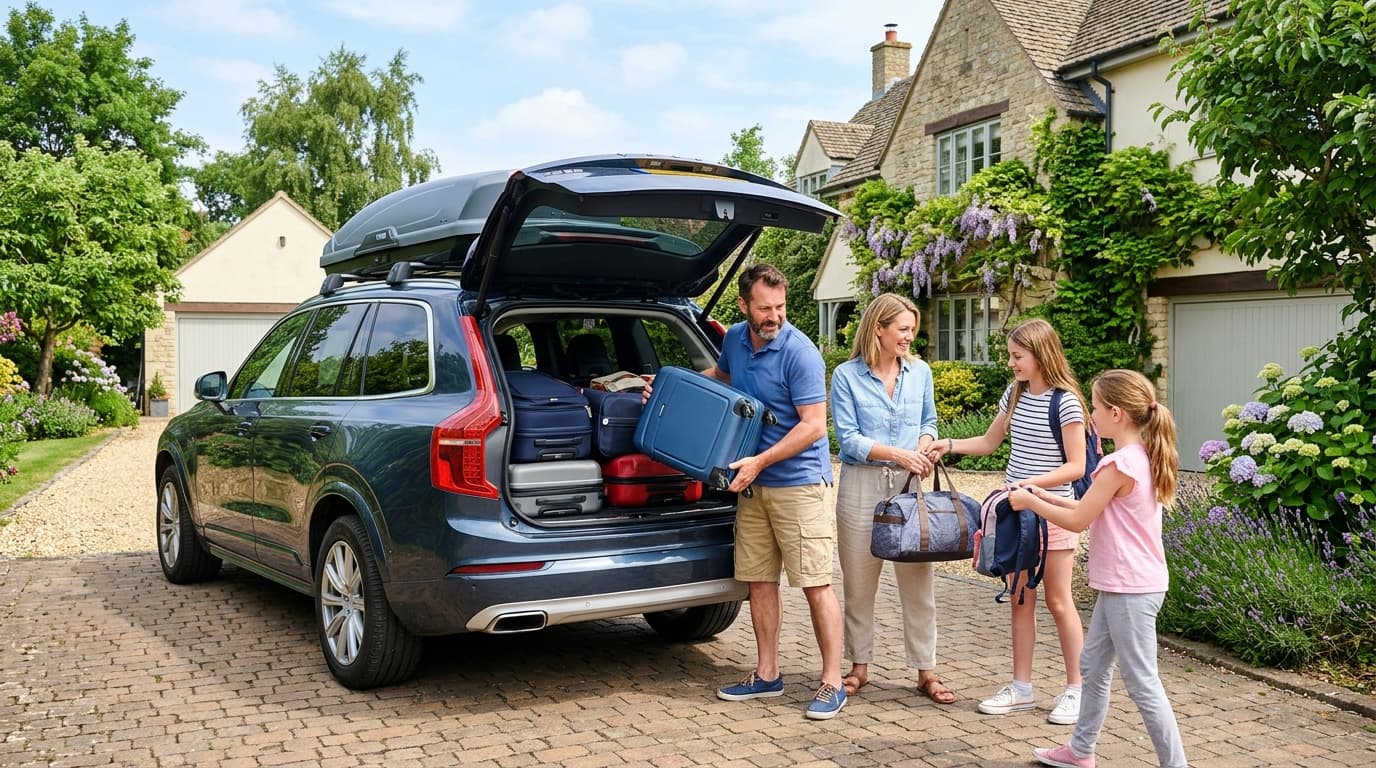
You load the car the night before, the third row is up, and the boot is full after three bags. The questions that follow always arrive in the wrong order: can I put the rest on the roof, am I allowed to, and at what point am I overloaded?
Bottom line: with seven people on board you still have 350 to 420 kg of payload left on most 7-seaters sold in Belgium. Weight is almost never the problem — boot volume always is. The one place where kilos really count is the roof, where 100 permitted kilos shrink fast to 55 usable ones.
How many kilos are left for luggage when seven of you travel?
Between 350 and 420 kg on the mainstream 7-seaters of the Belgian market. Payload on a 7-seater sits around 600 kg, and a family of seven only eats about 225 of them.
That figure surprises people, and the calculation trap behind it is worth spelling out. The mass in running order written on the registration certificate already includes 75 kg of driver and a full tank, by European convention. So you do not deduct the whole family's weight, but the family's weight minus that notional driver.
Take a realistic holiday load: two adults at 78 and 68 kg, a teenager at 55 kg, four children at 32, 27, 22 and 18 kg. Total: 300 kg of occupants. Take off the 75 kg already counted and 225 kg fall on the payload. On a Dacia Jogger with 601 kg of payload, that leaves 376 kg for suitcases, the dog and the bikes. Nobody reaches that figure with holiday luggage.
Where do you read your car's exact payload?
On the registration certificate, by subtracting code G from code F.2. Those two lines are enough, and they belong to your individual car — not to the model.
Code F.2 gives the maximum authorised laden mass of the vehicle in Belgium, what used to be called PTAC. Code G gives the mass in running order. The difference is your real payload, occupants included. On the manufacturer's plate — a metal or adhesive label on the driver's door pillar, under the bonnet or under the boot floor — you will find the same values plus the maximum axle loads. Nobody ever looks at those, and they are exceeded before the MAM when all the weight goes to the back.
Two gaps worth knowing. Payload varies by 50 to 100 kg between two trims of the same model: a sunroof, 20-inch wheels and electric seats are paid for in kilos. And a used car fitted out after delivery (tow bar, roof rack, conversion) has gained weight the certificate never recorded. If you buy used, the subject overlaps directly with what to check on the third row — see Dacia Jogger against the Citroën Berlingo: a reinforced boot floor or a bench added by a coachbuilder changes the numbers.
Residual payload: three 7-seaters sold in Belgium
| Model | Mass in running order | MAM (code F.2) | Payload | Left after 7 occupants (300 kg) |
|---|---|---|---|---|
| Dacia Jogger 1.0 TCe 110 Essential 7-seat | 1,261 kg | 1,862 kg | 601 kg | 376 kg |
| Peugeot E-5008 (electric) | 2,331 kg | 2,940 kg | 609 kg | 384 kg |
| Volkswagen Multivan T7 2.0 TDI 150 short | 2,206 kg | 2,850 kg | 644 kg | 419 kg |
The result runs against intuition: the Jogger, which costs three times less than a Multivan and weighs a thousand kilos less, offers comparable payload. Carmakers size the MAM on the seat count, not on the badge. The Multivan takes back the advantage on volume and towing capacity, never on the payload-to-weight ratio.
The electric case deserves a caveat: the E-5008 weighs over a tonne more than a Jogger because of its battery, and still keeps 609 kg of payload, because Peugeot raised the MAM accordingly. That is not systematic in the class, and it is a figure to check model by model before ordering. For the wider picture, see the best 7-seater cars in Belgium.
What can you actually put on the roof of a 7-seater?
Far less than the advertised figure. The permitted roof load includes the bars, the box and its contents — three items most drivers forget to count.
The Volkswagen Multivan T7 is rated at 100 kg on the roof, which is high for the class; many 7-seaters cap at 75 or 80 kg. Run the full arithmetic on the favourable case: 100 kg permitted, minus roughly 5 kg of crossbars, minus 20 kg for a Thule Motion 3 L box — Thule publishes the empty weight in its product documentation — and 75 kg of luggage remain. Which happens to be exactly the maximum load Thule allows inside that box. On a car limited to 80 kg of roof load, the same setup leaves only 55 kg: two full suitcases and nothing else.
Two practical rules I almost never see written down. The roof rating applies stationary and moving alike, but carmakers often recommend a reduced speed beyond a certain weight, and that information appears only in the manual. And the roof takes bulky, light items: duvets, tent, coats, beach gear. Heavy suitcases stay low, near the centre of gravity, as Touring points out in its loading guide. A heavily loaded roof box raises the centre of gravity of an already tall car — on a 7-seat SUV you feel it in corners within the first few kilometres.
Do you need a special licence to tow a trailer with a 7-seater?
Not necessarily, and the threshold depends neither on the car nor on the trailer taken separately, but on the sum of the two.
The Belgian category B licence allows towing in two cases. First: the trailer does not exceed 750 kg of maximum mass — which covers nearly every luggage trailer and bike trailer you can hire. Second: the trailer exceeds 750 kg, but the combined MAM of car and trailer stays under 3,500 kg. Beyond that you need code 96, an endorsement added to licence B after a 7-hour course, which pushes the combination ceiling to 4,250 kg. Beyond that again it is licence BE. Moniteur Automobile sets out the three cases with the corresponding Belgian formalities.
A worked example makes the boundary readable. A Dacia Jogger, MAM 1,862 kg, hitched to a 1,200 kg trailer: combination at 3,062 kg, licence B is enough. A Volkswagen Multivan T7, MAM 2,850 kg, with the same trailer: combination at 4,050 kg, code 96 required. Two 7-seaters, two opposite answers, for an identical trailer. Exactly the kind of detail people discover at the border rather than at the order desk. These rules are federal: they do not change between Wallonia, Brussels and Flanders.
The actual towing capacity, on the other hand, belongs to the vehicle and appears at codes O.1 (braked trailer) and O.2 (unbraked) on the registration certificate. The Jogger is rated at 1,200 kg braked and 640 kg unbraked. Check both lines before hiring anything: a 1,300 kg trailer stays illegal behind a Jogger even with code 96 in your pocket.
How do you load a 7-seater before setting off?
In seven steps, one hour the night before rather than forty irritable minutes on the morning itself.
- Read F.2 and G on the registration certificate and work out your payload. Note it in your phone once and for all: it will not change.
- Weigh the family, not the suitcases. Add up the occupants' real weights, take off 75 kg, subtract the result from the payload. What remains is your luggage budget.
- Load low, heavy and central. Full suitcases against the back of the third row, as low as possible and as close as possible to the rear axle.
- Keep the roof for bulky and light. Duvets, tent, pushchair, beach gear. Nothing dense, nothing fragile, nothing beyond 75 kg all in.
- Check tyre pressures, laden. The manual gives a "fully laden" value 0.2 to 0.4 bar above the everyday one, and that is the setting that matters with seven on board.
- Secure anything that can move. A loose bag at 50 km/h carries energy proportional to its mass and to the square of the speed — the third row has no bulkhead behind the children's heads.
- Drive 500 metres and check again. Bar torque, roof box latches, straps. That is the moment when mounting mistakes are still free to fix.
What do you risk in Belgium if you are overloaded?
From 50 to 5,000 € for an excess under 500 kg, with immediate collection offered on the spot or referral to the police court.
The Belgian scale then rises in 500 kg steps: 100 to 10,000 € between 500 and 1,000 kg of excess, 175 to 20,000 € between 1,000 and 1,500 kg, and so on. The gap between minimum and maximum reflects the court's discretion, which takes repeat offending into account. The full scale is published on the Belgian side and applies to private cars as well as vans.
Enforcement has changed in nature over recent years. Weigh-in-motion stations measure the weight of vehicles in traffic on the motorway and allow a ticket to be issued without stopping anyone. In other words, not being pulled over no longer means not being checked.
One consequence that gets mentioned rarely weighs more than the fine: after a crash, established overloading can be raised by your insurer as an aggravation of risk. Braking distance lengthens on an overloaded vehicle, and the expert report shows it. On that point, the companion article on Belgian child seat law reaches the same conclusion about how restraints are fitted.
Verdict
Seven of you including children: forget weight, focus on volume. You will have close to 380 kg of payload left and a 200-litre boot — it is the second figure that decides what stays at home.
Seven adults: the calculation tightens to roughly 150 kg of luggage on a Jogger. There, weigh things properly, and look at vans, whose payload is more generous. For the reliability angle on the segment, see the most reliable 7-seat SUV.
Adding a roof box: count 25 kg of tare before the first sock goes in, and check the roof rating in the manual, not on a forum. Between 80 and 100 kg permitted, the difference changes everything.
Hitching a trailer: add the two MAMs before you book. Under 3,500 kg, licence B is enough; above it, the code 96 course has to be planned, not improvised the day before.
The trap to avoid: believing the third row is expensive in weight. It is expensive in litres. A 7-seater loaded to the brim is almost always well under its MAM — unless the roof is loaded, and that is where an inspection turns.
Sources: Belgian registration certificate, codes F.2 (maximum authorised mass), G (mass in running order), O.1 and O.2 (towable masses); manufacturer spec sheets and the L'Argus and Caroom databases for the masses of the Dacia Jogger 1.0 TCe 110 Essential 7-seat (1,261 kg / 1,862 kg), the Peugeot E-5008 (2,331 kg / 2,940 kg) and the Volkswagen Multivan T7 2.0 TDI 150 short (2,206 kg / 2,850 kg, 100 kg roof load); Thule product documentation for the Motion 3 box (empty weight 17 kg in M, 20 kg in L, 23 kg in XL; maximum load 75 kg); Touring, "Charger sa voiture avant les vacances : 8 conseils pratiques" (weight distribution, 5 to 15 % extra consumption with a roof box); Moniteur Automobile, "Tracter une remorque avec un permis B" (750 kg, 3,500 kg and 4,250 kg thresholds, code 96 and its 7-hour course); monamende.be, scale of fines for overloading (50 to 5,000 € below 500 kg of excess); Service public de Wallonie, weigh-in-motion stations. Checked on 18/08/2026. Masses vary by trim and model year: read the ones for your car, never the brochure's. This guide is not legal advice.
Comparator
Compare voitures 7 places side by side.
Compare now →
Frequently asked questions
Sophie teste des voitures familiales depuis 2013, d’abord pour la presse auto belge, aujourd’hui en indépendante depuis le Brabant wallon. Mère de trois enfants, elle juge une 7 places sur ce qui compte vraiment au quotidien : trois sièges-auto qui rentrent de front, le coffre une fois la 3e rangée dépliée, et la hauteur de seuil quand on charge une poussette. Sa règle : un essai sans enfants à bord ne vaut rien.