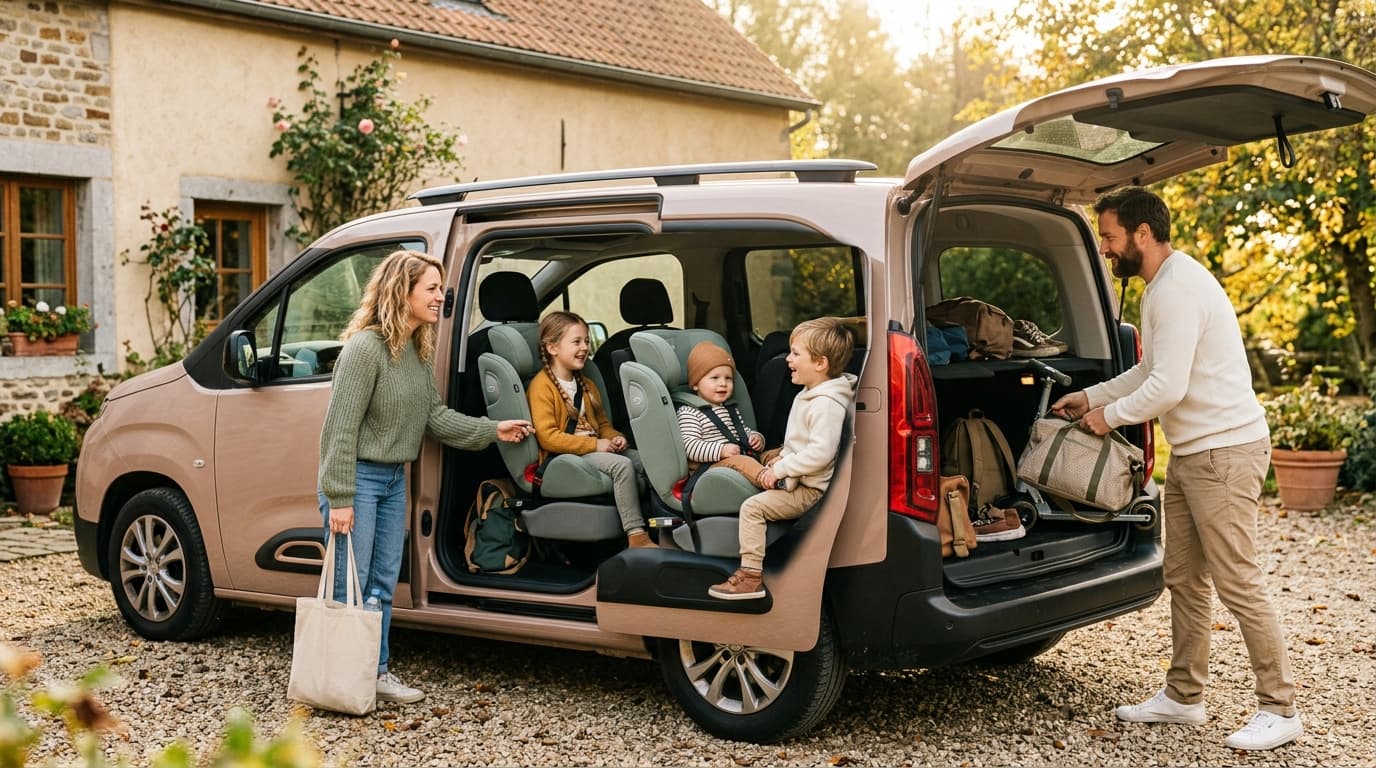
Five words, five factories of origin.
Short answer: leisure activity vehicle, MPV, van, minibus and 7-seat estate do not describe a number of seats. They describe the platform the car came off, and nothing else. The seat count sits in box S.1 of the Belgian registration certificate, and nowhere else.
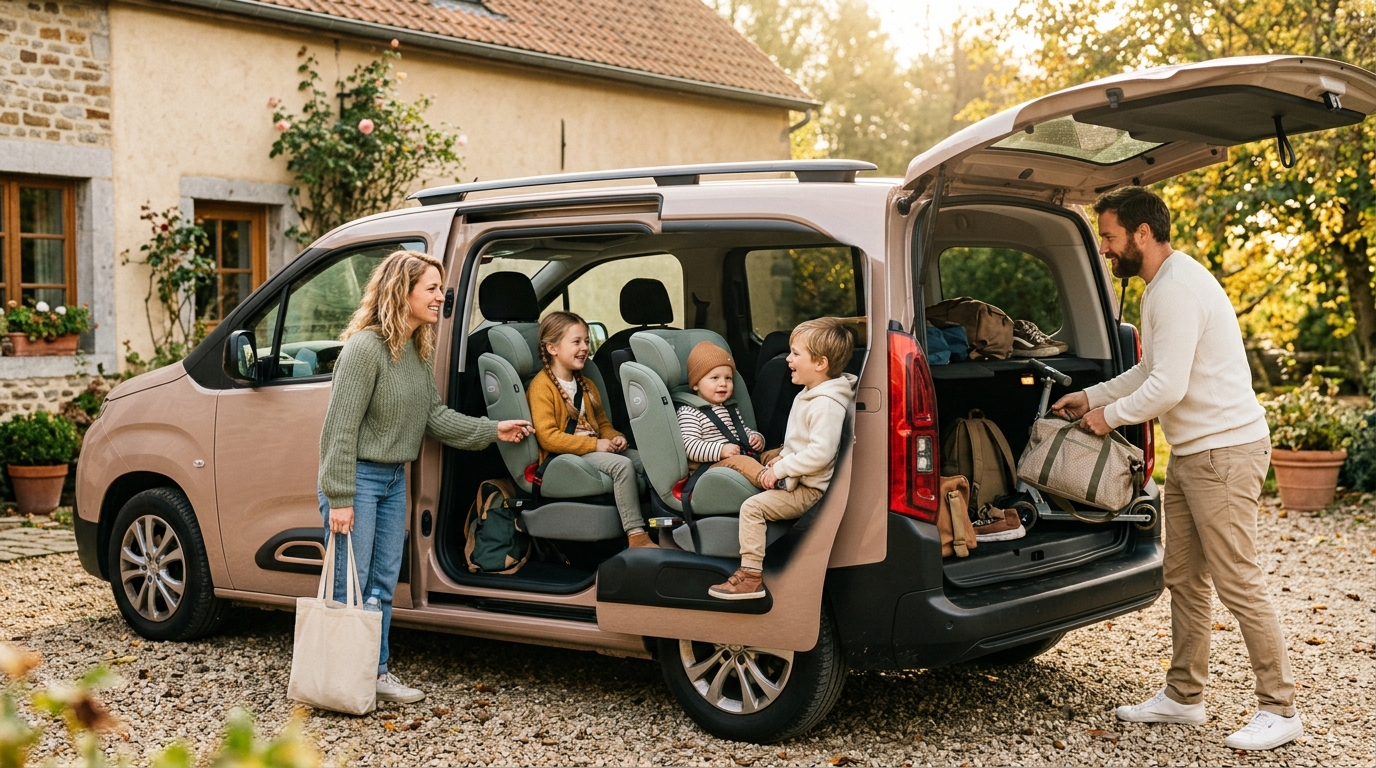
What is a leisure activity vehicle?
A light commercial van dressed as a family car.
French calls it a ludospace, a contraction of ludique and monospace, and the word covers the civilian derivatives of small panel vans: Citroën Berlingo, Peugeot Rifter, Opel Combo Life, Renault Kangoo, Ford Tourneo Connect, Volkswagen Caddy, Toyota Proace City Verso. The Berlingo and the Partner opened the category in 1996, the Kangoo followed a year later, and the recipe has not moved since: a van body, windows, seats and a contained price. Wikipedia carries the clearest definition in circulation.
The origin shows at a glance. Flat floor, generous headroom, hard plastics, sliding rear doors on both sides, and a large rear volume that acts as a sound box on the motorway.
Seven seats, yes, but only on the long version. The Citroën Berlingo XL measures 4,753 mm and the Renault Grand Kangoo 4,911 mm. The short version of the same model stays at five seats, and no option retrofits it after the order is placed.
Leisure activity vehicle or MPV: where does the line fall?
At the factory, not on the road.
An MPV is born on a passenger car platform and stays there: Volkswagen Touran, Renault Scénic and Grand Scénic, Citroën C4 Picasso, Volkswagen Sharan, Ford Galaxy, Opel Zafira, Kia Carens. A leisure activity vehicle is born commercial, sells first to tradespeople, and the family version is a variant of the same shell.
You feel the result on the first long trip, because sound deadening, sill material quality, suspension tuning and cabin noise at 120 km/h are precisely the line items a manufacturer trims when designing a working vehicle meant to run loaded and be replaced after five years.
The leisure activity vehicle gives the money back elsewhere: at equal budget, more habitable volume, three individual second-row seats, and sliding doors.
Van, minibus, combi: the same vehicle under three names?
Almost.
The van derives from a medium commercial vehicle: Volkswagen Multivan and Caravelle, Mercedes V-Class, Ford Tourneo Custom, Peugeot Traveller, Citroën SpaceTourer, Opel Zafira Life, Renault Trafic Combi, Toyota Proace Verso. It runs past five metres, sits high, and climbs to nine seats where an MPV tops out at seven.
Minibus names the same shell in eight or nine seat bench configuration, the one clubs and schools use. Combi is the manufacturer's word for the glazed bench version of a panel van. Three commercial labels, one platform.
The difference that counts turns on two figures, not on the word: type-approved seats and maximum authorised mass. Past nine seats including the driver, or past 3,500 kg, a category B licence no longer covers you, as set out in our piece on the nine-seat threshold.
Are 7-seat estates still on sale?
Not new in Belgium.
The Peugeot 307 SW and first-generation 308 SW, the Dacia Logan MCV and the Renault Mégane Grand Tour offered a fold-out bench sunk into the boot floor. The format has left the new-car ranges, absorbed by the SUV and by the leisure activity vehicle. Those seven seats exist on the used market today, with a third row frankly reserved for children.
The Dacia Jogger is the closest heir to that silhouette, and Dacia itself carefully avoids the word estate.
The word tells you nothing about the boot
Here is the point the five definitions do not settle.
| The word in the advert | Where the car comes from | Possible type-approved seats | To check before signing |
|---|---|---|---|
| Leisure activity vehicle | light panel van, glazed | 5, or 7 on the long body | overall length: the short body never reaches seven |
| MPV | passenger car platform | 5 or 7 | the boot with the last row in use, not the headline figure |
| Van | medium commercial, high floor | 5 to 9 | the maximum authorised mass, which decides the licence |
| Minibus | medium commercial with benches | 8 or 9 | box S.1 and the expiry date on your own licence |
| 7-seat estate | stretched saloon, used market only | 7 | the state of the floor well and the rear belts |
| 7-seat SUV | raised saloon platform | 5 or 7 | third-row headroom |
Then measure. Crossing manufacturer lengths with volumes recorded on six 7-seaters available in Belgium, the boot left once the last row is deployed runs from 137 to 763 litres. A ratio of 5.6 inside a single commercial promise.
| Model | Body style | Length | Type-approved seats | Boot, last row in use |
|---|---|---|---|---|
| Volkswagen Touran (2015) | compact MPV | 4,527 mm | 7 | 137 L |
| Dacia Jogger | raised estate | 4,547 mm | 7 | 160 L |
| Citroën Berlingo XL | long leisure activity vehicle | 4,753 mm | 7 | not published in seven-seat configuration |
| Peugeot 5008 | SUV | 4,791 mm | 7 | 259 L |
| Renault Grand Kangoo | long leisure activity vehicle | 4,911 mm | 7 | not published in seven-seat configuration |
| Volkswagen Multivan L2 | van | 5,173 mm | 5 to 7 | 763 L, measured to the roof |
Two lessons, and the second is the more useful. Twenty millimetres of length separate the Touran from the Jogger, for 23 litres of difference: overall length, which everyone treats as the sovereign indicator, predicts almost nothing. And on the Berlingo XL as on the Grand Kangoo, I looked for the seven-seat volume across manufacturer data sheets, Belgian configurators and press packs: nobody publishes it. A missing figure is rarely a good figure.
Sliding or hinged doors: what changes in the third row?
Everything, day to day.
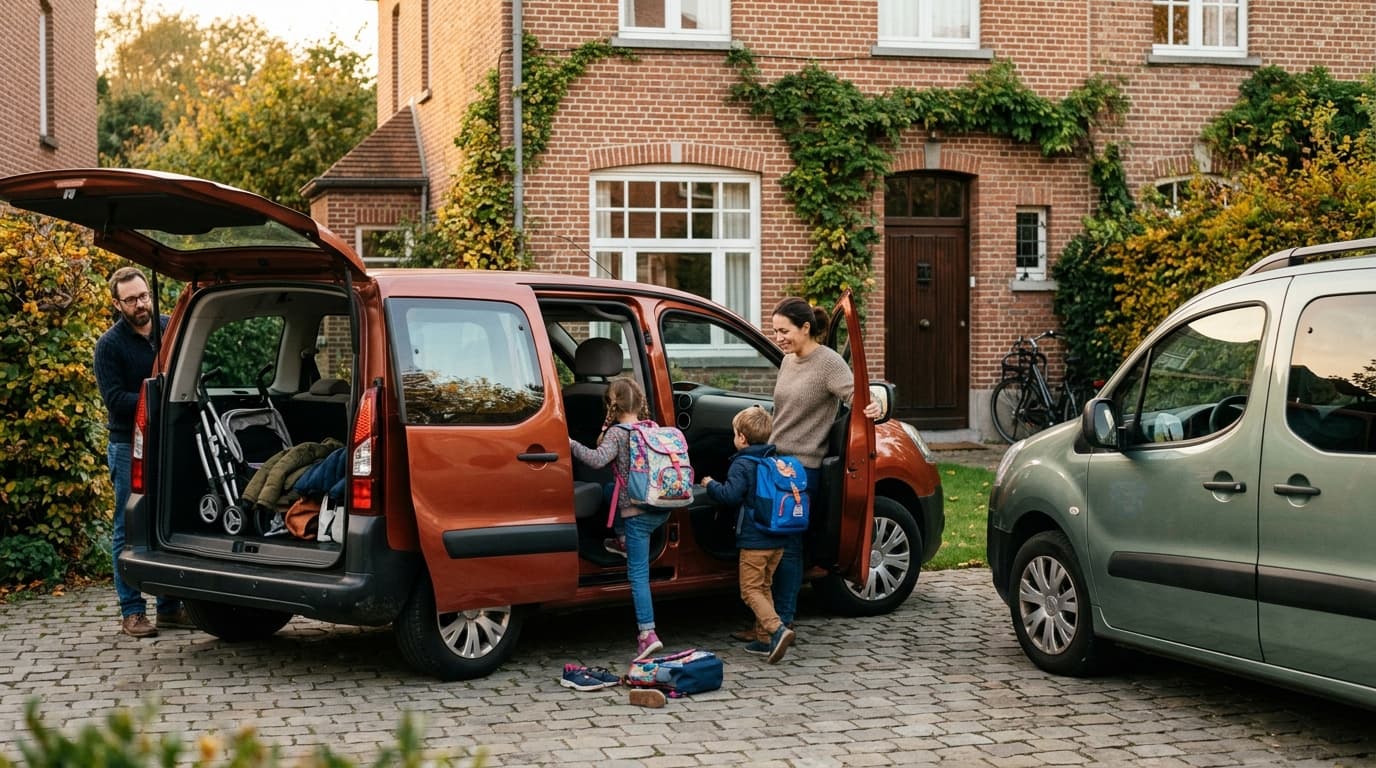
Leisure activity vehicles and vans inherit sliding doors on both sides, because their commercial base needed them. MPVs, estates and SUVs keep hinged doors. In a supermarket car park, the sliding door removes the risk of denting the car alongside and frees the full aperture to tip a seat and climb through to the back. With a child seat in row two, the gap becomes plain.
Does body style change anything by region?
No, and that is good news.
Type approval, seat count and vehicle category definitions are federal matters. A seven-seat Berlingo XL is a seven-seat Berlingo XL in Arlon and in Bruges alike. The low emission zones of Brussels, Antwerp and Ghent judge the Euro standard and the powertrain, never the silhouette.
Body style still comes in through the window, by way of mass. The Walloon registration tax applies a mass term that shuts the heaviest vans out of its large-family reduction, a point we worked through in our calculation of the Belgian registration tax on a 7-seater. The van pays for its commercial platform right down to the tax form.
Six lines to read before signing
The five words are there to sort adverts. They replace none of these six checks:
- box S.1 of the registration certificate, giving the type-approved seating positions excluding the driver;
- the overall length, to know whether you have the short or the long version of the same commercial name;
- the boot volume quoted with the last row IN USE, and the measuring convention behind it;
- the number of Isofix positions row by row, which does not track the number of seats;
- the maximum authorised mass, which governs the licence past nine seats and the tyre load index;
- the rear door type, sliding or hinged, tested once parked tight between two cars.
With the vocabulary settled, the real question is still open: is the third row of the model you have in mind usable by an adult, or only by a ten-year-old for twenty minutes. We measured it on six models in our survey of 7-seaters that really seat seven.
Sources: FPS Mobility and Transport, page on registration plates and certificates, for reading the certificate and box S.1; the federal portal belgium.be, vehicle registration section; Wikipedia, article "Ludospace", for the origin and definition of the term. Overall lengths recorded on 18/09/2026 from manufacturer data sheets: Volkswagen Touran second generation 4,527 mm, Dacia Jogger 4,547 mm, Citroën Berlingo XL 4,753 mm, Peugeot 5008 second generation 4,791 mm, Renault Grand Kangoo 4,911 mm, Volkswagen Multivan T7 L2 5,173 mm. Boot volumes with the last row in use are taken from our own measurements published on this site; the Multivan figure is measured to the roof and is not comparable with the others. No seven-seat volume is published by Citroën or Renault for the Berlingo XL and the Grand Kangoo as at the date of the survey. Dimensions and seat counts vary by trim and conversion: read the ones on your own registration certificate.
Monospaces & vans comparator
Compare all monospaces & vans side by side.
Compare now →
Frequently asked questions
Sophie teste des voitures familiales depuis 2013, d’abord pour la presse auto belge, aujourd’hui en indépendante depuis le Brabant wallon. Mère de trois enfants, elle juge une 7 places sur ce qui compte vraiment au quotidien : trois sièges-auto qui rentrent de front, le coffre une fois la 3e rangée dépliée, et la hauteur de seuil quand on charge une poussette. Sa règle : un essai sans enfants à bord ne vaut rien.