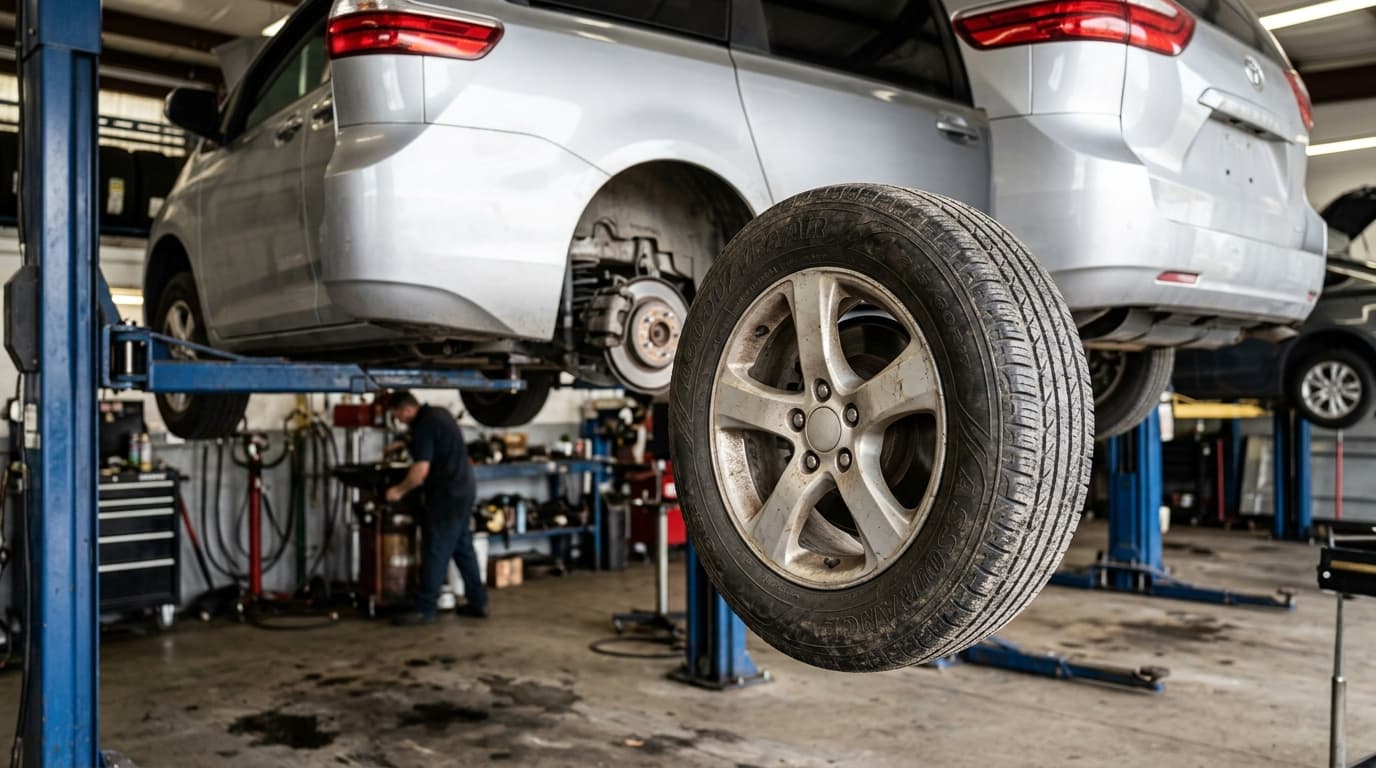
An ordinary tyre carries 615 kilos. A fully loaded Kia EV9 weighs 3,240.
Short answer: the load index is the two or three digit number just before the letter on a tyre sidewall, and it gives the maximum mass that one tyre can support on its own. The heavier the car, the higher the index required. Going below the manufacturer's figure means a fail at the roadworthiness test.
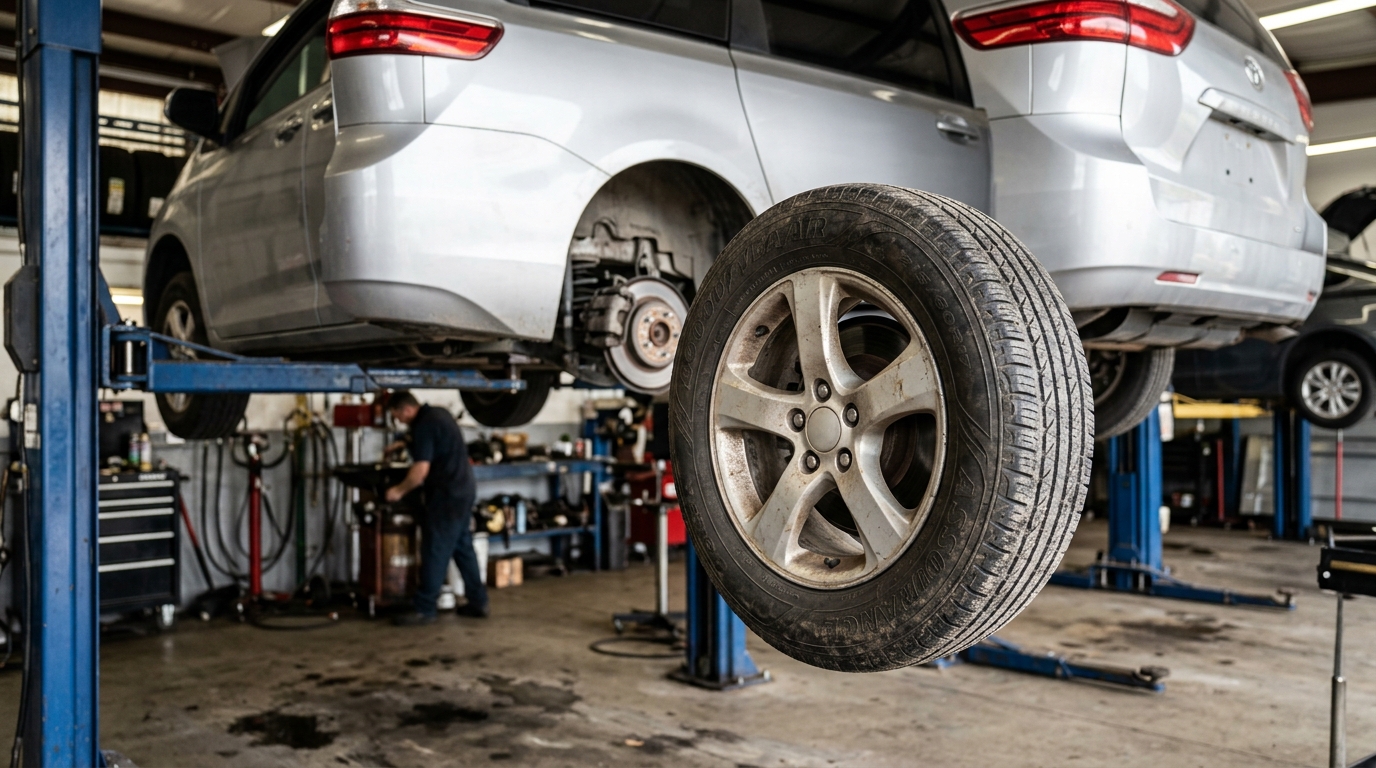
A Kia EV9 weighs 3,240 kg, four index 91 tyres carry 2,460
The arithmetic does not lie.
Index 91, the rating of an ordinary hatchback, corresponds to 615 kg per tyre. Multiply by four and you get 2,460 kg. The maximum authorised mass of a Kia EV9 99.8 kWh GT-Line 4WD is 3,240 kg, on a kerb weight already above 2,660 kg before anyone climbs in: the shortfall is 780 kg, and no inflation pressure, no brand and no argument about real-world use will close it.
That is the part the size charts never mention. A 7-seat electric car or a van carries a mass that left the territory of the ordinary tyre long ago, and the practical consequence lands on replacement day, when two references of the same size sit thirty euros apart and nobody looks at what separates them.
What does the number just before the letter mean?
On a sidewall marked 235/55 R18 104V, the size comes first, then the load index (104) and the speed index (V). The first converts to kilos through a standardised correspondence table, the same one for every manufacturer.
| Load index | Capacity per tyre | Capacity of four tyres |
|---|---|---|
| 91 | 615 kg | 2,460 kg |
| 100 | 800 kg | 3,200 kg |
| 103 | 875 kg | 3,500 kg |
| 104 | 900 kg | 3,600 kg |
| 108 | 1,000 kg | 4,000 kg |
Nine index points separate 91 from 100, and 740 kg separate their four tyres. Michelin publishes the full table if you need an intermediate value.
Why does dividing the mass by four not give the answer?
Because the rule is a product, not a division.
What matters legally is that a tyre's capacity multiplied by two covers the maximum load of the axle it is fitted to. A 7-seater does not spread its mass evenly: with the third row occupied and luggage stacked behind it, the rear axle takes distinctly more than a quarter of the total. The per-wheel average is a floor, never a target.
Four 7-seaters on the Belgian market, four sets of arithmetic
| Model and version | Maximum authorised mass | Average per wheel | Four index 91 tyres | Result |
|---|---|---|---|---|
| Dacia Jogger 1.0 TCe 110, 7 seats | 1,862 kg | 466 kg | 2,460 kg | 32 % margin |
| Peugeot 5008 II 1.2 PureTech 130 GT | 2,140 kg | 535 kg | 2,460 kg | 15 % margin |
| Volkswagen Multivan T7 1.5 TSI Base Long | 2,600 kg | 650 kg | 2,460 kg | 140 kg short |
| Kia EV9 99.8 kWh GT-Line 4WD | 3,240 kg | 810 kg | 2,460 kg | 780 kg short |
The Jogger and the 5008 stay in familiar territory: approved a little over two tonnes at most, they are covered without effort by the standard fitment of a family estate. The Multivan tips over the line. At 2,600 kg approved, four index 91 tyres are already out of the running on arithmetic alone, before anyone mentions a loaded rear axle or a roof box.
The EV9 is a case of its own, and it signals what is coming. A 99.8 kWh battery, four driven wheels, seven seats: kerb weight exceeds that of a site van, and the legal margin closes so far that index 103 leaves only 8 % of cushion against the maximum authorised mass. We measured the same shift when working out the residual payload with seven people on board; the tyre is the other end of that problem.
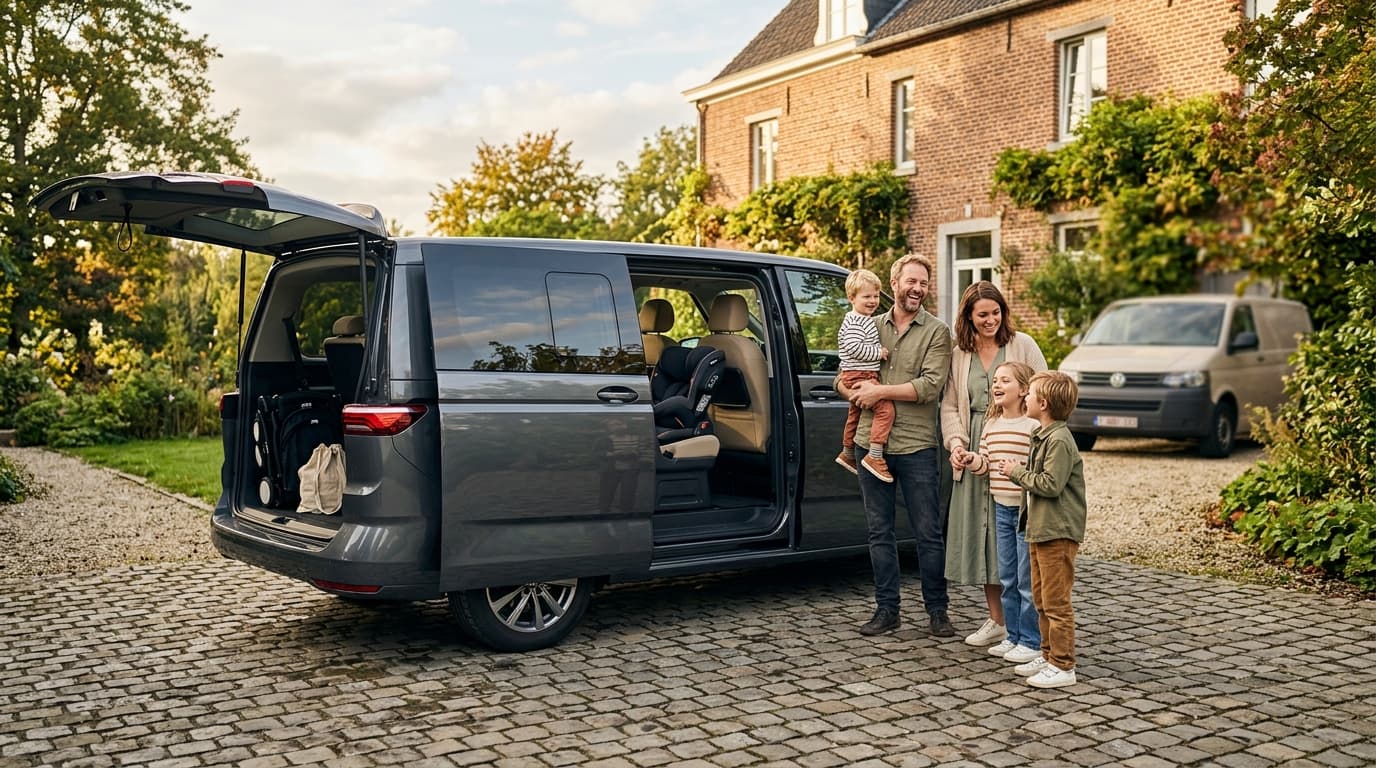
XL, Extra Load, Reinforced: one and the same marking
Three spellings for the same thing. The tyre accepts a higher reference inflation pressure, which raises its load capacity at identical size.
On an MPV or a large 7-seat SUV, that marking is not a comfort extra to be picked or dropped according to budget. When the manufacturer specifies it, it belongs to the vehicle's type approval, exactly like the size.
Can you fit a higher index than the manufacturer's?
Yes, without reservation, and it is often the answer when the original reference is getting scarce. A higher index passes the roadworthiness test; a lower one fails it.
Two qualifications are worth setting down before celebrating. First: a tyre that carries more changes neither the vehicle's maximum authorised mass nor the permitted axle load, because those figures come from the chassis, the brakes and the suspension, not from the rubber. Second, more prosaically: at a high index the sidewall is stiffer, the ride drier on Brussels cobbles, and the children sitting over the rear axle notice it.
The price premium is real, it varies with size and season, and it is checked by comparing two references at the same fitter on the same day. I would rather quote no figure at all than one that will have aged before your next set.
Does the Belgian roadworthiness test fail a low index?
Yes, and the fail is immediate.
Load and speed indices must be at least equal to those specified by the manufacturer. The standard is federal, set by the Royal Decree of 15 March 1968 on the technical conditions of vehicles, and it applies the same way in Wallonia, Brussels and Flanders. Only the running of the centres, their opening hours and their fees have been regional since the sixth state reform, with approved bodies grouped under GOCA. A framed exception exists for the speed index of winter tyres, provided the required sticker is displayed in the cabin; it does not extend to the load index.
Five places to read the index your car requires:
- the European certificate of conformity, permitted tyres section;
- the registration certificate, where the sizes are carried over to it;
- the pressure label stuck to the driver's door pillar;
- the owner's handbook, wheels and tyres chapter;
- the sidewall of the tyres fitted at delivery, if the car is still on its first set.
The workshop objection: "in practice it gets through"
It comes up regularly, and it is not absurd. The argument runs: you drive alone with two children 95 % of the time, the car is nowhere near its maximum mass, and a slightly lower index will never see the load it was ruled out for.
The reasoning holds on average use. It breaks on the two days a year when the car does exactly what you bought it for: seven on board, boot full, motorway to the Ardennes or south, at thirty degrees. That is when the rear axle reaches its maximum load, and that is when tyre temperature climbs. An undersized sidewall does not give way gradually.
There is also a reason with no mechanics in it. After an accident, a vehicle that does not match its type approval hands the insurer a reason to look at the file more closely, and that scrutiny arrives at the worst possible moment. Test Achats sets out Belgian tyre legislation and reaches the same place.
Verdict
Driving a Jogger or a 5008: the issue is minor, just check that the fitter does not drop below the label index to hold an advertised price.
Driving a van or a large electric SUV: the index belongs to the vehicle's spec sheet, not to its options. The Volkswagen ID. Buzz against the Kia EV9 piece shows how far two seven-seat body styles diverge on approved masses.
Buying used: look at all four sidewalls before signing. A mismatched or undersized set points to maintenance done on price, and it adds to the third-row checks to run on the spot.
Still weighing combustion against electric: add tyres to the sum. High indices cost more to replace, and the Kia EV9 against Peugeot E-5008 comparison places the mass gap between those two.
The trap to avoid: believing that a stronger tyre lets you load more. It takes more punishment; the registration document does not move.
Sources: Test Achats, dossier on Belgian tyre legislation (load and speed indices at least equal to the manufacturer's, framed exception for the speed index of winter tyres); Royal Decree of 15 March 1968 laying down general rules on the technical conditions of vehicles; GOCA, regional organisation of roadworthiness testing in Belgium; Michelin, load and speed index correspondence table. Maximum authorised masses taken from manufacturer data sheets and L'Argus technical sheets on 29/08/2026: Dacia Jogger 1.0 TCe 110 seven seats 1,862 kg, Peugeot 5008 II 1.2 PureTech 130 GT 2,140 kg, Volkswagen Multivan T7 1.5 TSI Base Long 2,600 kg, Kia EV9 99.8 kWh GT-Line 4WD 3,240 kg on a kerb weight above 2,660 kg. Index capacities (91 = 615 kg, 100 = 800 kg, 103 = 875 kg, 104 = 900 kg, 108 = 1,000 kg) follow the standardised table. Masses vary by trim, engine and model year: read the ones on your own certificate of conformity. This article replaces neither the vehicle handbook nor the advice of an approved fitter.
Monospaces & vans comparator
Compare all monospaces & vans side by side.
Compare now →
Frequently asked questions
Sophie teste des voitures familiales depuis 2013, d’abord pour la presse auto belge, aujourd’hui en indépendante depuis le Brabant wallon. Mère de trois enfants, elle juge une 7 places sur ce qui compte vraiment au quotidien : trois sièges-auto qui rentrent de front, le coffre une fois la 3e rangée dépliée, et la hauteur de seuil quand on charge une poussette. Sa règle : un essai sans enfants à bord ne vaut rien.