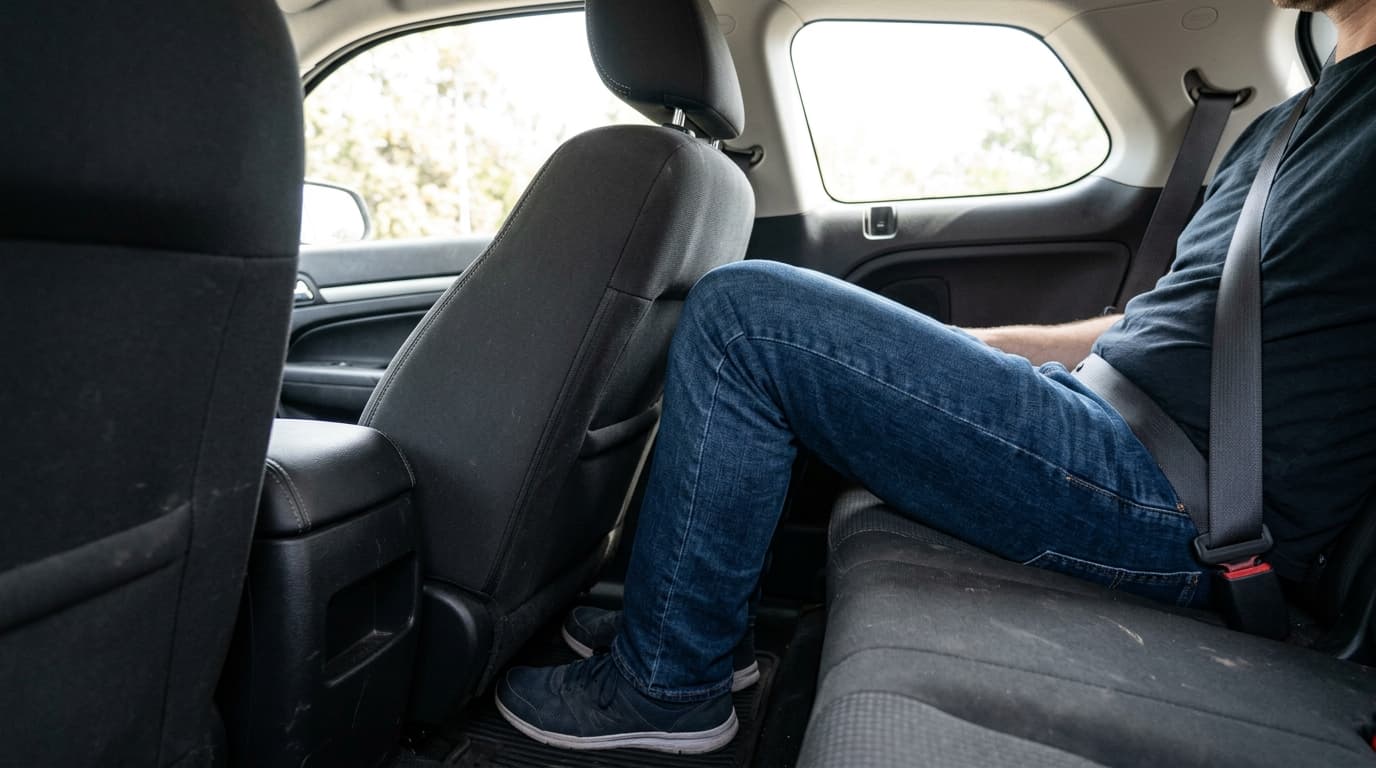
Six cars measured, and one figure decides everything: length.
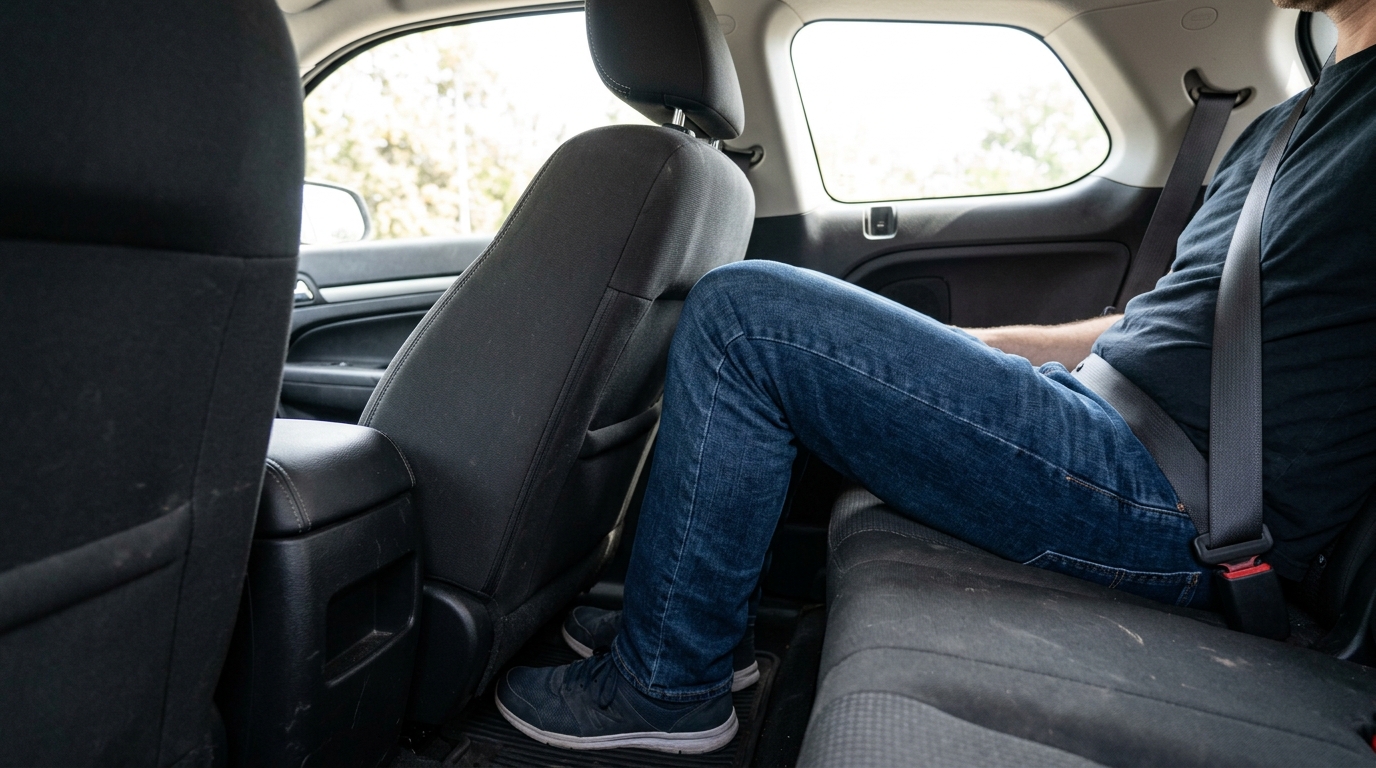
Short answer: a « real seat » in the third row matches no regulatory definition, in Belgium or anywhere else in Europe. The split happens on size. Below 4.75 metres, a third row in use leaves only 137 to 260 litres of boot space, and getting in there costs you a contortion.
485 litres for the X-Trail, with the third row folded
Nissan quotes 485 litres of boot space on the seven-seat X-Trail. The figure is accurate.
It is also measured with the last row stowed into the floor, which means with five people on board. The volume available when all seven seats are genuinely occupied appears neither on the configurator, nor in the brochure, nor in the manufacturer's dimensions table. I looked in all three.
The measurement standard allows that choice, and it makes commercial sense: an X-Trail owner travels five-up almost all year. Except that a parent comparing two lines of a table believes they are comparing the same thing. They are comparing a full boot with a boot stripped of its purpose.
That observation started this survey.
No European regulation defines a « real seat »
You read everywhere that the rules separate real seats from jump seats. They do not.
Type approval counts seating positions, and stops there. The number appears in field S.1 of the registration certificate, it is carried over from the European certificate of conformity, and the manufacturer sets it when the type is approved. No text attaches a comfort rating, a minimum headroom or a minimum distance between a cushion and the seatback ahead of it.
What is regulated applies to every seating position without hierarchy: belt anchorages, seat and seatback strength, head restraints where the position has one. An approved third-row jump seat meets the same anchorage requirements as the driver's seat. On that ground, there is no such thing as a lesser seat.
The consequence runs two ways, and it explains the confusion. A manufacturer who type-approves seven seats is fully entitled to sell you seven seats, whatever the legroom in the last row. And the « 5+2 » label appears on no official document: it is a brochure word, not a category. Two cars approved for seven can differ by twenty centimetres at the back with nothing on paper to separate them.
The Belgian Federal Public Service Mobility and Transport publishes the registration rules: they cover the number of seats, never their quality. On safety, Euro NCAP places its dummies in the first and second rows, never in the third. A five-star rating therefore says nothing about what happens in the last row, and family marketing rarely volunteers that point.
How much boot space is left with seven seats in use?
Between 137 and 763 litres, and the spread tells the whole story of the segment.
I took six models available in Belgium, shortest to longest, and set side by side two volumes that spec sheets rarely publish together: the boot with the third row unfolded, and the same boot once that row is stowed.
| Model | Length | Third row in use | Third row folded | Loss per seat unfolded |
|---|---|---|---|---|
| Volkswagen Touran (2015) | 4,527 mm | 137 L | 834 L | 349 L |
| Dacia Jogger | 4,547 mm | 160 L | 607 L | 224 L |
| Nissan X-Trail 7-seat | 4,680 mm | not published | 485 L | not calculable |
| Škoda Kodiaq | 4,758 mm | 340 L | 845 L | 253 L |
| Peugeot 5008 | 4,791 mm | 259 L | 748 L | 245 L |
| Volkswagen Multivan L2 | 5,173 mm | 763 L | 2,171 L | not comparable |
Three things jump out.
The first is the empty cell. The X-Trail is the only car here that publishes no volume with its seven seats occupied, and that silence says more than any number: when a manufacturer holds a good result, it prints it.
The second is the unit cost of a seat. Unfolding the third row of a Touran costs 349 litres per seat, against 224 on a Jogger and 245 on a 5008. The gap has nothing to do with generosity. It comes from the depth of the well cut into the floor to house the seat: the thicker and taller the seat, the bigger the hollow it frees, and the harder the boot collapses when it comes back up.
The third is a reading trap. The Multivan's 763 litres are measured up to the roof, not up to the parcel shelf like the rest. The value is correct, it is simply not comparable with the five lines above it, and Volkswagen Commercial Vehicles states as much in its technical information. Lining these figures up without saying so distorts every van-versus-SUV comparison.
That leaves the question nobody asks: 259 litres, what does that actually look like? Peugeot gives the useful unit rather than the volume, and it is the most honest data point I found during this survey: 42 centimetres of boot length behind the third row of the 5008. A standard cabin suitcase is 40 centimetres deep. One fits, upright, and nothing goes behind it.
The threshold reads at 4.75 metres
The table draws a clear step, and it falls between the X-Trail and the Kodiaq.
Below 4.75 m, the third row exists at the boot's expense: you top out at 260 litres, usually well under. Above it, the volume nearly doubles and access stops being acrobatic, because the extra centimetres go first into the wheelbase.
There is nothing official about this threshold. It is a field observation drawn from six models, and a 4.55 m Jogger partly contradicts it by taking two adults for an hour. It remains the best first filter I know.
1.60 metres, the limit Nissan writes down
Manufacturers often tell the truth. In small print, and rarely in the same place twice.
Nissan states that the X-Trail's third row suits occupants up to 1.60 m. Dacia presents the Jogger's as suitable for two children up to twelve, or for adults on journeys under an hour, and publishes its full dimensions. Two different wordings, one shared admission.
A twelve-year-old averages 1.50 m and grows six to eight centimetres a year. A car bought for its seven seats when the eldest is ten will therefore have five usable seats by the time that child turns fifteen, before the warranty has even run out. That is the calculation I would redo if I were choosing today, and it pushes towards the larger size far more reliably than a thirty-minute test drive.
How do you check this yourself at the dealership?
With a tape measure and ten minutes, the spec sheet becomes irrelevant.
The test that settles it is always the same: set the second row where it will actually live, not slid fully back for the demo, then sit behind it. Almost every 5+2 earns its third row by moving the second row fifteen centimetres forward, which shifts the problem onto the middle children rather than solving it.
Six things to check on site, in this order:
- the distance between your knee and the seatback ahead, with the second row at its working position;
- the height between cushion and roof lining, sitting upright, cap included;
- the cushion height above the floor: under 25 cm, thighs dangle and the trip turns unpleasant within half an hour;
- the number of Isofix positions per row, counted physically rather than read off a brochure;
- the presence of ventilation, a power socket and lighting at the rear, missing on many compact SUVs;
- the remaining boot length, measured from tailgate to the back of the last row.
On a used car, the list grows by everything the folding mechanism may have taken over five years. We set it out in the third-row checks to run before buying.
Is the five-seat version of the same model the better buy?
Often yes, and that is the least popular conclusion of this survey.
Kodiaq, 5008, Tiguan, X-Trail, DS 7: most are sold in five and seven-seat form, and the decision turns on one question. How many times a year will you genuinely carry six or seven people? Below roughly ten trips, the five-seat version gives a deeper boot, a flat floor with no hump, lower weight and a lower purchase price.
Above that, or as soon as a regular school car pool enters the picture, the third row pays for itself quickly. There is a resale argument too: on the Belgian used market, a seven-seat version finds a buyer more easily, which offsets part of the initial premium.
And if your real need is three children on one bench rather than seven passengers, the question is not rows but width: we covered it in the article on three child seats across.
Verdict
You want seven genuinely usable seats: start at 4.75 m of length and go up. Below that, you are buying a five-seater that copes with seven.
You go on holiday seven-up: look at the boot with the third row unfolded, never the other number. Under 200 litres, a roof box stops being optional.
You travel seven-up three times a year: take the five-seat version and rent a van for the departures. The maths almost always favours it.
Your children are over ten: skip straight to an MPV or a van. Our ranking of 7-seaters on the Belgian market sorts them by size rather than by badge.
The trap to avoid: confusing seven approved seats with seven habitable ones. The registration certificate counts, it does not judge.
Sources: Belgian FPS Mobility and Transport, registration rules and field S.1 of the certificate (number of seating positions set at type approval, driver included); Euro NCAP, test protocols placing dummies in the first and second rows; Volkswagen Commercial Vehicles Belgium, Multivan technical information (763 litres behind the third row, measured to the roof, 5,173 mm long-wheelbase version); Dacia, Jogger dimensions page (4,547 mm, 160 litres in seven-seat mode, 607 litres in five-seat mode). Volumes and lengths taken from manufacturer and press technical sheets on 30/08/2026: Volkswagen Touran 4,527 mm, 137 L and 834 L; Nissan X-Trail 4,680 mm, 485 L published with the third row folded, occupants quoted up to 1.60 m; Škoda Kodiaq 4,758 mm, 340 L and 845 L; Peugeot 5008 4,791 mm, 259 L, 748 L and 42 cm of boot length behind the third row. Volumes vary by trim, powertrain and model year, and measurement standards differ between manufacturers: check the figures for the exact version you are considering.
SUV 7 places comparator
Compare all suv 7 places side by side.
Compare now →
Frequently asked questions
Sophie teste des voitures familiales depuis 2013, d’abord pour la presse auto belge, aujourd’hui en indépendante depuis le Brabant wallon. Mère de trois enfants, elle juge une 7 places sur ce qui compte vraiment au quotidien : trois sièges-auto qui rentrent de front, le coffre une fois la 3e rangée dépliée, et la hauteur de seuil quand on charge une poussette. Sa règle : un essai sans enfants à bord ne vaut rien.