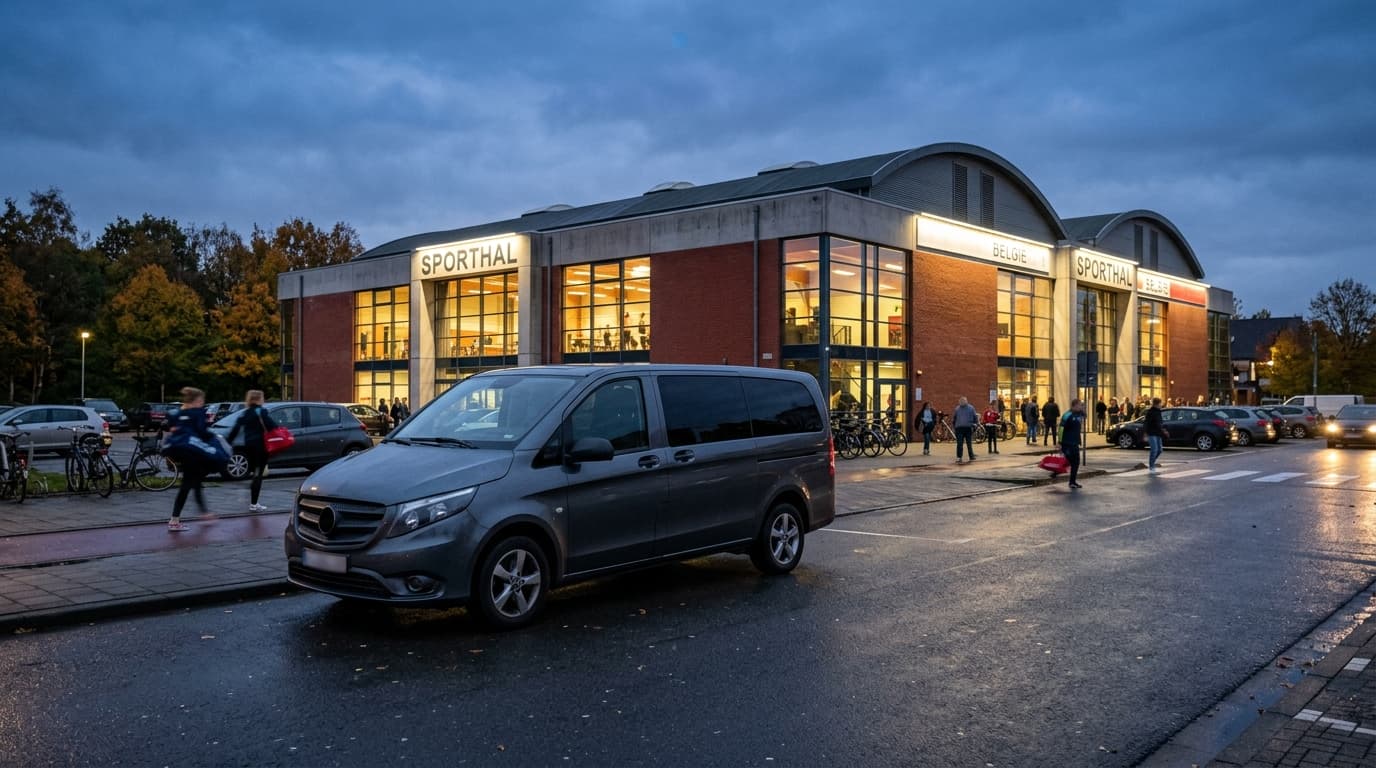
Eight passengers, not nine.
Short answer: in Belgium a category B licence covers a vehicle of nine seats at most, driver included, provided its maximum authorised mass stays under 3,500 kg. The two conditions stack. One passenger more and you need a D1.
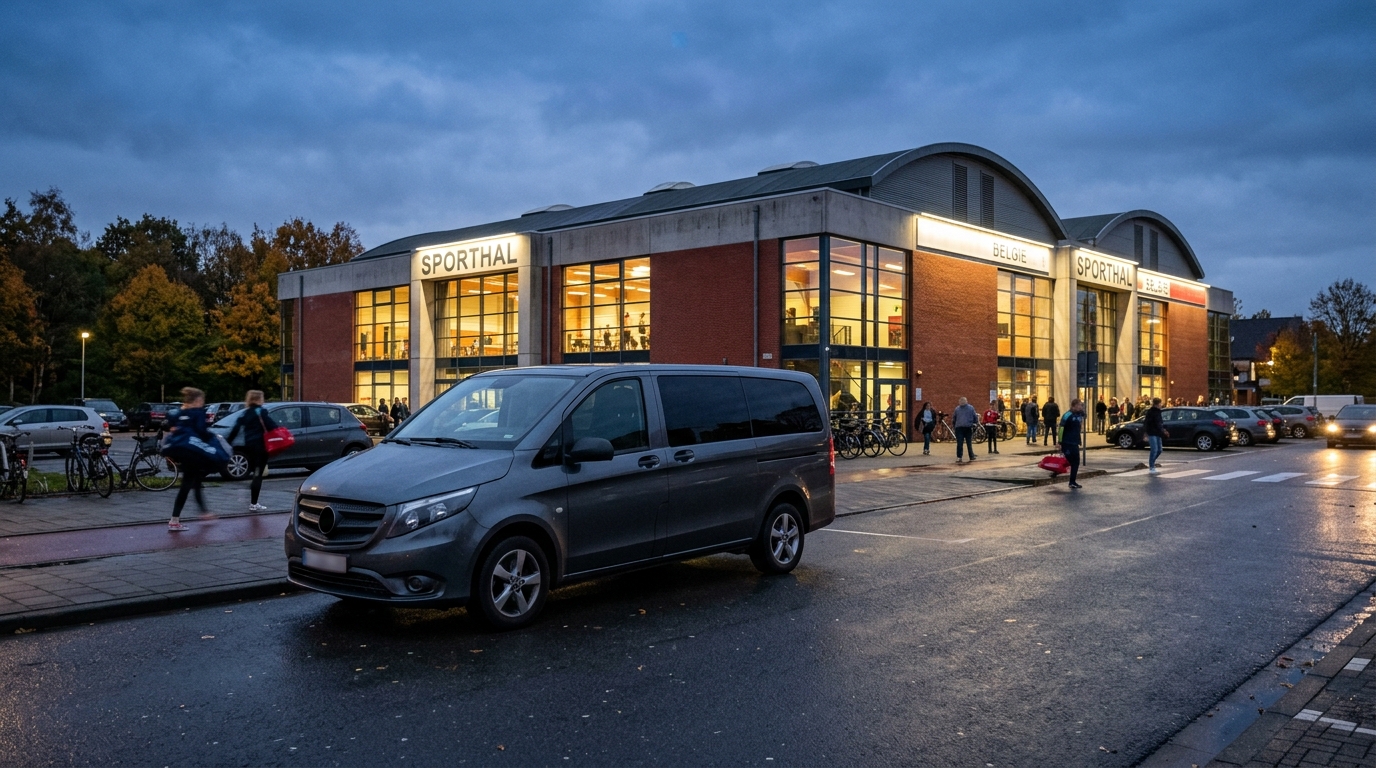
Nine seats means eight passengers and you
The ambiguity comes from the counting. A manufacturer, a rental firm and a classified ad all write "9 seats" with the driver's seat included, while the legal definition counts passengers besides the driver. Eight on one side, nine on the other, for the same vehicle.
The misunderstanding costs nothing until someone adds a ninth head. On the Thursday evening when the coach hands you the club shuttle with nine players to load, it costs you your insurance cover and your licence.
| The vehicle | Passengers besides the driver | Licence required | What else you need |
|---|---|---|---|
| 7 or 8 seats, under 3,500 kg | 6 or 7 | B | nothing |
| 9 seats, under 3,500 kg | 8 | B | nothing |
| 9 seats, above 3,500 kg | 8 | C1 | group 2 medical exam, licence valid 5 years |
| 10 to 17 seats, up to 8 m long | 9 to 16 | D1 | age 21, group 2 medical exam |
| More than 17 seats or more than 8 m | more than 16 | D | age 24, group 2 medical exam |
| Paid journey, whatever the seat count | depends on the vehicle | the matching licence | regional paid-transport authorisation |
Is a category B licence enough for a 9-seat minibus?
Yes, and with no extra formality.
The Belgian Federal Public Service Mobility and Transport defines category B as a vehicle whose maximum authorised mass does not exceed 3,500 kg, designed and built to carry no more than eight passengers besides the driver. A Ford Tourneo Custom 320, a Peugeot Traveller, a Citroën SpaceTourer, a Renault Trafic Combi, a Toyota Proace Verso, a Volkswagen Caravelle or an Opel Zafira Life in nine-seat configuration all fall into that box.
Two caveats, rarely read. A trailer above 750 kg pushes you to code 96 or to category BE, worked through in our calculation of the payload of a seven-seater. And the ninth seat cannot be improvised: adding a bench to a panel van requires type approval, without which the seat does not legally exist.
A 9-seater over 3.5 tonnes: which licence?
C1, not D1. The distinction catches everyone out, and it makes sense once stated: the border between B and C1 turns on tonnage, the border between C and D on passenger count. A vehicle for eight passengers at most stays in the C family whatever its mass, and Belgian category C1 covers the 3,500 to 7,500 kg band.
The trap is real on the bigger body styles. A Mercedes Sprinter Tourer nine-seater can be ordered either approved at 3,500 kg, drivable on a category B licence, or in a heavier version running up to five tonnes of maximum mass, which then demands a C1, with a medical exam and a five-year licence attached. Same bodywork, same seat count, two different licences.
At Ford, the number planted in the middle of the version name gives it away: a Tourneo Custom "320" is approved at 3,200 kg, a "340" at 3,400. The 320 L1H1 nine-seater weighs 2,362 kg empty, leaving 838 kg of payload. Nine occupants counted at 75 kg use up 675. That leaves 163 kg for the kit bags, and that is where the licence stops being the problem.
When do you need a D1 licence?
From the ninth passenger.
The D1 licence covers vehicles designed to carry more than eight and at most sixteen passengers besides the driver, with length capped at 8 metres. A fifteen-seat school minibus, a seventeen-seat club shuttle, a care-home vehicle: all of them sit in D1.
The minimum age is 21. You can sit the theory test from 17 years and 9 months and hold a provisional licence at 18, but the full licence then carries code 121: until the age of 20, driving is limited to regular transport on Belgian territory and to journeys under 50 km; between 20 and 21, the limit falls back to Belgian territory alone. The code is removed at your local council once you turn 21.
What does a D1 licence cost in Belgium?
The test fees are modest. The training is not.
Since 1 January 2026, the fee schedule applied in examination centres sets the category C and D theory test at €23, the full D1 practical test at €69, the public-road element alone at €57, and lodging an appeal at €12.50 for categories other than B. Figures taken on 6 September 2026 from the fee schedule published by an approved centre. Fees have been a regional matter since the sixth state reform: check the one that applies at your own centre before booking.
The heavy line is elsewhere. Driving hours on a category D vehicle cost far more than a car lesson, and the rate varies enough between schools that a single figure would mislead you. Get three quotes.
Is a medical exam required to drive a 9-seater?
Not on a category B licence.
D1 and C1, yes. Both fall under group 2, which requires an examination by an approved doctor and a fitness-to-drive certificate valid for five years at most. The doctor may shorten that period, never extend it.
Can you be paid for a journey in a 9-seater?
Here the answer changes by region, and it changes completely.
Paid transport of people in a vehicle of fewer than nine seats is a regional competence, not a federal one. In Wallonia you need an access-to-profession certificate issued by the Government, then an operating licence from the municipality. In Brussels, the chauffeur-driven car hire authorisation is issued by Brussels Mobility. In Flanders it is the IBPV authorisation, for individueel bezoldigd personenvervoer. A Brussels licence is not valid in Flanders, and the reverse holds too.
Parents sharing costs as they take turns driving children to football is not, in principle, paid transport. The line turns on whether a profit is made, and it is worth checking with your municipality or region before setting up a rota with financial compensation.
The club van, Thursday evening
Five lines to read before turning the key:
- the number of approved seats, on the registration document, rather than the number of seats you count by eye;
- the vehicle's maximum authorised mass, in the same document, to know whether you are on the B side or the C1 side;
- the categories printed on the back of your own licence, and their expiry date for D1 and C1;
- the vehicle's insurance certificate, checking that an occasional driver is covered;
- the belts and head restraints of the last row, because an approved seat without a working belt is not a usable seat.
The licence is only the first question. Once it is settled, the ones this site has been asking from the start remain: who actually fits in the third row of a seven-seater that really seats seven, what load index the tyres of a two-and-a-half-tonne van demand, and how far apart two body styles everyone thinks are interchangeable really sit.
Sources: Belgian Federal Public Service Mobility and Transport, pages on category B, categories C, C1, CE and C1E, and categories D, D1, DE and D1E; age conditions and code 121 for the D1 licence as published by approved examination centres and regional portals; examination fee schedule in force since 1 January 2026, taken on 06/09/2026 (C and D theory €23, full D1 practical €69, public-road element alone €57, appeal €12.50); SPW Mobilité et Infrastructures for professional competence (code 95) and the five-year validity of the group 2 medical examination; Wallonie.be, Brussels Mobility and the Flemish IBPV rules for paid transport of fewer than nine people. Manufacturer masses and dimensions taken on 06/09/2026: Ford Tourneo Custom II 2.0 EcoBlue 130 320 L1H1 nine seats, 2,362 kg empty for 4.97 m long; Mercedes Sprinter Tourer nine seats available at 3,500 kg and in heavier versions. Masses and seat counts vary by trim and conversion: read the ones on your own registration document. This article replaces neither legal advice nor the regional rules that apply to your situation.
Monospaces & vans comparator
Compare all monospaces & vans side by side.
Compare now →
Frequently asked questions
Sophie teste des voitures familiales depuis 2013, d’abord pour la presse auto belge, aujourd’hui en indépendante depuis le Brabant wallon. Mère de trois enfants, elle juge une 7 places sur ce qui compte vraiment au quotidien : trois sièges-auto qui rentrent de front, le coffre une fois la 3e rangée dépliée, et la hauteur de seuil quand on charge une poussette. Sa règle : un essai sans enfants à bord ne vaut rien.