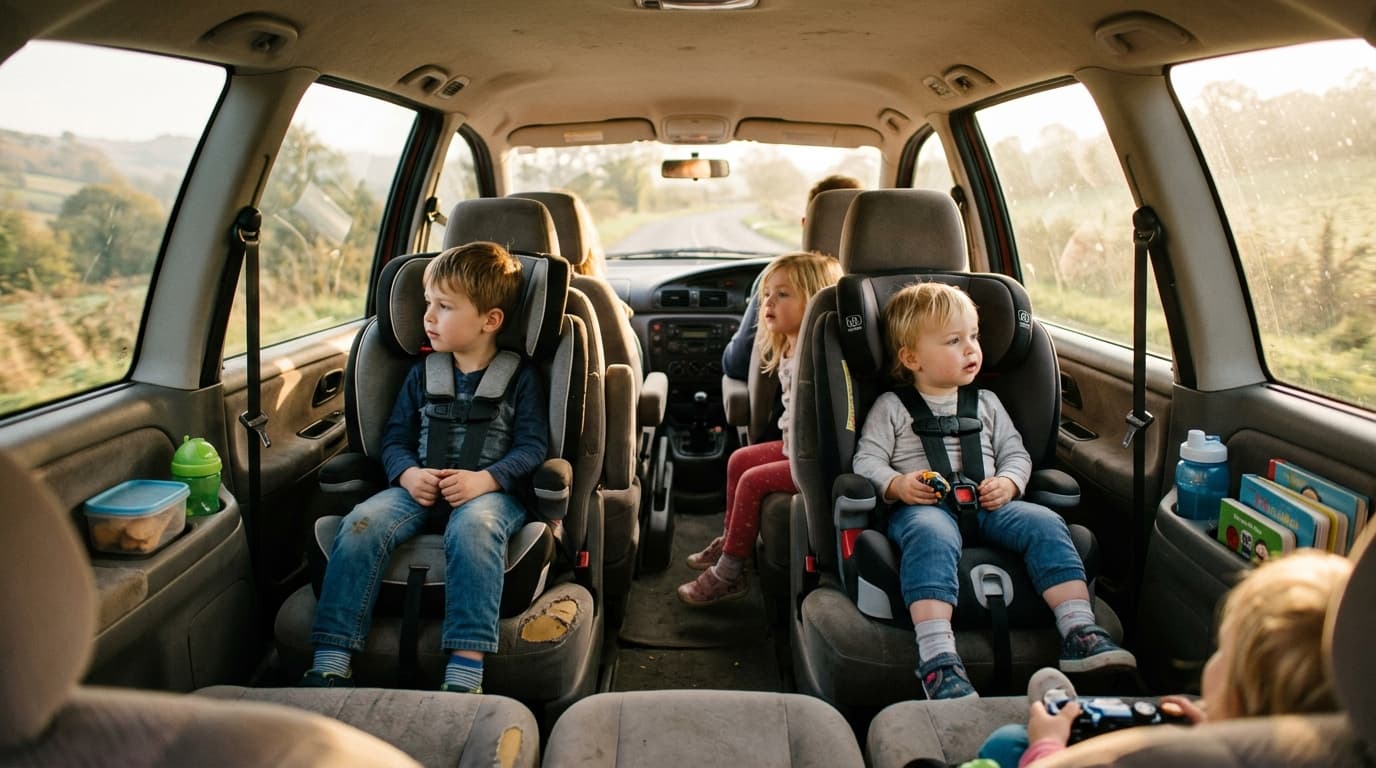
You have three children, two child seats that refuse to share a bench, and you are wondering whether a 7-seater solves the problem legally or only in your head. Belgian law on carrying children fits in a few lines, but none of the guides repeating it ever gets down to the concrete case of a three-row vehicle.
Bottom line: in Belgium every child under 1.35 m needs a full seat, a belt and an approved restraint. A 7-seater therefore gives you up to six legal child positions, but the number of child seats you can actually install depends on your model's Isofix anchor points, not on the law.
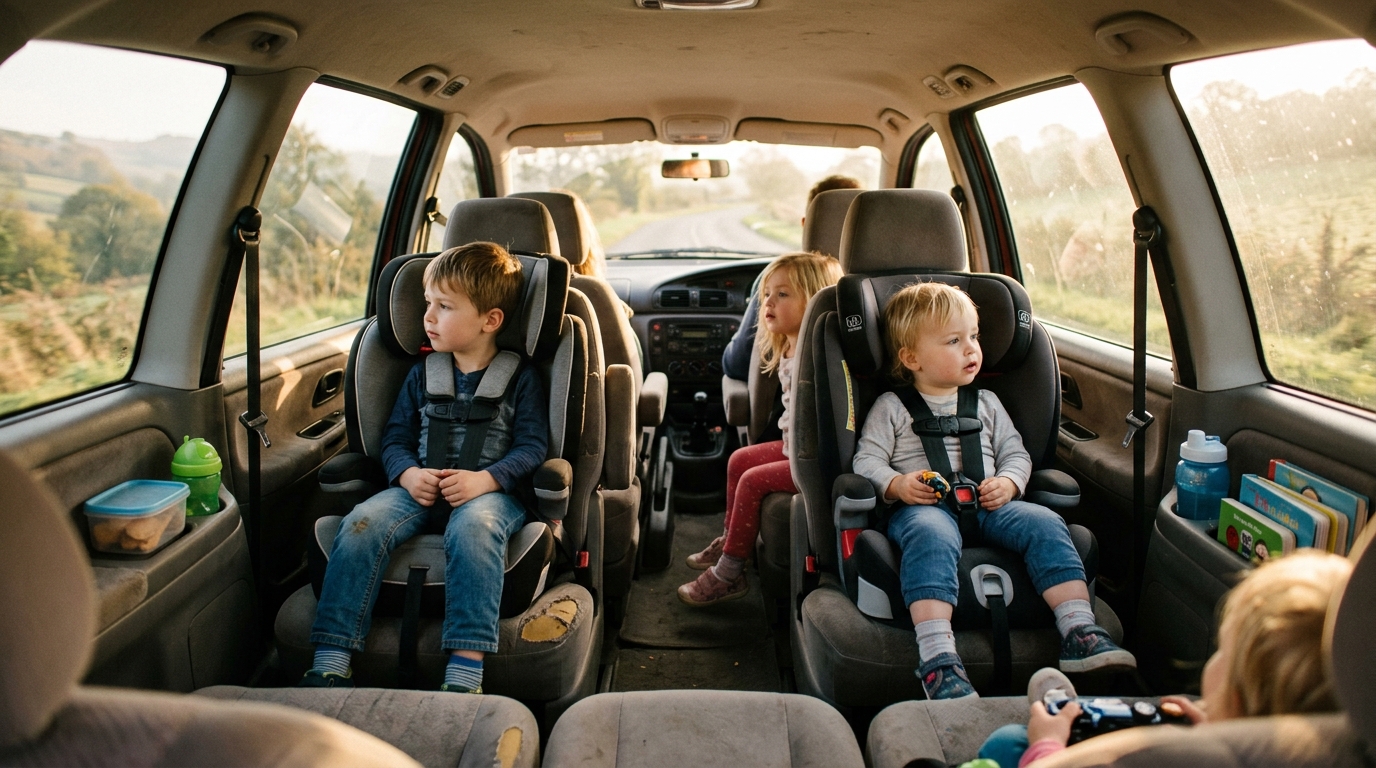
How many child seats fit in a 7-seater?
As many as there are positions with a belt and compatible anchor points. The law sets no ceiling on child seats: it requires one seat and one belt per child. The carmaker, not the legislator, limits what you can install.
The Belgian rule comes from EU directive 2003/20/EC of 8 April 2003: a child takes a full seat. Three children do not share two belts, a child never travels on an adult's lap, and a bench approved for three stays a bench for three however small the children are. On a 7-seater that gives six usable passenger seats, split between a second row of two or three and a third row of two or three depending on the model.
Where the maths gets complicated: an i-Size approved seat needs Isofix anchor points, and carmakers do not fit them everywhere. A 7-seater advertising six rear seats may offer only two Isofix positions. The table below shows the gap between three models sold in Belgium. If your starting problem is fitting seats side by side, I covered that case separately in three child seats across a 7-seater.
What exactly does Belgian law say about children in cars?
Every child under 18 and shorter than 1.35 m must travel in an approved restraint suited to their size. Above 1.35 m, the vehicle's own seat belt is legally enough.
The criterion is height, never age, which surprises a lot of parents. A nine-year-old measuring 1.28 m is still legally tied to a booster; an eight-year-old who has shot up to 1.37 m is not. The Vias institute, Belgium's road safety reference centre, notes that no distance waives the rule: the school run counts as much as the drive down to Bordeaux. The local police put it in the same terms.
Two details the general guides skip. A backless booster is only allowed in Belgium from 1.25 m and 22 kg, roughly age 5 or 6, and it protects less well than a high-back model. And the standard has moved: R44-04 has not been sold new in the EU since 1 September 2024, replaced by i-Size R129, in force since 9 July 2013 and based on height rather than weight. An R44-04 seat you already own stays legal on board.
Is there an exemption for the third child in a 7-seater?
Yes, and it was written for this kind of vehicle. Article 35.1.2 of the road code allows, in a vehicle with a maximum of eight seats besides the driver's, a third child aged 3 or over and shorter than 1.35 m to travel on the seat belt alone, in the rear.
The exemption kicks in when two restraints already occupy the bench and a third will not fit. It is narrow, and its three conditions often fail at the worst moment: the child must have turned 3, must be in the rear, and the vehicle must not exceed eight seats besides the driver. A 7-seater qualifies. A ten-seat minibus does not.
The practical trap, with children: this exemption never applies to the youngest. An 18-month-old can never travel without a seat, exemption or not. A family of three with a baby therefore has to find three genuine seat positions, and that is exactly where choosing a model becomes a legal decision as much as a purchase. Worth noting too: in taxis and occasional public transport, children over 3 may travel belted without a seat if none is available — an exception that does not extend to your own car.
Can you fit a child seat in the third row?
Often no, and this is the blind spot of every 7-seater comparison. The law allows it as soon as the position has a belt, but the carmaker must have approved the rearmost row to take a restraint — and many have not.
The clearest case is the Skoda Kodiaq. Its third row has no Isofix anchor points and is approved for no child seat, boosters included. An SUV sold as a family car, with a 7-seat option costing between 2,500 and 3,500 €, whose rearmost row can legally carry only passengers over 1.35 m. At the other end, the Volkswagen Multivan T7 fits Isofix and i-Size, top tether included, to all five rear seats: up to five child seats in one car. In between, the Dacia Jogger offers two Isofix points on the outer second-row seats, and a rearmost row where seats can only be belted in.
The habit that prevents the mistake: open the seat maker's vehicle compatibility list before buying, not after. Maxi-Cosi, Britax Römer and Joie all publish one, model by model, position by position. It will tell you in thirty seconds whether the seat you want is approved for the rear of your car — something the showroom salesperson almost never has to hand.
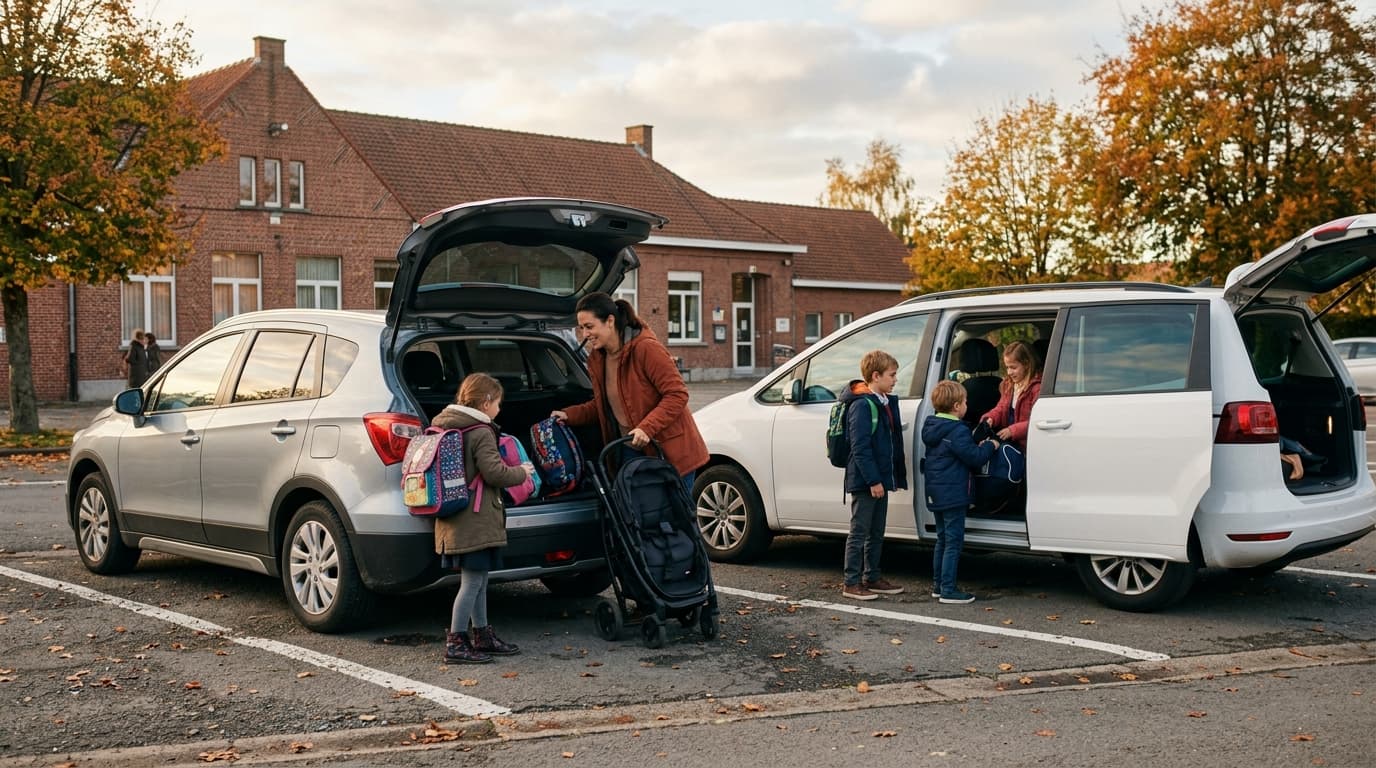
Isofix positions by model sold in Belgium
| Model | Isofix, second row | Isofix / approval, third row | Child seats installable | Seats |
|---|---|---|---|---|
| Volkswagen Multivan T7 | 2 individual seats, Isofix + i-Size + top tether | 3-seat bench, Isofix + i-Size | up to 5 | 7 |
| Skoda Kodiaq | 2 outer seats, Isofix + top tether | no anchor points, row not approved for child seats | 2 | 7 (option) |
| Dacia Jogger | 2 outer seats, Isofix (nothing in the centre) | 2 seats, belt fixing only | 2 on Isofix, +2 belted subject to compatibility | 7 |
The figure that matters for a family with three young children: the Multivan is the only one of the three that takes three harnessed seats without improvising. That is not a size effect, it is an approval choice — Volkswagen certified its rear seats, Skoda did not. The Kodiaq's used-market case is covered here: Seat Tarraco versus Skoda Kodiaq. For the Jogger, see Dacia Jogger against the Citroën Berlingo.
Do you need a special licence for a 7-seater?
No. A category B licence covers vehicles with a maximum of 9 seats including the driver. A 7-seater, and even an 8-seater, sits comfortably inside that limit.
Category D starts beyond 8 passengers in addition to the driver. In other words you would need a 10 or 12-seat minibus before it applies, which never happens on the family car market. The question simply does not arise for a Kodiaq, a Sorento or a series Multivan.
The point to watch sits elsewhere, and mostly concerns used buys: the seat count on the registration certificate must match the vehicle actually presented. A van converted to 7 seats by a coachbuilder, a third-row bench added later, an imported van whose papers still say 5 seats — these situations exist and get settled at the roadworthiness test, not on the road. You may never carry more people than the approved seat count, however many belts you can see.
How do you check a 7-seater before signing?
In six steps, with your own seats in the boot. Allow thirty to forty minutes at the dealership, and do it before signing, not at handover.
- Read the seat count on the registration certificate and compare it with the number of belts present. Any gap is a deal-breaker.
- Locate the Isofix anchor points row by row, third row included. Look for the tabs or guides between backrest and cushion, and the top tether point behind the backrest or in the floor.
- Open the seat maker's compatibility list (Maxi-Cosi publishes its own online) for your exact model and model year, position by position.
- Fit your own seats, not the showroom ones. An insufficient belt length or an over-reclined backrest shows up immediately, and never on a spec sheet.
- Test access to the rear row with the seats in place: on many SUVs, a child seat in the second row blocks the sliding mechanism and makes the third row unreachable.
- Check that the rear belts retract fully. A slack or jammed belt is grounds for failure at the Belgian roadworthiness test, and a real safety problem in the meantime.
What fines do you risk in Belgium?
174 €, by immediate collection, for a child under 1.35 m carried without a suitable restraint. It is a third-degree offence, and it can be issued for each child concerned in the vehicle.
No circumstance softens it: not the length of the trip, not a bench that was already full, not having left the booster at grandma's. Moniteur Automobile, in its 2 April 2026 update, notes that 60 to 80 % of children are not properly restrained — usually through poor installation, not a missing seat. Which tells you the check bears as much on how you buckle up as on the equipment itself.
The other consequence is financial and rarely mentioned: after a crash, a badly restrained child can affect what your insurer pays. Touring flagged this in its guide of 29 April 2026. One figure to settle the argument: in a 50 km/h impact, a 15 kg child's weight is multiplied by thirty, close to 500 kg to hold back.
Verdict
Three children, one under 3: you need three genuine approved positions, so either a second row taking three child seats or a certified third row. The Multivan T7 is the only one of the three models here that ticks the box without compromise.
Three children all over 3: the article 35.1.2 exemption saves you — two seats plus one belted child in the rear is legally enough. A Kodiaq or a Jogger will do, as long as you accept that the rearmost row takes no child seat.
Buying used: the registration certificate outranks everything else. Seat count, belts present and full retraction of the rear belts take ten minutes to check and save you a failed roadworthiness test.
The trap to avoid: believing a car approved for seven takes seven occupants of any size. Legally, yes. In practice, the third row of several SUVs is usable only by passengers over 1.35 m, and nobody tells you at the order desk. For the wider picture, see the best 7-seater cars in Belgium.
Sources: article 35 of the Royal Decree of 1 December 1975 on general road traffic regulations (exemption 35.1.2 for vehicles with a maximum of eight seats besides the driver's); EU directive 2003/20/EC of 8 April 2003 (one full seat per child); ECE R129 i-Size regulation, in force since 09/07/2013, end of new sales of R44-04 seats in the EU on 01/09/2024; Vias institute, child seat FAQ (vias.be); police.be, reminder of the legislation on carrying children; Moniteur Automobile, "Les sièges auto pour les enfants en voiture", updated 02/04/2026 (1.35 m threshold, backless booster from 1.25 m and 22 kg, airbag deactivation); Touring CarSelect, "Siège auto en Belgique", 29/04/2026 (174 € immediate collection, insurance liability); Isofix anchor data taken from Volkswagen (Multivan T7), Skoda (Kodiaq) and Dacia (Jogger) documentation. Checked on 12/08/2026. Isofix equipment varies by trim and model year: check the exact position on the car you are buying, not on the brochure. This guide is not legal advice — in a dispute, the text of the road code prevails.
Comparator
Compare voitures 7 places side by side.
Compare now →
Frequently asked questions
Sophie teste des voitures familiales depuis 2013, d’abord pour la presse auto belge, aujourd’hui en indépendante depuis le Brabant wallon. Mère de trois enfants, elle juge une 7 places sur ce qui compte vraiment au quotidien : trois sièges-auto qui rentrent de front, le coffre une fois la 3e rangée dépliée, et la hauteur de seuil quand on charge une poussette. Sa règle : un essai sans enfants à bord ne vaut rien.