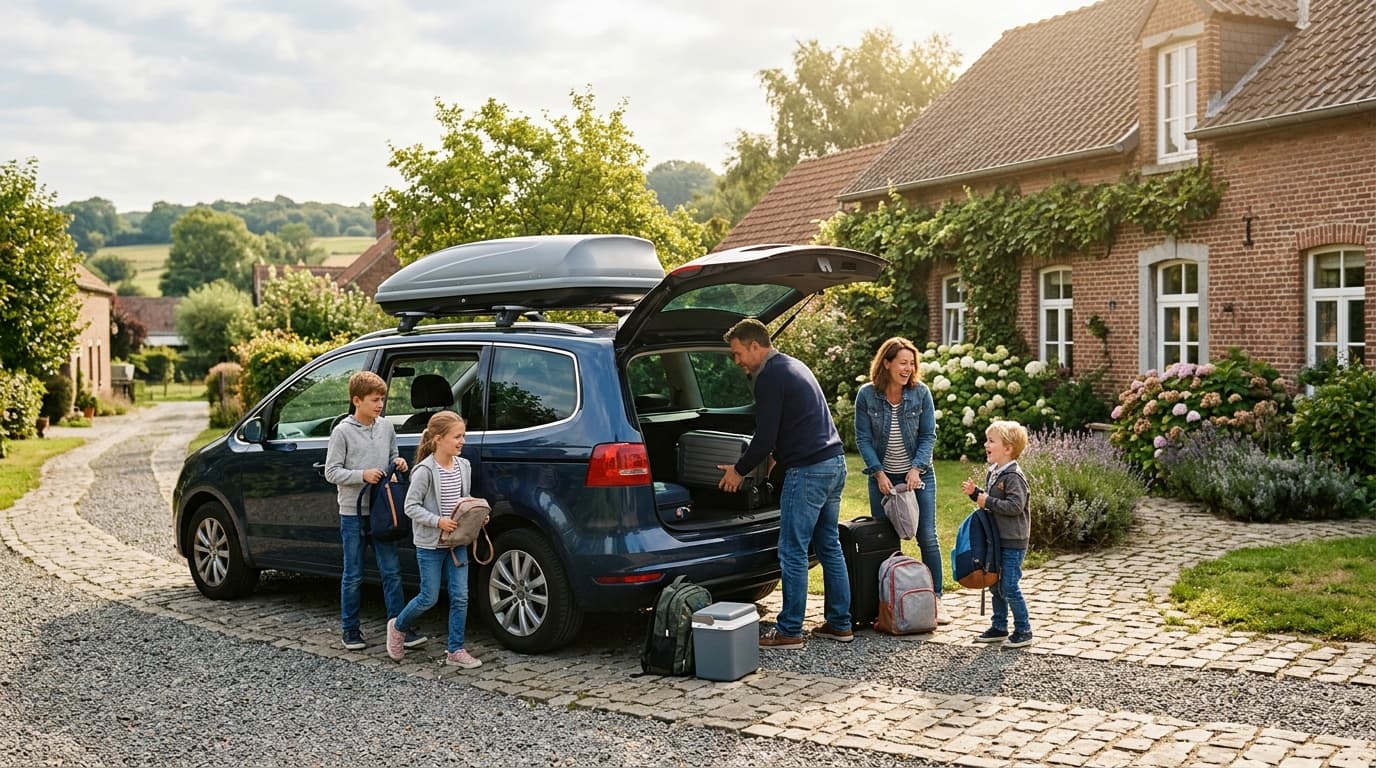
The bigger the roof box, the fewer kilos you are allowed to put in it.
Short answer: on a 7-seater, the largest mainstream roof box offers 590 litres, but the car's roof load only allows 45 to 70 kg of luggage inside it. It fills with duvets and clothes, not suitcases. And if you travel seven-up two weeks a year, renting remains the better option.
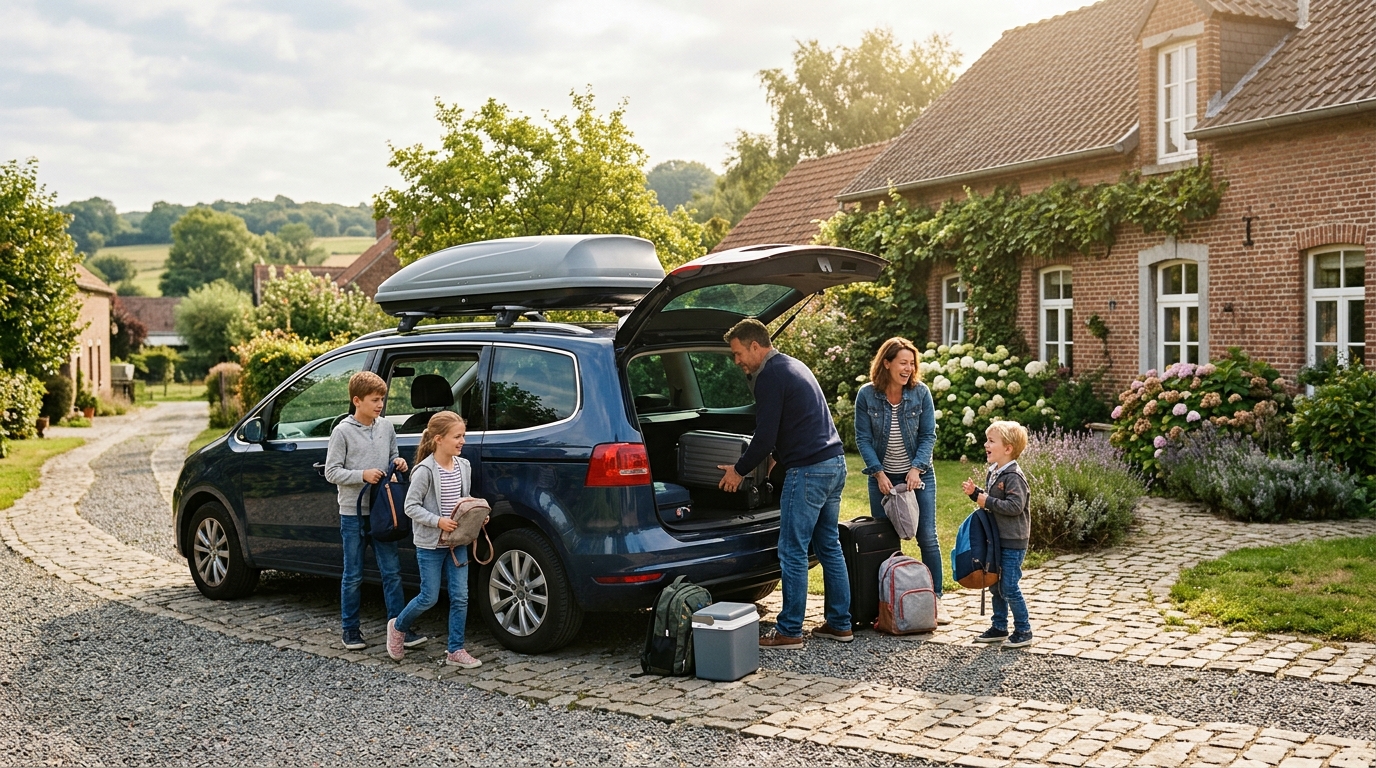
590 litres on the label, 44.8 kg allowed on a 75 kg roof
The usual reasoning runs one way only. The third row is in use, 150 to 250 litres are left behind the seatbacks, so you need the biggest roof box available, and the biggest holds 590 litres. The sum stops there, in the shop, in front of the label.
One line is missing. The roof load in the car's handbook covers everything above the roof panel: the bars, the empty box and its contents. Touring weighed the bars in its test at 5.2 kg. Thule lists 25 kg for its Motion 3 XXL, the 590 litre model. On a Volkswagen Touran, whose roof is rated at 75 kg, that leaves 44.8 kg of luggage. Two 23 kg suitcases, the hold allowance on most airlines, already exceed it.
Per unit of volume, that is 76 grams per litre. A bottle of water weighs a thousand.
The surprise comes when sizes are compared. The Northline Tirol 420 tested by Touring weighs 22.4 kg for 420 litres; the same 75 kg roof leaves it 47.4 kg. Going from 420 to 590 litres, you gain 170 litres and lose 2.6 kg of permitted load, because a longer box is also a heavier box and that weight comes out of yours.
What roof load for which 7-seater?
From 75 to 100 kg on the models whose figure I could read in a manufacturer document or an independent test. Your own handbook is the authority, not this table.
| Car's roof load | Example | Northline Tirol 420 (22.4 kg) | Thule Motion 3 XL, 490 L (23 kg) | Thule Motion 3 XXL, 590 L (25 kg) |
|---|---|---|---|---|
| 75 kg | Volkswagen Touran | 47.4 kg | 46.8 kg | 44.8 kg |
| 80 kg | Dacia Jogger, factory modular bars | 52.4 kg | 51.8 kg | 49.8 kg |
| 100 kg | Volkswagen Multivan T7, Kia EV9 | 72.4 kg | 71.8 kg | 69.8 kg |
The three right-hand columns give the luggage weight left over, with 5.2 kg of bars deducted. None of these boxes accepts more than 75 kg of contents, whatever the car.
Two readings. Between a 75 kg roof and a 100 kg roof, the usable gap is 25 kg, more than half of what a Touran allows: the choice of car matters far more than the choice of box. And on any one car, the three boxes sit within 2.6 kg of each other. Size barely changes the permitted weight, it only changes the room you have to spread it.
The Jogger deserves a line of its own, because its lengthwise rails swivel to become crossbars, with nothing extra to buy. Dacia rates them at 80 kg. Their own weight is already part of the car, so the real sum is slightly kinder than the column suggests.
Does a 600 litre roof box actually exist?
Nearly. The model everyone calls "the 600 litre" at Thule is the Motion 3 XXL, and its Belgian product page states 590 litres, with outer dimensions of 232 × 92 × 45 cm and an inner space of 220 × 77 × 38 cm. The XL, one size down, holds 490 litres and measures 215 × 89 × 43 cm.
A hundred litres apart, 17 cm longer, 2 kg heavier. On 4 October 2026, the Thule page for the Motion 3 XXL showed €1,049.95, against €929.95 for the XL.
Those 17 cm matter on an MPV. A 2.32 m box on a 4.55 m car has to sit forward for the tailgate to open without touching it, and the bar positions are not always free. Open the tailgate fully before tightening the clamps.
The serious objection: duvets weigh nothing
It is correct, and it rescues the large box.
Not everyone puts suitcases on the roof. Seven sleeping bags, seven winter coats, the pillows, a tent and the air beds take up a huge volume for very little weight, and that is exactly what a 7-seater cannot stow when the third row is in use. In that case 76 grams per litre is plenty, and the extra litres earn their keep.
The same goes for skis. Thule gives 215 cm of usable length in the XXL: adult skis lie flat in it, which a shorter 420 litre box does not always allow.
The objection fails as soon as the roof box becomes the overflow for the boot. Packs of water, the crate of tins, the sports bags, the full cool box: all of it is dense, and all of it ends up on the roof on departure morning because there is no room left below. In practice, with children, nobody weighs anything, you fill until the lid shuts. With 590 litres, the lid shuts very late.
So a large box fills by volume, while the law and the manufacturer limit it by weight. The remaining kilos belong inside the car: most 7-seaters keep more than 350 kg of payload with seven people on board. Heavy items go low, against the seatbacks, even if that means wedging them between second-row feet.
How much more fuel does a car use with a roof box?
About one litre more per 100 km on the motorway, according to the only serious comparative measurement I found.
ADAC, the German motoring club, tested ten boxes in February 2020 on a Volkswagen Touran 2.0 TDI held at 130 km/h. With a bare roof the car used 6.1 litres. With the best-shaped box in the test, a Kamei Oyster 450, it needed 0.94 more. With the worst, 1.29 more. The average is above 18 %. Touring, which published the same results for Belgium, adds that the bars alone already cost 0.4 litre.
Over a 2,000 km round trip to the south of France, that comes to between 19 and 26 litres of fuel. This is not the item that wrecks a holiday budget.
Two caveats. The test covered boxes of 390 to 455 litres, lower and shorter than an XXL: I found no published measurement on a 590 litre box, and nothing suggests it does better. On an electric car the same drag is paid in range, and charging stops on an already heavy 7-seater stretch accordingly.
2.08 m at the very least: the height nobody writes down
A 45 cm box adds to the height of the car. So do the bars, but their thickness varies from one model to the next, so I count only the box here: the figures below are minimums.
| 7-seater | Height | With a 45 cm box, bars excluded |
|---|---|---|
| Dacia Jogger | 1,632 mm | 2,082 mm |
| Renault Espace E-Tech | 1,645 mm | 2,095 mm |
| Škoda Kodiaq | 1,679 mm | 2,129 mm |
| Citroën ë-Berlingo XL | 1,880 mm | 2,330 mm |
Height bars at underground car parks in Belgium commonly read between 1.80 m and 2.00 m. None of these four cars gets in any more. The Berlingo also exceeds most car wash gantries and a good many private garages.
Before buying a large box, check:
- the roof load in the vehicle handbook, under loading or roof bars;
- the empty weight of the box on the maker's own sheet, not the retailer's;
- the total height with the box fitted, taken with a tape measure, against your garage and the car park at your holiday address;
- the tailgate opening fully with the box in position;
- where it will live eleven months out of twelve, because a 2.32 m object does not slide behind a wardrobe.
Can you fit a roof box without bars?
A hard box, no. It clamps onto two crossbars, themselves anchored to the rails or fixing points provided by the manufacturer.
Soft bags strapped through the cabin do exist. I do not recommend them on a 7-seater without reading the vehicle handbook first: the roof load applies whatever the fixing, and a strap running through the door frames passes at head height for rear passengers.
€58 for a badly secured load, in all three regions
The Belgian highway code says nothing about roof boxes specifically. It requires a load to be firmly secured, not to obstruct visibility and not to compromise the stability of the vehicle. The federal police restated the rule in a note dated 5 June 2025: a €58 fine, plus costs, for a private motorist. The rule is federal, so identical in Liège, Brussels and Antwerp.
Exceeding the roof load itself is a matter for the manufacturer's handbook. It becomes a problem after an accident, when the assessor weighs what was on the roof.
Three roofs, three answers
75 or 80 kg roof (Touran, Jogger and most compact MPVs): the XXL gives you not one kilo more than a 420 litre box. Take it only if you carry textiles, duvets or long skis.
100 kg roof (Multivan T7, Kia EV9): with close to 70 kg usable, a large box starts to make sense, provided you measure total height before booking a car park.
One or two trips a year: do not buy one. A Belgian van rental firm listed a 600 litre box at €54 a week when I ran my rental price survey on 2 October 2026. It takes nineteen weeks of rental to reach the price of a new XXL.
If a roof box is not enough, the issue is the size of the car, and the question becomes that of seven real seats with a real boot.
Sources: Thule Belgium product pages for the Motion 3 XXL (590 L, 232 × 92 × 45 cm, 25 kg, 75 kg load, €1,049.95) and Motion 3 XL (490 L, 215 × 89 × 43 cm, 23 kg, 75 kg load, €929.95), read on 04/10/2026; Touring, roof box test and advice, published 06/02/2025 and updated 25/03/2025 (Volkswagen Touran roof at 75 kg, bars at 5.2 kg, Northline Tirol 420 at 22.4 kg, boxes tested from 390 to 455 L); ADAC, test of ten roof boxes, 26/02/2020 (Touran 2.0 TDI at 130 km/h, 6.1 L without a box, +0.94 to +1.29 L with one); Dacia, press release of 10/12/2021 on the Jogger's modular roof bars (80 kg); Kia EV9 owner's manual, 2024 edition (100 kg evenly distributed); Volkswagen Multivan T7 roof load (100 kg) and vehicle heights taken from our own surveys of 18/08/2026 and 18/09/2026; Belgian federal police, note on carrying loads safely, 05/06/2025. Remaining weights and heights with a box are our own calculations. I have neither fitted nor tested any of these boxes: the specifications come from the makers and the tests cited. Roof load varies by version and roof type: read the figure in your own handbook.
Monospaces & vans comparator
Compare all monospaces & vans side by side.
Compare now →
Frequently asked questions
Sophie teste des voitures familiales depuis 2013, d’abord pour la presse auto belge, aujourd’hui en indépendante depuis le Brabant wallon. Mère de trois enfants, elle juge une 7 places sur ce qui compte vraiment au quotidien : trois sièges-auto qui rentrent de front, le coffre une fois la 3e rangée dépliée, et la hauteur de seuil quand on charge une poussette. Sa règle : un essai sans enfants à bord ne vaut rien.