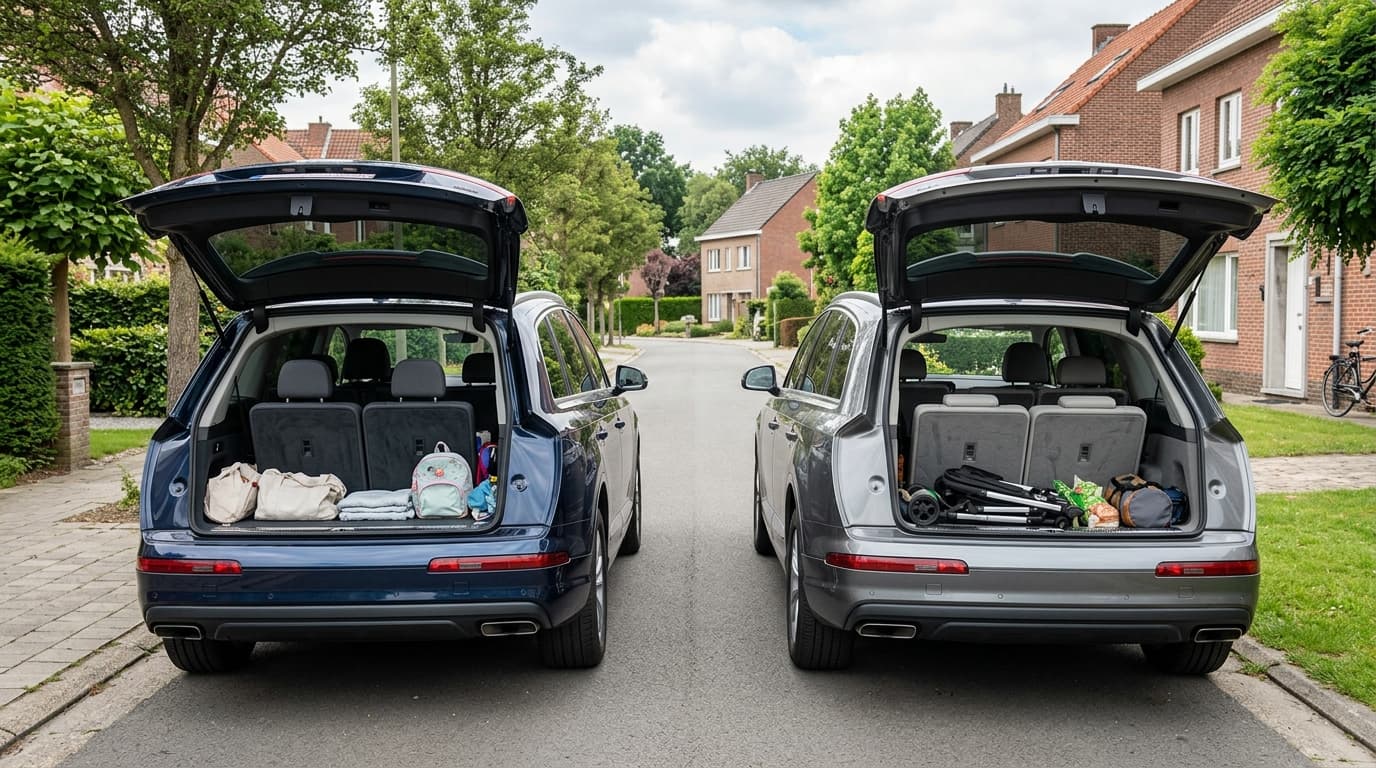
The Hyundai Santa Fe, if the third row is used every week. The Mazda CX-80, if it stays folded nine days out of ten.
Short answer: the Santa Fe is the better seven-seater of the two, because its rearmost row takes two child seats on Isofix and taller passengers. The CX-80 is the better long-distance car: five Euro NCAP stars, a litre less per 100 km in a back-to-back test, 687 litres of boot with five seats. Neither keeps a real boot with seven on board.
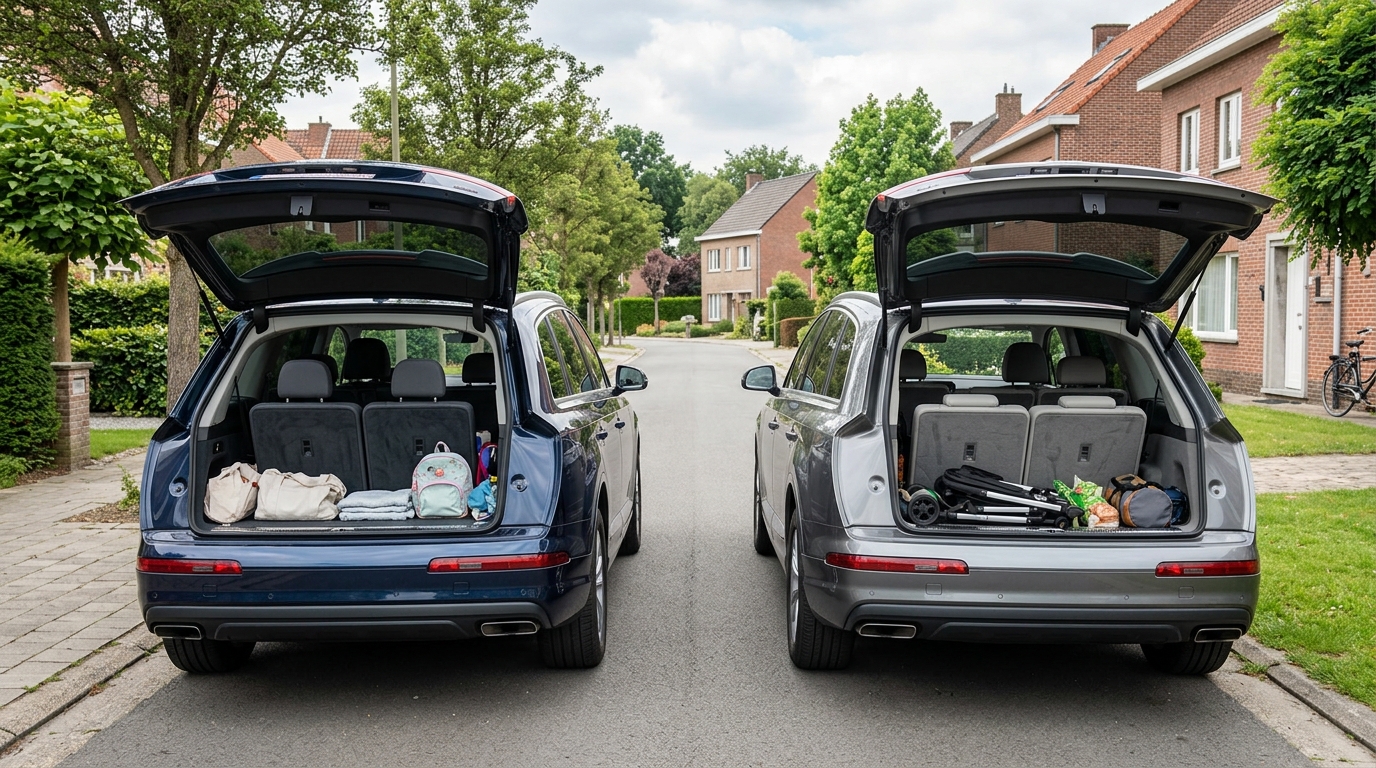
16.5 cm more for the Mazda, 59 litres of boot gained
The CX-80 is just short of five metres. The Santa Fe stops at 4.83 m. On paper the Mazda should crush the Hyundai for cabin space, all the more since its wheelbase is 30.5 cm longer.
It does not, and the table shows it line after line.
| Criterion | Mazda CX-80 | Hyundai Santa Fe | Gap |
|---|---|---|---|
| Length | 4,995 mm | 4,830 mm | +165 mm Mazda |
| Width | 1,890 mm | 1,900 mm | +10 mm Hyundai |
| Height | 1,710 mm | 1,720 mm | +10 mm Hyundai |
| Wheelbase | 3,120 mm | 2,815 mm | +305 mm Mazda |
| Boot with 7 seats | 258 L | not found in a manufacturer source | to be measured |
| Boot with 5 seats | 687 L | 628 L | +59 L Mazda |
| Maximum boot | 1,971 L | 1,949 L | +22 L Mazda |
| Isofix in row 2 | 2 positions | 2 positions | level |
| Isofix in row 3 | 0 | 2 positions | +2 Hyundai |
| Euro NCAP rating (2024) | 5 stars | 4 stars as standard | Mazda |
| Adult / child protection | 92% / 88% | 84% / 88% | +8 points Mazda |
| Mass of the car tested | 2,206 kg | 2,050 kg | +156 kg Mazda |
| Consumption recorded by What Car | about 6.0 L/100 km | about 7.1 L/100 km | 1.1 L Mazda |
Sixteen and a half centimetres of bodywork for 59 litres of boot, then only 22 litres once everything is folded. The Mazda's length went elsewhere: under a long bonnet housing a straight-six mounted lengthways. The Santa Fe does the opposite, with a transverse engine, an almost vertical tail and a roof one centimetre higher. Its cabin takes up a larger share of the car.
In a Belgian car park, those 16.5 cm are not neutral either.
Who really fits in the third row?
Children and teenagers in both. An adult, more readily in the Santa Fe.
The road tests disagree with each other, and that is instructive. What Car, in its comparison, writes that six-footers travel comfortably in the back of the Santa Fe on a long trip, while those in the CX-80 have to duck slightly, sitting closer to the floor. Top Gear, on 11 June 2025, keeps the last row of both cars for little ones. And the same What Car, after months with a CX-80 on long-term test, notes on 12 September 2025 that tall adults fit if the second row agrees to slide forward. AutoScout24, in its Belgian test of 14 October 2024, speaks of restricted legroom, for children and teenagers.
Three readings, one constant: in the Mazda, space in the back is negotiated with the middle row.
Access is another problem. In the CX-80, What Car describes two ways of reaching the back when child seats occupy the second row: remove a seat, or climb over a backrest. For a grandparent, that is a no. The six-seat version, with two individual seats and an aisle between them, settles it at the cost of one seat.
With children on board, bring to the test drive:
- your own child seats, fitted where they will stay;
- the tallest person who will sit in the back, shoes on;
- a tape measure, to note knee room with the second row set to your liking;
- a minute on the stopwatch to climb in and out of the back unaided.
No Isofix in the back of the CX-80, two in the Santa Fe
This is the line that settles it for a family with three young children.
The Euro NCAP datasheet for the CX-80 reads "not applicable" for Isofix and i-Size on both third-row seats. The anchors are on the outer seats of the second row, the centre seat being rated difficult. The Santa Fe datasheet, by contrast, rates Isofix and i-Size installation as easy on the outer third-row seats.
The count is quick: four anchor positions in the back of the Hyundai, two in the Mazda. With three seats, the CX-80 forces you to fit one with the belt, in the centre of the second row or in the back, provided the seat manual and the car manual allow it. Our record of Isofix positions row by row explains how to count them.
How much boot is left with seven on board?
The real test is the boot once all seven seats are in use. The CX-80 quotes 258 litres. That is honest for an SUV, and it is still the volume of a city car: a folded pushchair, two soft bags.
For the Santa Fe, I found no volume behind the third row in the sources consulted, only 628 litres with five seats and 1,949 litres at most. I am not making one up. Ask the dealer for the figure, or better, put your pushchair in the boot with all seven seats raised.
Either way, leaving with seven and luggage means a roof box or a trailer, and the question becomes that of seven real seats with a real boot.
Five stars against four: does the Euro NCAP rating change the choice?
A little, not as much as the label suggests.
Both cars were tested in 2024, under the protocol tightened in 2023. The CX-80 gets five stars with 92% for adult protection, 88% for children, 84% for vulnerable road users and 79% for safety assist. The Santa Fe gets four stars with standard equipment, with 84% for adults and the same 88% for children. The gap is at the front and in the driver aids, not in the children's seats.
One limit is shared. Euro NCAP places no dummy in the third row: the rating says nothing about the protection of those travelling in the back, in either car.
6.0 against 7.1 litres over the same route
What Car drove both cars over 377 miles, or 607 km. The Santa Fe burned 43.21 litres, the CX-80 36.16. That gives about 7.1 and 6.0 L/100 km. AutoScout24 had measured 5.8 L/100 km on the CX-80 diesel, a 3.3-litre straight-six with 254 hp, in its Belgian test.
Over 20,000 km a year, a 1.1 litre gap comes to 220 litres. The Mazda also exists as a 327 hp plug-in hybrid with a 17.8 kWh battery, quoted at 60 km of electric range. The Santa Fe comes as a full hybrid and as a plug-in hybrid, like its cousin the Kia Sorento, which we compared in the Santa Fe against Sorento piece.
The downside fits in one figure: the car tested by Euro NCAP weighed 2,206 kg at Mazda, 2,050 kg at Hyundai.
How much do they cost in Belgium?
On 6 October 2026, Hyundai's Belgian website lists the Santa Fe Hybrid from 56,295 euros. For the CX-80, the last Belgian price I could date is the launch one: 59,190 euros for the diesel and 59,290 euros for the plug-in hybrid, recorded by AutoScout24 on 14 October 2024, when the range started at a mid-level trim. Ask the dealer for today's price before comparing.
The registration tax (TMC, taxe de mise en circulation) is not calculated the same way in Namur, Brussels and Ghent. In Wallonia, mass enters the formula, and a 156 kg gap ends up counting; in Flanders, emissions matter most; in Brussels, power and age. The three scales are set out in our article on the registration tax for a 7-seater.
Verdict by family
Three children in child seats, or a back row used every week: Hyundai Santa Fe. Four Isofix positions in the back, a third row where road tests seat adults, 16.5 cm less to park.
Two children, long trips, the third row as a stopgap: Mazda CX-80. Five stars, lower consumption, 687 litres with five seats.
Grandparents in the back: try the CX-80 as a six-seater, or the Santa Fe. Not the seven-seat CX-80 with two child seats in the middle.
Sources: dimensions and boot volumes of the Mazda CX-80 and Hyundai Santa Fe recorded on autotijd.be on 06/10/2026; Mazda CX-80 road test by AutoScout24 Belgium, 14/10/2024 (258, 687 and 1,971 L, launch prices, 5.8 L/100 km measured, six-seat version); 2024 Euro NCAP datasheets for the Mazda CX-80 and Hyundai Santa Fe (stars, percentages, mass of the cars tested, Isofix positions per row); What Car, Hyundai Santa Fe against Mazda CX-80 comparison (fuel used over 377 miles, converted by me) and CX-80 long-term test, report of 12/09/2025; Top Gear, comparison of 11/06/2025; Santa Fe Hybrid price recorded on hyundai.com/be on 06/10/2026. The gaps in the table are my own calculations. I did not drive either car for this article: the measurements come from the road tests and bodies cited. Equipment, seat count and anchor points vary by trim: check the actual car you are buying and its manual.
SUV 7 places comparator
Compare all suv 7 places side by side.
Compare now →
Frequently asked questions
Sophie teste des voitures familiales depuis 2013, d’abord pour la presse auto belge, aujourd’hui en indépendante depuis le Brabant wallon. Mère de trois enfants, elle juge une 7 places sur ce qui compte vraiment au quotidien : trois sièges-auto qui rentrent de front, le coffre une fois la 3e rangée dépliée, et la hauteur de seuil quand on charge une poussette. Sa règle : un essai sans enfants à bord ne vaut rien.