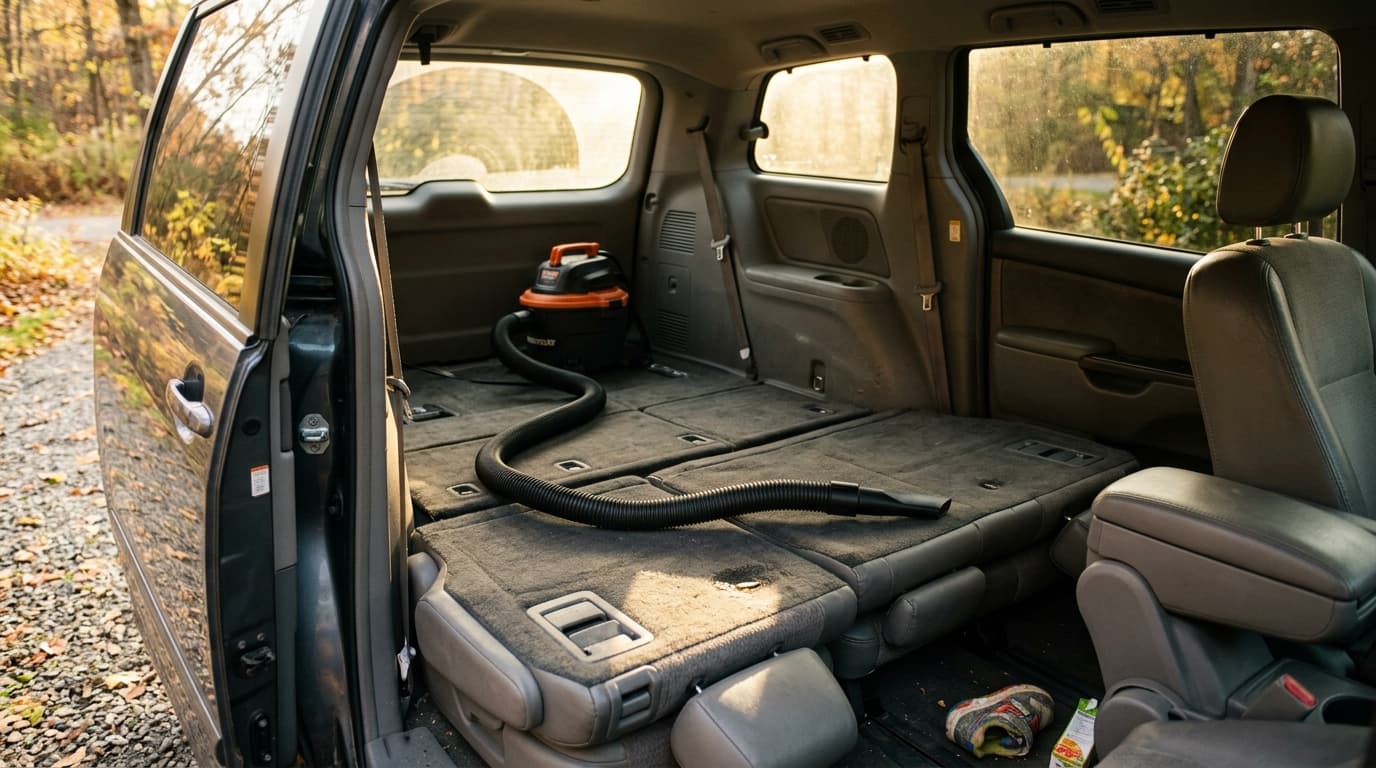
Three rows, three times the crumbs. The bill, though, does not triple.
A full interior clean comes to €120 on a seven-seat MPV or SUV in Belgium, against €90 on a city car. At home, the same job takes about three hours and a machine that can pick up water, not a handheld boot vacuum.
How much does interior cleaning cost on a 7-seater in Belgium?
Between €90 and €140 depending on body style, from a professional working by hand.
The list below was taken on 6 September 2026 from a mobile valeter in the province of Liège, for a full interior service: complete vacuum, seats, mats and carpets, plastics, interior glass.
| Body style billed | Seats | Full interior | Cost per seat |
|---|---|---|---|
| City car | 5 | €90 | €18.00 |
| Saloon or hatchback | 5 | €110 | €22.00 |
| SUV or MPV | 7 | €120 | €17.14 |
| Large SUV, van or panel van | 8 to 9 | €140 | €15.56 |
The cost per seat is my own calculation, and it says the opposite of what you would expect. Moving from five seats to seven lifts the bill by 33 %, while the seat count rises by 40 %. The flat rate does not follow the number of chairs: it follows working time, and a third row used two weekends a year cleans up faster than a children's bench used every morning.
Two reference points. A Brussels car wash advertises a basic interior, vacuum and glass without any fabric treatment, at €19 on a small car and €29 on a large one. And the average hourly rate for mobile car cleaning in Belgium sits around €41: three hours of work comes to €123, almost exactly the MPV flat rate.
The add-ons climb fast. Pet hair removal €30, cabin deodorising €30, treatment for mould or heavy soiling €50. On a family seven-seater with a dog and a child seat that took a bottle of milk in the spring, two lines are enough to take the bill from €120 to €180.
How long does it take to clean three rows?
Three hours.
On my own car, a five-seater takes an hour and a quarter including the glass. The same job on a seven-seater always overruns, and the extra time does not come from the seats: it comes from the floor well the third row folds into, a hollow of several hundred litres that has been collecting everything that slid out of the boot for months.
| Step | Time across 3 rows | Kit |
|---|---|---|
| Emptying, removing mats and child seats | 20 min | bags, tray |
| Vacuuming rows 1 and 2, runners included | 40 min | wet-and-dry vacuum, crevice tool, fine brush |
| Third row and floor well | 45 min | long hose, rail brush |
| Spot-treating the fabric | 30 min | textile cleaner, soft brush, microfibres |
| Plastics, sills, boot | 25 min | plastic cleaner, detailing brush |
| Glass, six side windows instead of four | 20 min | ammonia-free glass cleaner, microfibre |
What kit does a three-row cabin need?
A vacuum that handles water, and a long hose.
This is the one line not to compromise on. A cordless handheld empties a city-car boot; it will not lift shampoo water out of a van carpet. Across three rows, the wet-and-dry vacuum, or the spray extractor for those going further, is the tool that separates a clean seat from a damp seat that will smell musty by Thursday. Kärcher, Sonax, Meguiar's and the Norauto own ranges are distributed in Belgium and cover all of these categories. I have not tested them all and I am not going to pretend otherwise: choose on hose length and on how easily you can buy the consumables, not on the advertised wattage.
The second tool costs almost nothing and appears on no list: a fine brush, a stiff toothbrush or a hard-bristled detailing brush, for the seat runners. Without it the crevice tool passes straight over the rails and leaves the grit exactly where it is.
A wet-and-dry cleaner does the job across all three rows. The rest is habit.
The method in seven steps
- Empty everything, boot and door bins included. Take out the child seats and the mats; they clean separately and dry faster outside.
- Deploy the third row, fold it back, then deploy it again. You will see what was jammed in the hinges drop into the well.
- Vacuum top down and back to front, so you do not carry dust onto what is already done.
- Do the runners before the carpets. Fine brush into the channel, vacuum straight after, on rows 1 and 2 as well as on the sliding bench.
- Spot-treat before you shampoo. Textile cleaner applied locally, five minutes' dwell, gentle brushing, wiped off with a microfibre. Never soak a seat fabric.
- Extract the water immediately after each treated area. Fabric left damp for more than two hours in a closed cabin develops the smell that costs €30 of deodorising.
- Leave it open for two hours, sliding doors and tailgate included, before the mats go back in.
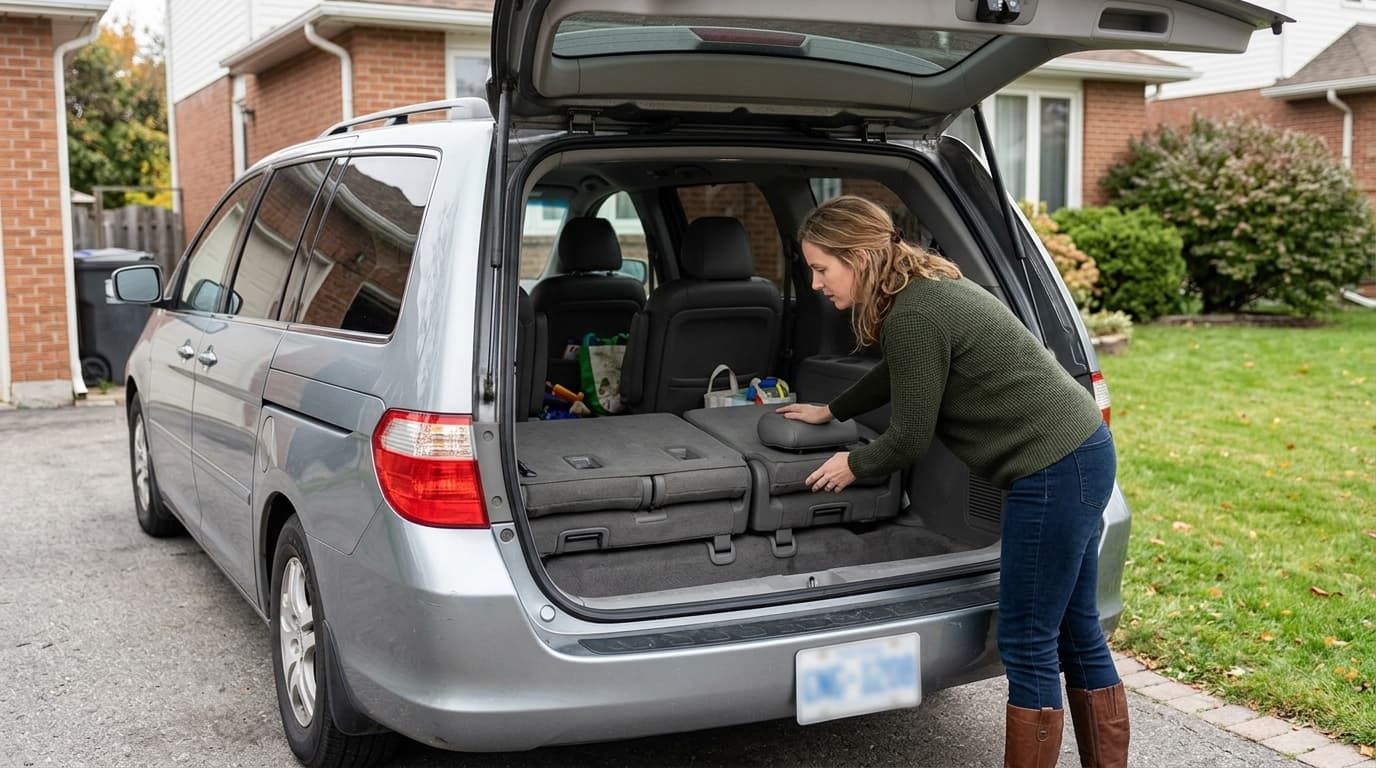
Seat runners, the job nobody does
Two channels per sliding seat, four on a split second row, plus those of the folding bench. That is where the grit, the crumbs and the felt-tip caps end up, and that is where the squeak that eventually jams a backrest comes from. Five minutes per rail, once a year.
Shampoo or steam on three rows?
Steam to sanitise, extraction to clean. They do not do the same job.
Steam lifts and disinfects without soaking, which makes it comfortable on third-row seats that are rarely deeply dirty. It removes nothing, though: the dirt comes to the surface and has to be wiped off at once, otherwise it settles back as it dries and leaves the tide mark everyone knows. The spray extractor sprays then sucks back, so it really does evacuate what it lifts, but it puts a lot of water into a cabin that, in a van, will not dry in an hour. On a family car used daily, the combination that works is simple: extraction on rows 1 and 2, steam on row 3.
The roadworthiness test wants the third row deployed
Here is the Belgian anchor, and it turns a chore into a dated obligation.
A vehicle is presented clean, bodywork and underside included, boot completely empty, every seat deployed and every belt fastened before it crosses the line. On a five-seater nobody gives it a thought. On a seven-seater whose last row has been folded away since the previous summer, it means checking that both rear belts pull out, latch, and retract, and that no strap was trapped under the floor when the seats went down. It is the silliest re-test reason on the list, and ten minutes the evening before settles it.
The technical framework is federal, but the organisation of the centres and their fees have belonged to Wallonia, Brussels and Flanders since the sixth state reform: the list of approved stations is held by GOCA, and Test Achats keeps the presentation conditions up to date. Beyond that, interior cleaning knows no regional border, with one exception: rinsing. Most municipal by-laws forbid washing a vehicle on the public highway, and the City of Brussels general police regulation prohibits fouling sewers and watercourses. Spray extractor on the pavement, then, only after reading your own municipality's rules.
When should you hand it to a professional?
When there is water in the carpet, or a smell that shampoo will not shift.
A leak through a tailgate seal or a boot hatch soaks the foam under the carpet, and no amount of vacuuming reaches it. Same verdict for established mould, for dried vomit in the foam of a backrest, or for marked leather trim. At €120 for the MPV flat rate the trade-off is quickly made, and Le Moniteur Automobile also points out that a sound cabin counts in the resale value of a family car.
The five mistakes that come up most often on a three-row cabin:
- Soaking the fabric. A drenched seat dries for three days in a van and comes out smelling worse than before.
- Forgetting the floor well of the third row, which is the dirtiest point in the car.
- Running the crevice tool without brushing the runners, which leaves the grit exactly where it grinds.
- Using an ammonia-based glass cleaner on tinted windows or a rear screen.
- Putting dressing on the steering wheel or the pedals, which then turn slippery.
Once the cabin is clean, the other large-vehicle questions remain open: the points to inspect on a used third row, what load index the tyres of a two-tonne vehicle demand, and which of these models offer seven real seats rather than five plus two jump seats.
Sources: price list of a mobile car-cleaning business in the province of Liège, taken on 06/09/2026 (full interior €90 city car, €110 saloon or hatchback, €120 SUV or MPV, €140 large SUV, van or panel van; add-ons pet hair €30, deodorising €30, mould or heavy soiling €50); price list of a Brussels car wash taken on 06/09/2026 for a basic interior (€19 small car, €29 large car); average hourly rate for mobile car cleaning in Belgium observed on a booking platform, around €41 an hour, taken on 06/09/2026. Belgian roadworthiness-test presentation conditions per Le Moniteur Automobile and Test Achats; list of approved centres on goca.be; prohibition on fouling sewers and watercourses in the City of Brussels general police regulation. Cleaning times measured on my own five-seat and seven-seat cars, and given as an indication. Prices vary from one operator and one region to another: ask for a quote for your body style. No product mentioned has been through a comparative test on my part, and no brand named here pays this site.
Budget & occasion comparator
Compare all budget & occasion side by side.
Compare now →
Frequently asked questions
Sophie teste des voitures familiales depuis 2013, d’abord pour la presse auto belge, aujourd’hui en indépendante depuis le Brabant wallon. Mère de trois enfants, elle juge une 7 places sur ce qui compte vraiment au quotidien : trois sièges-auto qui rentrent de front, le coffre une fois la 3e rangée dépliée, et la hauteur de seuil quand on charge une poussette. Sa règle : un essai sans enfants à bord ne vaut rien.