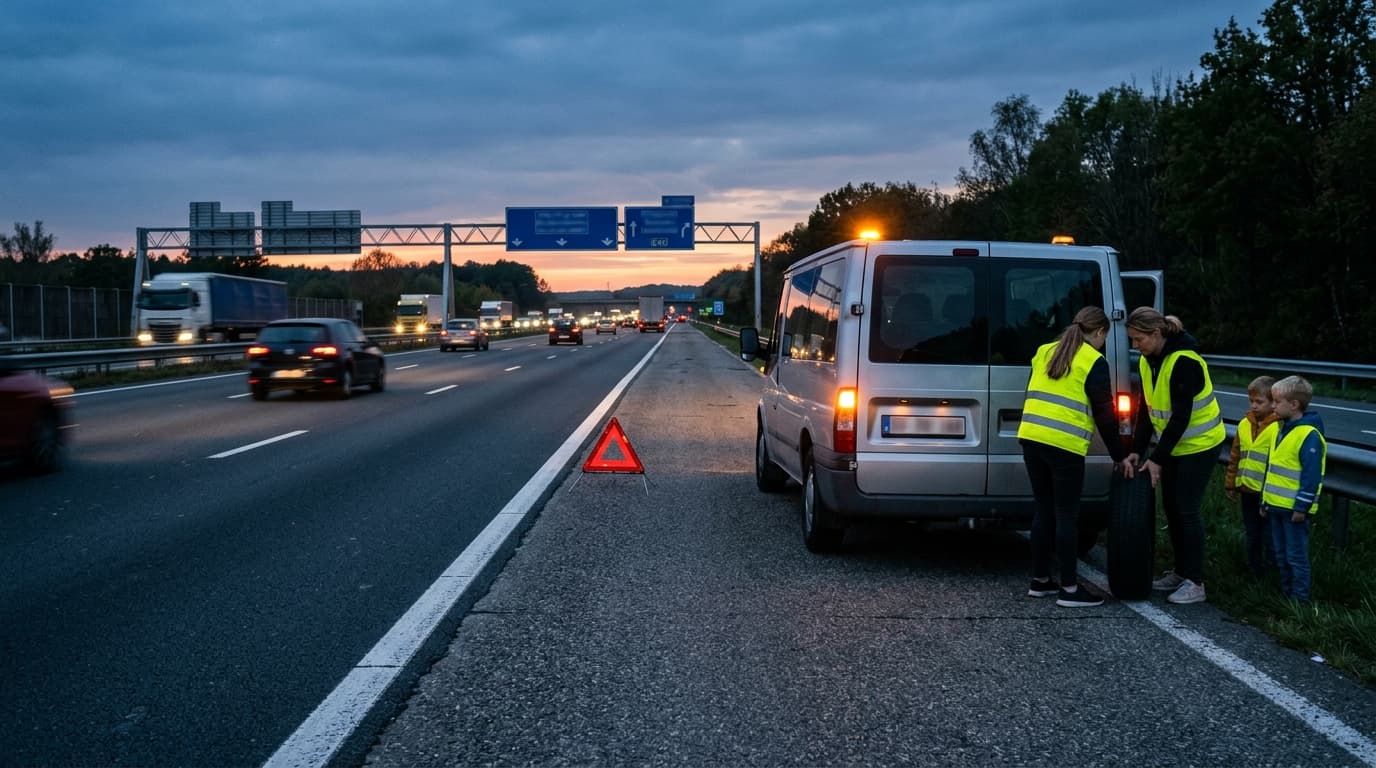
One.
Short answer: Belgian law requires one hi-vis vest per vehicle, not one per occupant. The rule knows nothing about the number of approved seats. In a full seven-seater it lets six people step out unseen, which is why the legal minimum falls short here.
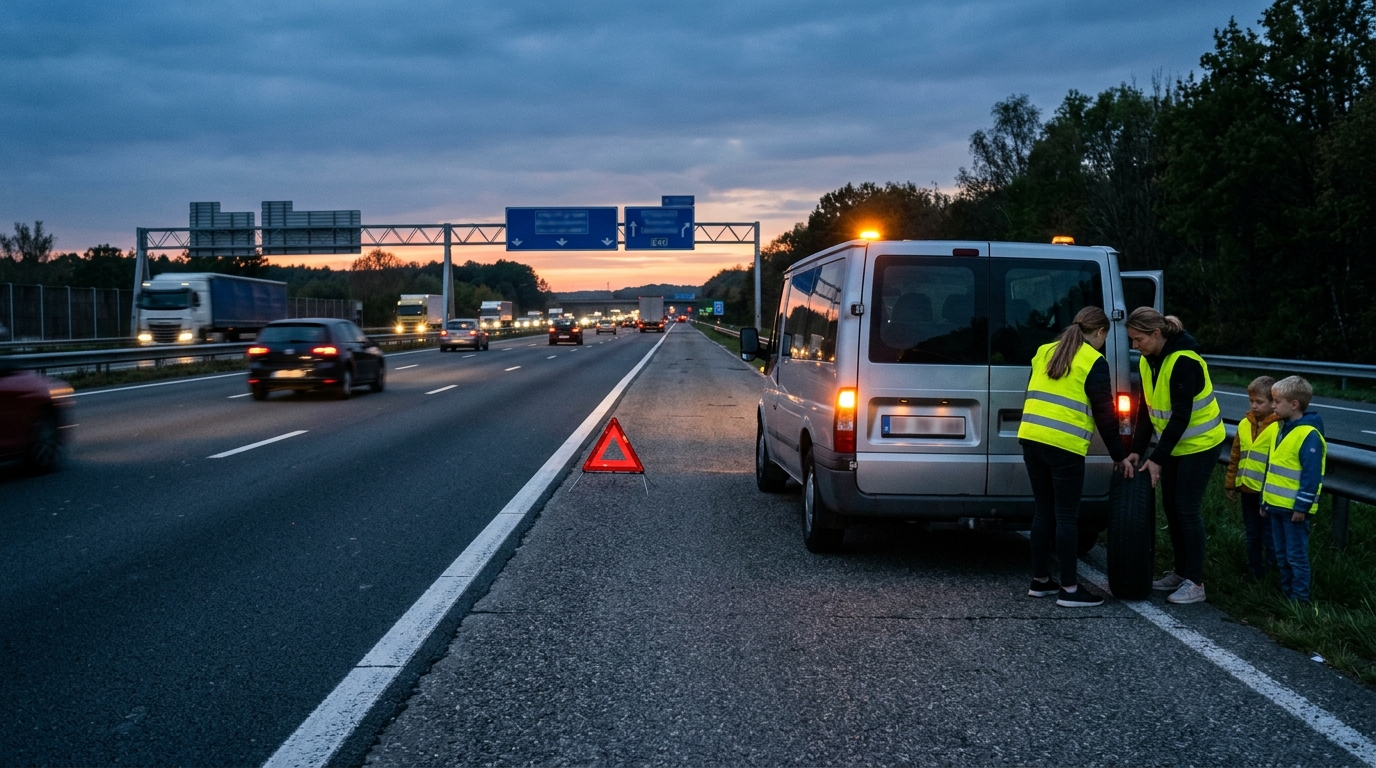
One vest per car, not one per passenger
Belgian rules speak of the vehicle, never of its occupants. A Polo and a nine-seat Ford Tourneo fall under the same requirement: at least one high-visibility vest on board, stowed so you can grab it without getting out.
The duty to wear it is written differently, and that is where the logic turns over. It applies to anyone leaving the vehicle where stopping is prohibited, motorways and expressways first of all. A driver on their own reads those two sentences without seeing a contradiction. A parent who has to get five children out of an MPV stranded on the hard shoulder does.
Seven seats, seven vests. Not a legal requirement, simply the only arithmetic that stands up.
Four mandatory items, three checked at the centre
Four objects are required in a car registered in Belgium. Three of them are inspected at the roadworthiness test.
| Item | Belgian requirement | Where to stow it | Replacement |
|---|---|---|---|
| Hi-vis vest | at least 1 per vehicle, EN ISO 20471 | cabin, never the boot | when soiled or torn |
| Warning triangle | 1 minimum, ECE R27 approved | boot or tailgate sill | for life, unless broken |
| Fire extinguisher | 1 kg powder under 3,500 kg, BENOR V label | cabin, secured, reachable by the driver | 5 years maximum |
| First aid kit | 1, contents matching DIN 13164 | glovebox or under a seat | as internal expiry dates fall |
The triangle goes 30 metres behind the vehicle on an ordinary road, 100 metres on a motorway. Two distances almost nobody respects, and they make all the difference for a long vehicle stranded on a bend.
Which extinguisher for a van over 3.5 tonnes?
The capacity required follows the maximum authorised mass, not the seat count.
Under 3,500 kg, a 1 kg powder extinguisher is enough, and that covers almost every seven-seater sold in Belgium. Between 3,500 and 7,500 kg you need 2 kg. Above that, 3 kg.
The threshold creeps closer as the body style grows. A Ford Tourneo Custom in 340 guise is approved at 3,400 kg and stays on the right side; a Kia EV9 in 99.8 kWh all-wheel-drive form shows 3,240 kg, still under the bar. A Mercedes Sprinter Tourer ordered in its heavy version crosses it, and its owner then buys the wrong extinguisher nine times out of ten, because they look at the "car" shelf rather than at the box on their registration document. The same confusion shows up in the licence a nine-seater demands, where tonnage decides as much as the seat count.
When does a car fire extinguisher expire?
Five years after it enters service, at most.
The date sits on the BENOR V approval sticker, the same one certifying that the unit is meant for vehicles rather than buildings. Two labels coexist in Belgium, BENOR V for vehicles and BENOR B for property, and only the first one counts here.
Where do you stow all this with the third row up?
The question looks secondary. It is not, because the boot of a seven-seater in use holds next to nothing.
I measured the full set, vests included, with a tape measure and a cardboard box. A folded triangle takes around 2.2 litres, a 1 kg extinguisher roughly 1.9 litres, a DIN 13164 first aid kit about 3.3 litres, and a vest in its pouch 0.6 litres. Seven vests, so 4.2 litres. The total lands around 12 litres.
Set against the boot left once all seven seats are up, the figure speaks: in a 2015 Volkswagen Touran, 137 litres remain, and the mandatory kit eats 9 % of it. In a Peugeot 5008, which offers 259 litres and 42 cm of boot length behind the last row, the share drops below 5 %. In a Dacia Jogger and its 160 litres, it climbs back to 7.5 %.
Two of those objects have no business in the boot anyway. The vest has to stay grabbable from the cabin, and the extinguisher must be reachable by the driver and secured, otherwise it becomes a 1 kg projectile at the first emergency stop. The triangle, logically, belongs near the tailgate, since you use it on the way out of the back.
On models with a heavy tailgate, one detail is worth checking before you buy the kit: the side boot hatch, where fitted, stays reachable even with the third row occupied. That is the best home for the triangle.
What to do when you break down on a motorway with seven on board?
The order of the moves changes when the car is full. Here it is, the way I run it.
- Pull to the right and switch on the hazards before you come to a stop, not after. Aim for the hard shoulder, wheels turned to the right.
- Put your vest on inside the cabin, before opening the door. Hand out the others while everyone is still seated.
- Get passengers out on the right-hand side, never on the traffic side. On a van with sliding doors, the right-hand door opens without reaching into the lane.
- Gather everyone behind the barrier, upstream of the vehicle rather than behind it. Count the children once they are through, not before.
- Set the triangle 100 metres back, walking behind the barrier rather than on the shoulder.
- Call for recovery from the orange roadside phone if you can see one: it locates the call automatically. Otherwise 112, or your own breakdown cover.
Does the roadworthiness test differ by region?
No, and that is rare enough to be worth saying.
Mandatory equipment falls under the federal highway code and technical regulations. The list is identical in Wallonia, Brussels and Flanders. What the sixth state reform devolved is the organisation of the centres, their fees and the summons calendar, not the content of the inspection. An expired extinguisher is flagged in Namur exactly as in Aalst.
Five minutes before the holidays
The round to make before a long trip with seven on board, once a year:
- the BENOR V sticker on the extinguisher, and its expiry date;
- the extinguisher gauge, needle in the green band;
- the extinguisher bracket, which should hold when pulled by hand;
- the number of vests against the number of people getting in, not against the number of seats;
- the expiry dates inside the first aid kit, dressings and antiseptic first;
- the triangle hinges and the state of its reflective strip.
The rest of the load follows another logic, kilos rather than litres: it is worked through in the calculation of a seven-seater's payload, and in the choice of tyre load index for a two-tonne vehicle.
A full set is sold by most Belgian retailers, with Auto5 and Carglass carrying the BENOR V approved extinguisher. Buy the vests singly rather than in packs of two: a pack of two in a seven-seater means five people with nothing.
Sources: Royal Decree of 15 March 1968 laying down general rules on the technical requirements for motor vehicles, article 70 for the fire extinguisher and the warning triangle; Federal Public Service Mobility and Transport for the technical regulations and vehicle categories; federal and local police for the list of items checked; GOCA and the regional roadworthiness bodies for what is inspected at the centre. Extinguisher capacities by maximum authorised mass and the five-year validity of the BENOR V label taken on 09/09/2026 from approved Belgian distributors. Third-row-in-use boot volumes taken from manufacturer sheets: Volkswagen Touran 2015 137 litres, Dacia Jogger 160 litres, Peugeot 5008 259 litres. Kit dimensions measured by hand on 09/09/2026, as an order of magnitude: sizes vary between references. This article replaces neither the rules in force nor the instructions supplied with your extinguisher.
SUV 7 places comparator
Compare all suv 7 places side by side.
Compare now →
Frequently asked questions
Sophie teste des voitures familiales depuis 2013, d’abord pour la presse auto belge, aujourd’hui en indépendante depuis le Brabant wallon. Mère de trois enfants, elle juge une 7 places sur ce qui compte vraiment au quotidien : trois sièges-auto qui rentrent de front, le coffre une fois la 3e rangée dépliée, et la hauteur de seuil quand on charge une poussette. Sa règle : un essai sans enfants à bord ne vaut rien.