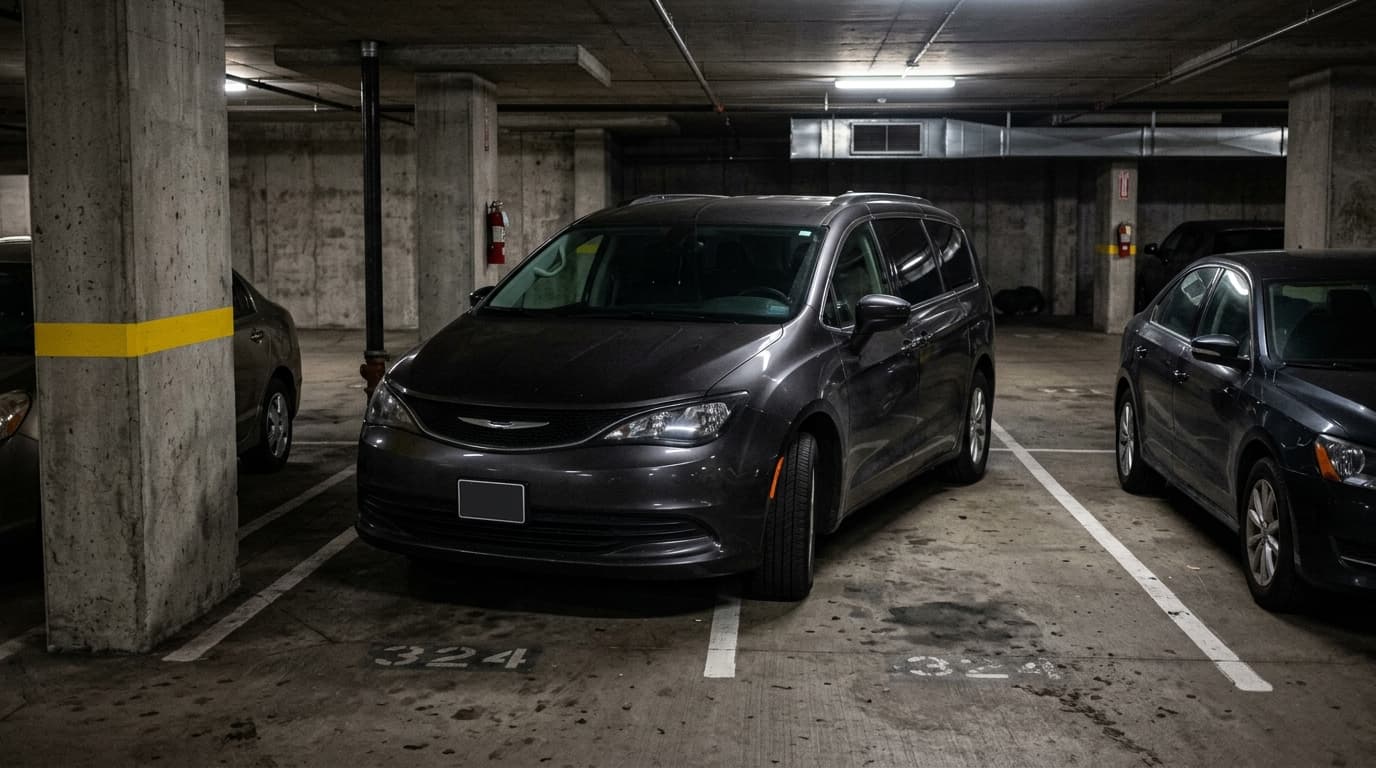
It fits. Barely.
The Walloon recommendation for a perpendicular bay is 5.25 m by 2.50 m, line marking excluded, and the survey of common practice goes down to 2.30 m wide. A modern seven-seater measures 2.05 to 2.13 m with its mirrors unfolded. That leaves between 8 and 22 cm per side, mirrors included.
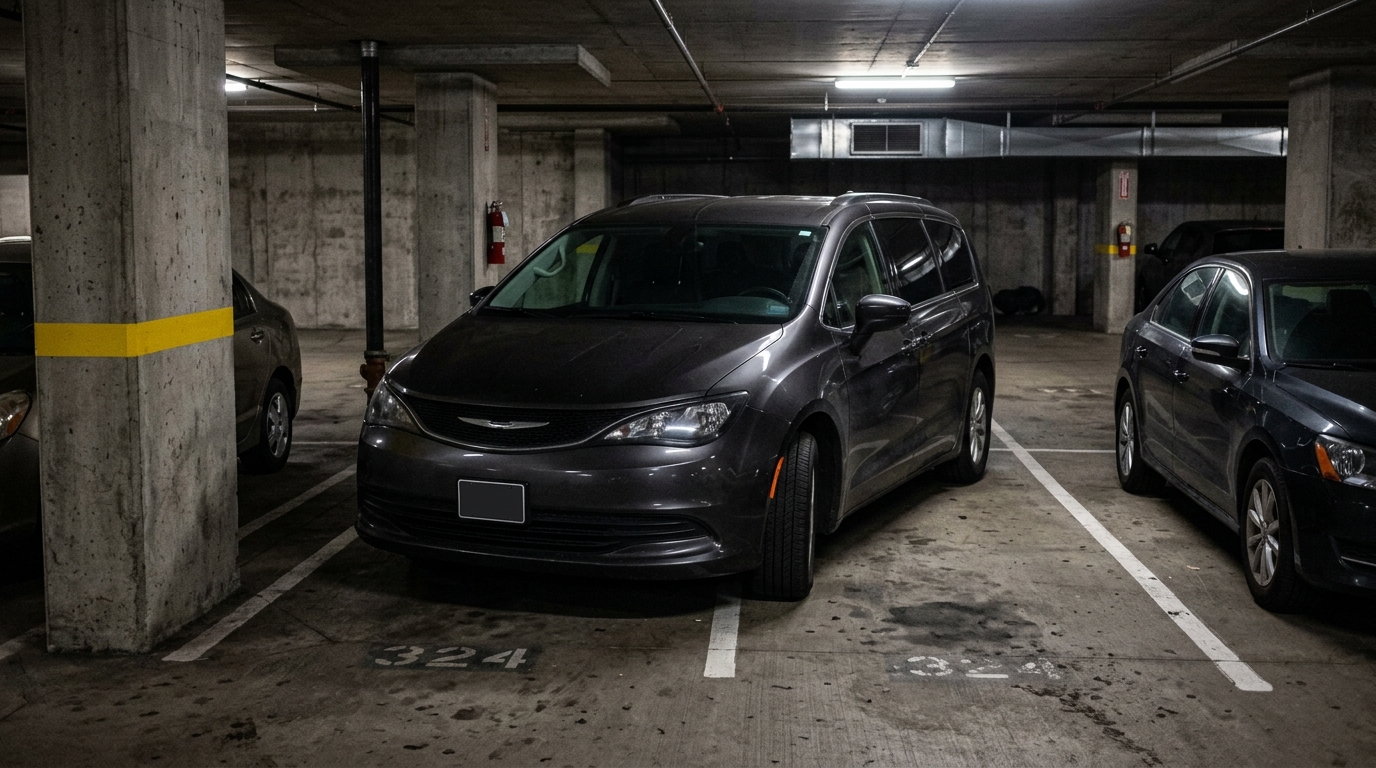
5.25 m by 2.50 m in Wallonia, 2.30 m in your street
The Public Service of Wallonia publishes the figure in sheet 102 of its Sécurothèque, updated on 5 March 2024. Two tables sit side by side there, and the difference between them is exactly what matters to the owner of a large vehicle.
The first records what is actually built, in Belgium and in neighbouring countries: 5 m to 5.5 m long by 2.3 m to 2.8 m wide for a perpendicular bay, with a circulation aisle of 5 m to 7 m. The second gives the measurement recommended in Wallonia where nothing gets in the way: 5.25 m by 2.50 m, line marking excluded, plus 5.50 m of free width for manoeuvring.
The other layouts follow the same logic. A parallel bay, the kerbside one, measures 6 m by 2 m. An angled bay at 60 degrees measures 5.25 m by 2.65 m, because the vehicle sits diagonally and takes up more width than it actually has.
One sentence in the sheet is worth quoting as it stands: where there is a wall or any other obstruction, the larger dimension should be aimed for. Which means the narrowest bay in an underground car park is the one wedged against the pillar, and that is the one still free at 6 pm.
Does the standard everyone quotes apply in Belgium?
No. Most pages written on this question quote the French standards NF P91-100 and NF P91-120, which carry no regulatory weight here.
They are nevertheless copied across, legal minimum of 2.30 m and 5 m aisle included, by sites written for Belgian readers. As it happens the orders of magnitude match, so the mistake stays harmless in practice. It becomes awkward the moment a reader claims a right from it, in front of a building manager or a developer: there is no enforceable Belgian standard on the width of a private parking bay.
In Belgium, parking falls under town planning, and town planning is regional.
The figure that decides everything is almost never published
Try finding the width of a seven-seater with its mirrors unfolded on Belgian manufacturer sheets. You will be there a while.
Škoda publishes the Kodiaq's length, body width and height, but not the width including mirrors. Renault does give it, buried in the specification comparator, line 1 of 40, never in the illustrated "dimensions" page. Dacia shows it plainly on its Jogger dimensions page, and gets the width excluding mirrors wrong in the same sentence: the site quotes 1,520 mm, which is the vehicle's track and not its body width. The only document that sets out all three values on a single line, body, mirrors folded and mirrors unfolded, is the Stellantis Berlingo price list, a thirty-page commercial PDF meant for dealers.
Four seven-seaters sold in Belgium, recorded on 18 September 2026, against the recommended Walloon bay.
| Seven-seater | Length | Body width | Mirrors folded | Mirrors unfolded | Height |
|---|---|---|---|---|---|
| Recommended Walloon bay | 5,250 mm | 2,500 mm | not applicable | not applicable | not applicable |
| Dacia Jogger 7-seat | 4,547 mm | not published | not published | 2,052 mm | 1,632 mm |
| Renault Espace E-Tech 7-seat | 4,722 mm | 1,843 mm | not published | 2,083 mm | 1,645 mm |
| Citroën ë-Berlingo XL | 4,753 mm | 1,848 mm | 1,921 mm | 2,107 mm | 1,880 mm |
| Škoda Kodiaq | 4,758 mm | 1,864 mm | not published | 2,133 mm | 1,679 mm |
Unfold the mirrors and the Espace gains 240 mm, the ë-Berlingo 259 mm, the Kodiaq 269 mm. A quarter of a metre of width that appears in no advert, no road test and no illustrated spec page. The gap between models changes character too: only 21 mm separate the bodies of the Espace and the Kodiaq, against 81 mm once the mirrors are out. So the quoted width is not merely too small, it also ranks the vehicles in the wrong order.
How much room is left to open the door?
The calculation is a single subtraction, and it appears nowhere.
In a recommended 2.50 m bay, the Jogger has 224 mm per side, the Espace 208 mm, the ë-Berlingo XL 196 mm and the Kodiaq 183 mm. In a 2.30 m bay, the bottom of the range recorded by the SPW, those margins fall to 124, 108, 96 and 83 mm respectively.
Those millimetres are not door-opening room. They are the millimetres between your mirror and the white line, and your neighbour has exactly the same margin on the other side, usually without ever having worked it out. The door opens into whatever is left once both cars are parked, which is the gap between two bodies, not between two mirrors.
With children on board, the question changes shape. Slipping through sideways takes about thirty centimetres. Strapping a child into a car seat takes twice that, because you have to lean in, pull the harness and stand back up. On three perpendicular 2.50 m bays, with a Kodiaq in the middle and two saloons either side, it works. With a ë-Berlingo on the left, it works badly. In a car park with 2.30 m bays, it stops working, and that is precisely the kind of detail you discover on the first day of the school year.
Sliding doors change this calculation completely, and it is the strongest practical argument for the leisure activity vehicle and MPV body styles: they open within the vehicle's own footprint, borrowing nothing from the neighbour.
Folding the mirrors gives back 186 mm
It is the only free clearance in the problem.
The Citroën price list gives both values: 2,107 mm with mirrors unfolded, 1,921 mm folded. The difference is 186 mm, or 93 mm more per side. In a 2.30 m bay, the ë-Berlingo goes from 96 to 189 mm of lateral margin. The gesture takes a second, it is automatic on most trim levels, and it doubles the margin.
Does a 7-seater clear an underground car park gantry?
The only figure that counts is the one posted at the gantry.
No Belgian regulation imposes a minimum clear height on a private car park open to the public. The operator sets the limit, posts it, and that limit binds the driver who goes under it. Signposted values commonly run from 1.80 m in older buildings to 2.00 m in recent ones, and plenty of Brussels car parks stop at 1.85 m.
Of the four models recorded, three clear everything: 1,632 mm for the Jogger, 1,645 mm for the Espace, 1,679 mm for the Kodiaq. The ë-Berlingo, quoted at 1,880 mm maximum height, clears 1.90 m and gets stopped below 1.85 m. Twenty millimetres decide it.
Then comes the roof. Longitudinal bars add a few centimetres, a bike carrier more, and a roof box between 35 and 45 cm depending on the model. At that point no Belgian seven-seater gets into an underground car park any more, nor under an automatic car wash gantry, whose limits sit around the same values. Roof loading has its own arithmetic, the one measured in kilos, set out in the calculation of payload and roof load.
4.75 m in a 5 m bay, plus the tailgate swinging up
Lengthwise the constraint is almost always comfortable, which feels wrong when you have just bought a vehicle that looks enormous.
In a 5.00 m perpendicular bay, the Jogger has 453 mm to spare, the Espace 278 mm, the ë-Berlingo XL 247 mm and the Kodiaq 242 mm. In the recommended 5.25 m bay, the Kodiaq has 492 mm. The tailgate opens towards the circulation aisle, which is 5.50 m wide in the Walloon recommendation, and nothing obstructs it.
The hard part lies elsewhere, and none of the technical sheets consulted mentions it.
The Kodiaq's turning circle is quoted at 12.0 m, the Espace's at 11.6 m kerb to kerb or wall to wall, the Berlingo XL's between 11.5 and 12.0 m. The recommended aisle is 5.50 m, and the survey of common practice puts it between 5 m and 7 m. A vehicle whose turning circle is more than twice the available aisle width gets parked in several movements, with the neighbours' doors thirty centimetres away, and that is exactly the situation of a seven-seater in a car park built to the minimum. Nothing breaks. You simply lose twenty seconds and a little patience, four times a day.
Wallonia, Brussels, Flanders: one published set of figures
Road marking is federal. The continuous 0.10 m white line that delimits a bay on the public road comes from the road manager's code, ministerial decree of 11 October 1976, and it is the same from Arlon to Bruges.
The dimensions are not. Parking falls under town planning, a regional competence, and only one region publishes a freely accessible technical sheet with figures: Wallonia, through the SPW Sécurothèque. That is why this article rests on the Walloon figures, including for a reader in Ghent.
In Brussels and Flanders, parking standards live in the regional town planning regulations and in municipal rules, which deal mostly with how many bays must be provided per dwelling and far less with their dimensions. For a private car park, the only enforceable document is therefore the building plan or the co-ownership rules. Before signing a garage lease or a sale agreement, ask for the measurement, not the description.
Six measurements to take before signing
The survey takes a tape measure and about ten minutes, and it saves two years of daily irritation:
- your vehicle's width with the mirrors unfolded, if the manufacturer sheet does not give it;
- the same width with the mirrors folded, which is the one you will actually live with;
- the height with the roof bars fitted, and a second value with the box in place;
- the width of the bay you are after, line marking included and excluded, both figures;
- the width of the aisle in front of the bay, to compare against the vehicle's turning circle;
- any pillar, wall or bike store on either side, which wipes out half the margin you calculated.
The same exercise applies before buying, not only before renting a bay. A vehicle that will not fit at home ends up parked outside, which changes its wear, its insurance and its resale value. The subject then meets that of how many usable seats there really are on board: a seven-seater is chosen on two footprints, the cabin's and the one where it sleeps.
Sources: Sécurothèque of the Public Service of Wallonia, sheet 102 on parking space, updated 5 March 2024, for the recorded and recommended dimensions; road manager's code, ministerial decree of 11 October 1976, articles 17.2 and 19.4, for bay marking. Vehicle dimensions recorded on 18/09/2026: Dacia Jogger dimensions page; Renault Espace E-Tech technical sheet; Citroën Berlingo and ë-Berlingo price list and technical characteristics applicable from 02/03/2026; Škoda Kodiaq dimensions sheet on Autotijd, since Škoda does not publish width including mirrors. Lateral and longitudinal margins calculated by us from those values. Gantry heights and the dimensions of a private car park vary from one operator to the next: no figure in this article replaces measuring on site or reading the sign at the entrance.
SUV 7 places comparator
Compare all suv 7 places side by side.
Compare now →
Frequently asked questions
Sophie teste des voitures familiales depuis 2013, d’abord pour la presse auto belge, aujourd’hui en indépendante depuis le Brabant wallon. Mère de trois enfants, elle juge une 7 places sur ce qui compte vraiment au quotidien : trois sièges-auto qui rentrent de front, le coffre une fois la 3e rangée dépliée, et la hauteur de seuil quand on charge une poussette. Sa règle : un essai sans enfants à bord ne vaut rien.