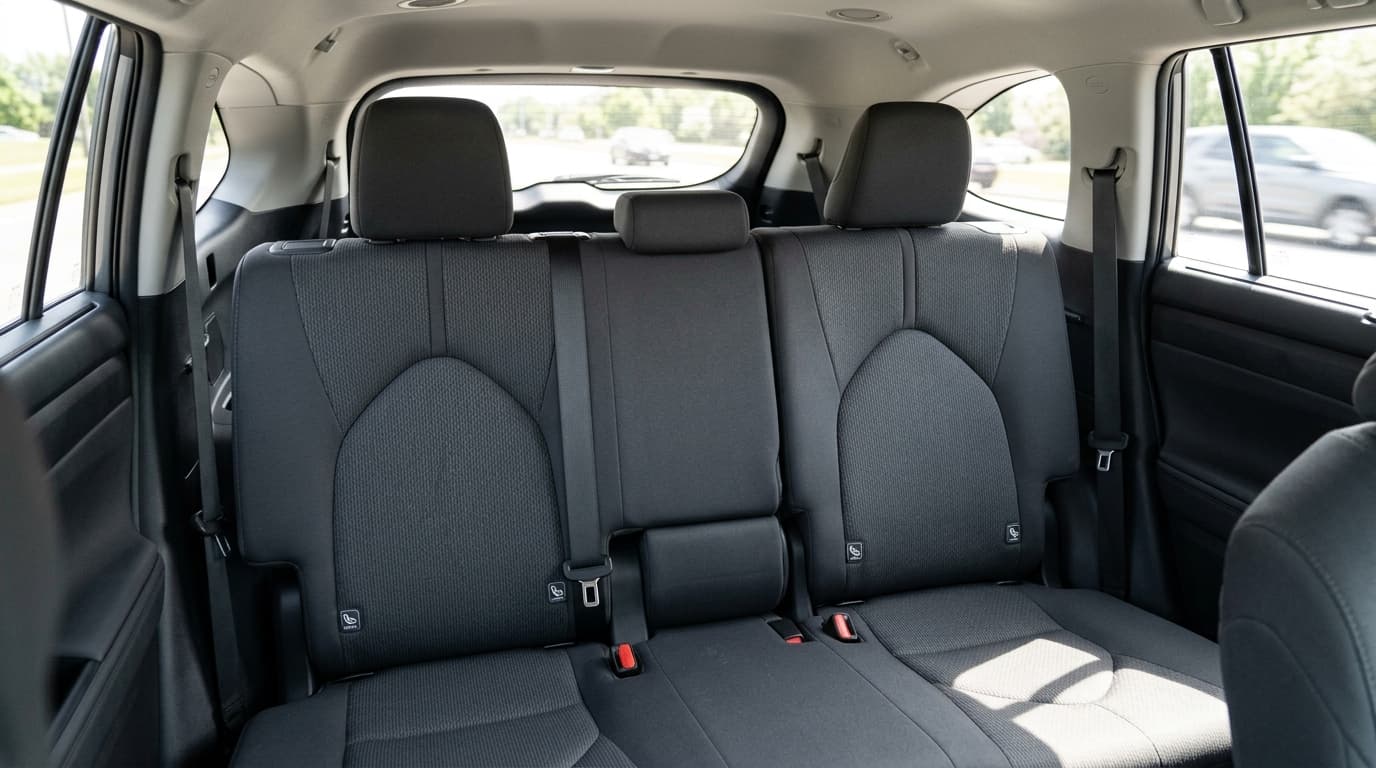
Seven approved seats. Two Isofix anchorages.
The gap is no anomaly: European rules only require anchorages on two rear positions of new cars, since February 2011, and no manufacturer is obliged to go beyond that. Across the electrified seven-seaters recorded here the count runs from two to four positions, and the third row rarely gets any.
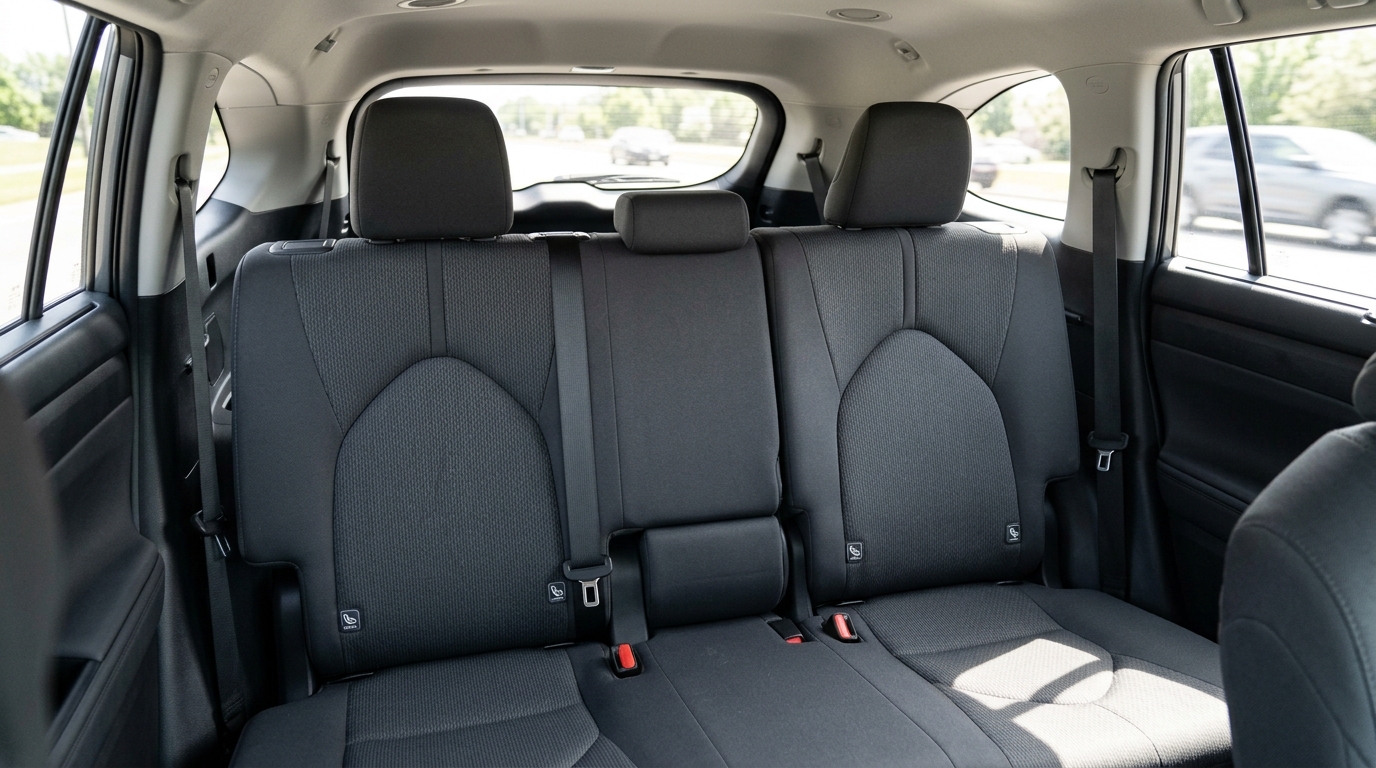
How many Isofix positions does a 7-seater have?
Between two and four. Never seven.
An Isofix anchorage is a pair of metal bars welded to the body structure, at the junction between the cushion and the seatback. Standard ISO 13216 has defined them since 1999, the top tether followed in 2004, and European regulation made two positions mandatory on new vehicles registered after February 2011. Two, no more. Anything beyond that is the manufacturer's choice, and that choice is stated in the handbook, not in the brochure.
Recorded on 19 September 2026 from the handbooks and compatibility tables of four electrified seven-seaters sold in Belgium, one of them counted twice because it changed generation.
| Seven-seater | Row 2 | Row 3 | Isofix positions | Approved seats |
|---|---|---|---|---|
| Kia Sorento HEV and PHEV (from 2021) | 2 outer, top tether on all 3 | 2 seats, top tether on both | 4 | 7 |
| Hyundai Santa Fe Hybrid (from 2024) | 2 outer | 2 seats, top tether on both | 4 | 7 |
| Hyundai Santa Fe Hybrid (up to 2023) | 2 outer | no anchorage, no top tether | 2 | 7 |
| Peugeot 5008 (3 individual seats) | 3 seats | no anchorage | 3 | 7 |
| Toyota Highlander Hybrid (2023) | 2 seats, top tether | no lower anchorage, 1 central top tether | 2 | 7 |
Set against the approved seat count, the best of them covers 4 positions out of 7, or 57 % of the car. The worst equipped covers 29 %. A family with three children still in seats therefore ends up, across half the segment, with one seat too many and one child seat to belt in.
A fifth candidate is missing, and its absence speaks. Renault happily publishes that the Espace E-Tech's third row is designed for passengers up to 1.70 m tall, but the number of anchorages found there appears neither in the configurator, nor on the technical sheet, nor in the specification comparator.
The Santa Fe gained two positions by changing generation
Same name, same hybrid body, same promise of seven seats. And two anchorages of difference.
The TM generation, sold until 2023, offered nothing in the third row: no lower anchorage, no top tether hook. The MX5 generation, launched in 2024, puts two Isofix anchorages and two top tethers in the last row, each on its own seat. It is one of the rare improvements in this segment that shows up on no technical sheet and that genuinely changes life for a family of five.
For a used buyer the consequence is unpleasant: two Santa Fe Hybrids from 2023 and 2024 wear the same badge and are not equivalent on this point. Before comparing two listings, compare the two handbooks, and rely on the chassis number rather than the registration year, because a car registered in 2024 may well be a TM sold off at the end of its run.
Why is the third row so poorly equipped?
Because it folds away, and a seat that disappears into the floor offers no structure to weld an anchorage to.
The second row sits on a flat floor and on the sills; the third folds into a well, on hinges and rails. A manufacturer wanting to put Isofix there has to reinforce the seat structure itself, so make it heavier, so eat into the boot volume it advertises. Many prefer to skip it.
The top tether costs less: it is a hook screwed to the back of the seatback. On the Highlander Hybrid it is the only concession made to the rear row, with a single central hook. The middle position also happens to be the only one with an adjustable head restraint, so the only one where a shell sits flush against the seatback.
The boot left once those seats are up runs between 137 and 340 litres depending on the model. The question of how many seats are genuinely usable therefore comes before the question of anchorages.
Can the support leg rest on the floor well?
Only if the vehicle handbook says so in as many words, for that exact position.
An i-Size seat, approved under regulation R129, needs a third point of support: either a top tether strap, or a support leg reaching down to the floor. The support leg is simpler to fit and more forgiving to adjust. It has one flaw, and in a seven-seater that flaw sits in exactly the wrong place: it has to rest on a surface that will not give way.
And the largest cavity in a seven-seater's cabin is precisely the well where the third-row seats are stored. Its lid is sized to hold luggage, not to take the vertical load of a support leg in a frontal impact. Some manufacturers have reinforced the hatch and say so; others forbid it; others stay silent, which amounts to a prohibition, because an installation the handbook does not provide for is not a compliant installation. And a support leg that punches through a lid at the moment of impact is the third anchor point vanishing at the moment it is needed. The test is done by hand, in thirty seconds. Press down with your full weight on the load area: if it flexes or sounds hollow, find the matching line in the handbook before going any further. Doubt is settled in writing, never by ear.
Do you need Isofix to fit a child seat?
No, and this is the most widespread confusion.
Isofix is a fixing method, not a legal condition. A seat approved under ECE R44 attaches with the position's three-point belt, and many i-Size seats also allow belted installation alongside Isofix. On a third row without anchorages the belted route therefore stays open, on two conditions: that the vehicle handbook does not exclude the position, and that the seat maker's compatibility list names the car.
That list is the most useful document in the whole business and the least consulted. Britax Römer, Cybex, Maxi-Cosi, Joie and BeSafe all publish one, position by position, and it holds surprises: a seat cleared for row 2 of a model can be explicitly excluded from its row 3, because of belt geometry.
The survey, in six steps
Allow twenty minutes, at the dealer or in front of a private seller's car, and bring your own seats.
- Take the handbook out of the glovebox and open the child safety chapter. Photograph the Isofix compatibility table: it gives, position by position, the authorised size classes from a to g.
- Raise the third row and look for the two Isofix logos at the junction of cushion and seatback. They are sometimes hidden under a removable pad or behind a zip.
- Open the tailgate and look at the back of the row 3 seatbacks. The top tether hook is often alone, often central, and often unmarked from inside the cabin.
- Test the support leg if your seat has one. Place it where intended, press down firmly, listen. A lid that sounds hollow and flexes under your palm is a lid not to be used without written confirmation.
- Fit your seat, properly. Clip it in, tension the top tether, close the belt, and check that the row 2 seatback returns to its in-use position without hitting the shell installed behind it.
- Put the actual child in it, then close the door. A seat that fits empty but stops the door closing once the child is in has solved nothing.
Step 5 is the one people skip, and it is the one that rules cars out. The same method applies when you need to line up three child seats across in the second row.
Is it worth paying to have the installation checked?
Nothing in this table needs buying, apart from the seat you already own.
| Item | What it is for | Time | Cost |
|---|---|---|---|
| Vehicle handbook | Compatibility table per position, support leg authorisation | 5 min | 0 € |
| Your own child seats | The only test that counts, geometry varies between models | 10 min | already owned |
| Torch or phone | Finding the top tether hooks behind the row 3 seatbacks | 2 min | 0 € |
| Seat maker's compatibility list | Checking that row 3 is covered, not just row 2 | 3 min | 0 € |
| Fitting check by a specialist retailer | Second opinion when the handbook stays silent | 15 to 30 min | often free with purchase |
A paid check only makes sense in one case: an existing installation you have doubts about, on a car you already own. Otherwise the pre-purchase inspection is enough, and it joins the full third-row check on a used car.
What does Belgian law say about a child in the last row?
The row makes no difference. Article 35 of the highway code requires a suitable restraint for every child under 18 measuring less than 1.35 m, on every seating position fitted with a belt, third row included.
Failing to comply has been a third-degree offence since January 2013, punished by an on-the-spot payment of 174 €. This rule is federal: it is identical in Wallonia, Brussels and Flanders, and none of the three regions adjusts either the height threshold or the amount. Roadworthiness testing, regionalised since the sixth state reform, checks belts and their anchorage points but does not judge a child seat installation.
One exception exists, and it is narrower than people assume. Article 35.1.2 lets a child over three years old travel on the belt alone for an occasional short-distance trip, where the driver is neither the child's father nor mother and no suitable restraint is available in the vehicle. A school run every Tuesday does not meet that definition. The full framework is set out in our article on Belgian law and child seats in a 7-seater.
Five recurring mistakes
- Reading seven seats on the registration certificate and inferring seven Isofix positions.
- Seeing a top tether hook and assuming a lower anchorage in the same place.
- Resting a support leg on the well lid without having read the handbook.
- Clearing the seat for row 2, then fitting it in row 3 without rechecking the list.
- Buying used on the model year rather than on the handbook.
Sources: How to transport my child, Belgian highway code, article 35 and exception 35.1.2; thematic file no. 6 on restraint systems, Vias Institute; Transporting children, some special cases, local police, for the 174 € on-the-spot payment and the third-degree classification; Child car seats, rules and i-Size standards, Moniteur Automobile; roadworthiness testing and inspection points, GOCA; Isofix fixings, Peugeot 5008 user guide; Hyundai owner's manuals for the TM and MX5 generations of the Santa Fe; Renault Espace E-Tech 7-seat configurator, which states a third row designed for passengers up to 1.70 m; support leg and floor storage compatibility, Sécurange association. Positions recorded on 19/09/2026 from manufacturer handbooks and compatibility tables for the model years quoted. Equipment varies by trim and by market: the handbook of your own car is the only enforceable document, and no line of this article replaces a trial with your own seats.
7 places hybrides comparator
Compare all 7 places hybrides side by side.
Compare now →
Frequently asked questions
Sophie teste des voitures familiales depuis 2013, d’abord pour la presse auto belge, aujourd’hui en indépendante depuis le Brabant wallon. Mère de trois enfants, elle juge une 7 places sur ce qui compte vraiment au quotidien : trois sièges-auto qui rentrent de front, le coffre une fois la 3e rangée dépliée, et la hauteur de seuil quand on charge une poussette. Sa règle : un essai sans enfants à bord ne vaut rien.