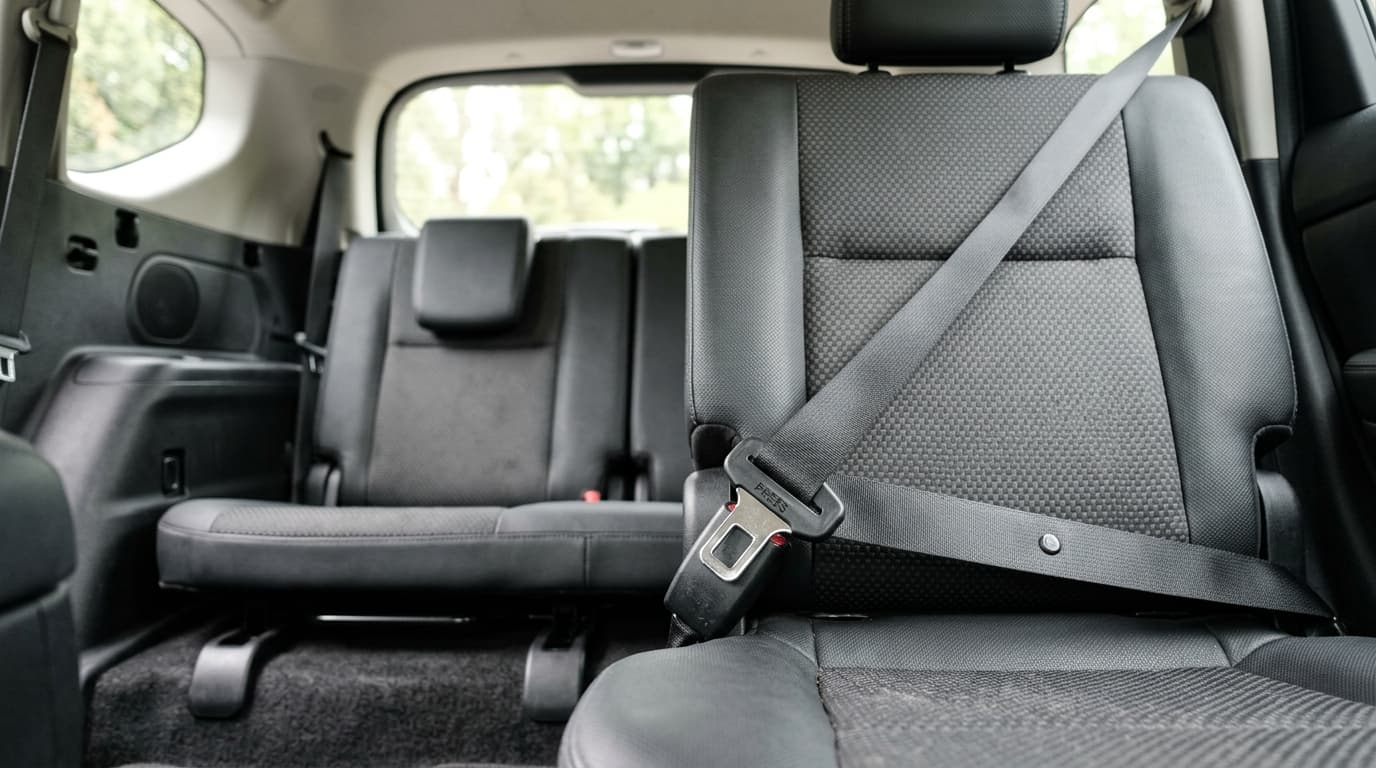
Yes. At the back too.
Short answer: in Belgium, a seatbelt must be worn in every seat that has one, and the third row of a seven-seater is no exception. An unbelted adult pays their own €138.67 in 2026, charges included. For a child, the driver is in principle the one who answers for it.
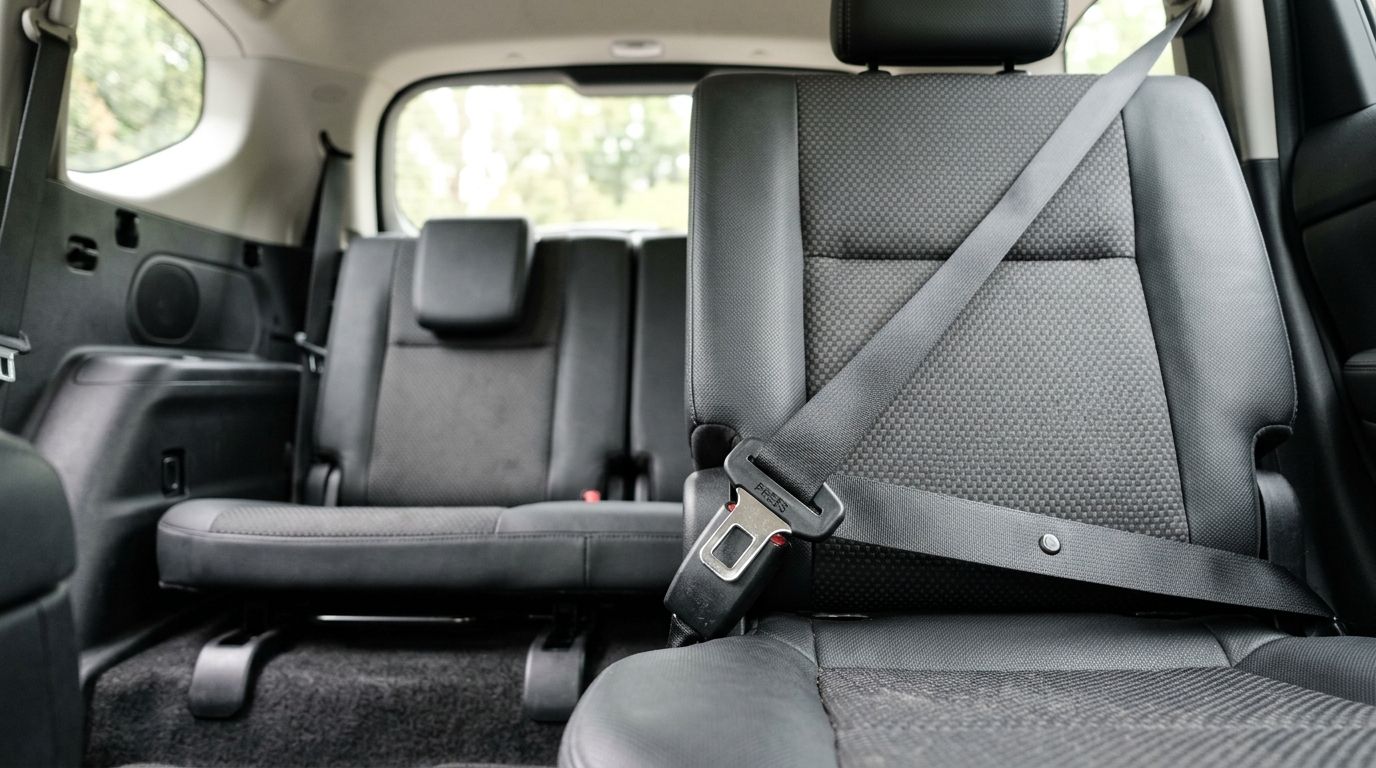
Is a seatbelt compulsory in the third row?
Yes, as soon as the seat has a belt, which means every seven-seater sold new today. Article 35 of the Belgian highway code requires the driver and every passenger of a motor vehicle to wear one, in the front since 1975 and in the back since 1991, as the local police reminded drivers in October 2023.
The text does not distinguish between rows. It only knows seats with a belt and seats without.
The temptation is real, though, and I understand it: the back of a seven-seater is a seat you unfold for ten minutes, for the cousin you drive home from a party or your son's friend dropped at football, and the buckle often hides under the folded cushion, so you set off without looking for it. The code makes no exception for short trips. Nor does it make one for occasional seats, which remain approved seats once they appear on the certificate of conformity. A third-row seat designed for passengers up to 1.70 m, as Renault states for the Espace E-Tech, is still a seat where the belt gets buckled. Seat size changes nothing.
Who pays when the back-row passenger is not belted?
The adult passenger pays their own fine. The police put it plainly: the fine applies whether you are the driver or a passenger. For minors, the code puts the driver in charge of making sure they are belted, so the driver is in principle the one fined.
An adult not wearing a belt has been a second-degree offence since 2012. A child under 1.35 m without a suitable restraint has been third degree since 2013. The amounts follow indexation: second degree cost €116 in 2023 and €128 under the scale updated on 1 June 2026, plus €10.67 in charges.
Take an ordinary Sunday evening, seven aboard on the way back from a birthday party, and count.
| Unbelted occupant | Where | Degree | Who pays | 2026 amount |
|---|---|---|---|---|
| Grandfather | Row 3 | 2nd | himself | €138.67 |
| Grandmother | Row 3 | 2nd | herself | €138.67 |
| Teenager, 15, 1.62 m | Row 2 | 2nd | the driver, in principle | €138.67 |
| Child, 7, 1.20 m, no booster | Row 2 | 3rd | the driver, in principle | €201.67 |
| Total | €340.34 of it for the driver | €617.68 |
Six hundred euros for a twenty-minute drive.
The rule is federal: the amount is the same in Namur, Brussels and Ghent.
What if the back belt is trapped, damaged or missing?
It all depends on what is actually at that seat.
| Situation at the back | Belt compulsory? | What to do |
|---|---|---|
| Belt in working order, adult passenger | Yes | Buckle up before setting off |
| Child under 1.35 m | Yes, with a suitable restraint | A seat or booster compatible with that seat, see the handbook |
| Teenager of 1.35 m or more | Yes | The belt alone is enough, the driver checks |
| Buckle trapped under the folded cushion | Yes, the seat has one | Free the buckle before sitting, never sit on it |
| Belt that will not latch or retract | Yes, so the seat is unusable | Leave the seat empty and get it repaired |
| Seat without a belt on an older vehicle | No duty to wear one | Off limits to children under three, check box S.1 |
| Seat added later, missing from the papers | Not applicable | It is not an approved seat: nobody sits there |
| Passenger holding a valid exemption | No | Keep the exemption card on board |
The last two rows come back to the same paperwork question, covered in our article on the certificate of conformity of a 7-seater.
Can a child ride at the back without a car seat?
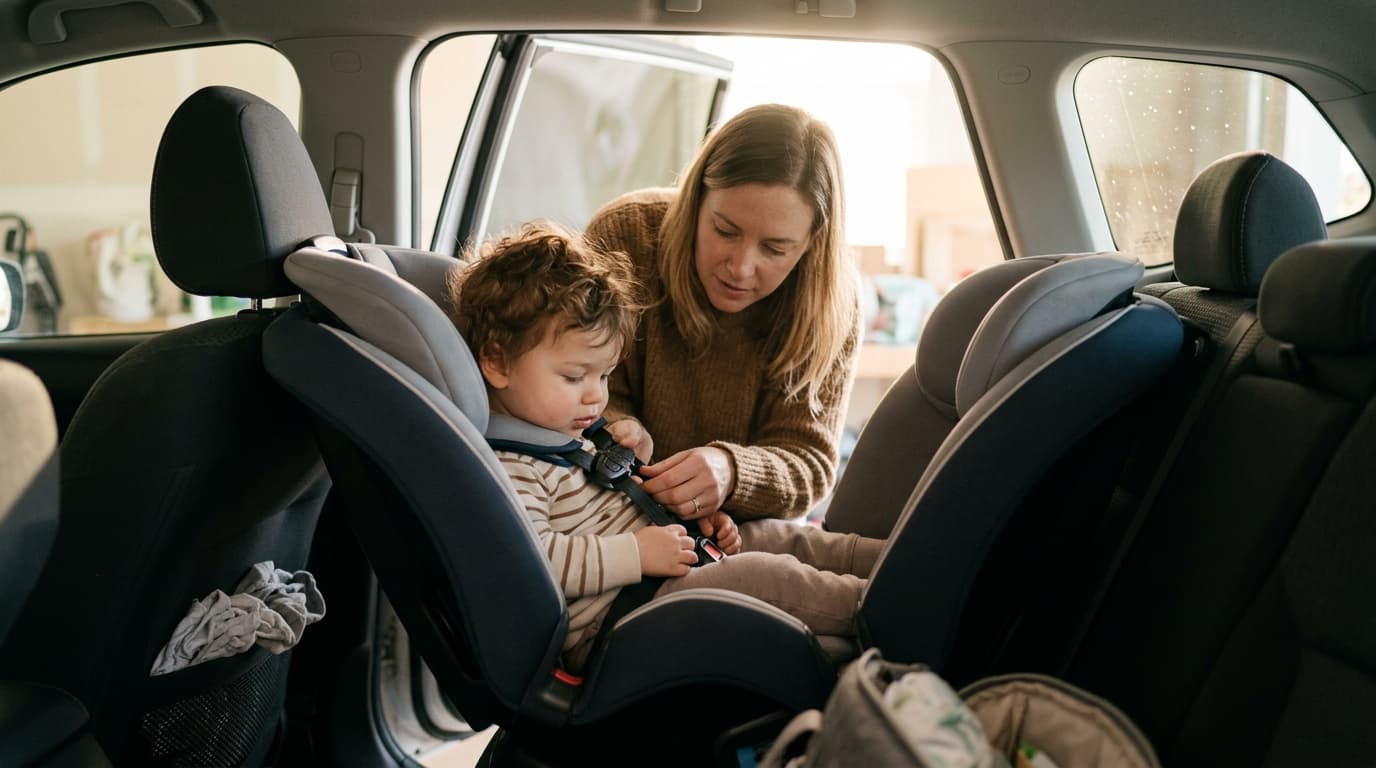
No, if they are under 1.35 m. The row changes nothing: a suitable restraint, on a seat with a belt. The exception for a third child over three, when two restraints already fill the bench, exists but is narrow. It is set out in Belgian child seat law in a 7-seater, and the anchorages available at the back in our survey of Isofix positions in the third row.
Is a medical exemption from before 2022 still valid?
Only if it is recent. Exemptions issued before 1 March 2022 stopped being valid on 31 December 2025, and many holders found out at a roadside check.
The new procedure starts with a certificate drawn up by a doctor on the template of the Federal Mobility Service (SPF Mobilité), then an online application through the Seatbelt app. Cost: €23. Duration: ten years at most. The procedure is federal and identical in all three regions, as the Walloon procedure page states. Pregnancy exempts nobody: the lap strap goes under the bump.
Does the roadworthiness test check the back belts?
Yes, every belt and its anchorages, row by row, under the common European checklist of Directive 2014/45/EU.
Vehicle inspection has been a regional matter since the sixth state reform, with separate approved bodies in Wallonia, Brussels and Flanders, but the seatbelt check is the same everywhere. A frayed strap, a slack retractor or a buckle that no longer latches is recorded as a defect. On a seven-seater, it is precisely the back-row belts, the least used and the most often pinched by the folding mechanism, that cause trouble. Unfold the third row the day before the test and give each strap a sharp tug.
Why is the third row the least measured in a crash?
Because nobody puts a dummy there. Euro NCAP's child occupant protection protocol, in technical bulletin CP 008-1 of May 2025, places the Q6 and Q10 dummies in the outer second-row seats for the frontal and side tests. The third row only enters the assessment to check that child seats can be fitted there, with second-row seats folded if need be.
In other words, a seven-seater's five stars say nothing about the protection of a passenger sitting above the rear overhang, a few tens of centimetres from the tailgate. All the more reason to buckle up there, and to keep the back for passengers who genuinely fit, a question we cover in the 7-seater with seven true seats.
Six checks before setting off with seven
- Every third-row buckle is out from under the cushion and within reach.
- Every strap pulls out and winds back smoothly, all the way.
- Every buckle latches and releases, tested by hand.
- The back-row head restraint is raised for an adult; many models ship it lowered.
- No child under 1.35 m sits at the back without a restraint compatible with that seat.
- The number of occupants does not exceed the seats in box S.1.
Sources: local police, "Porter la ceinture", 06/10/2023 (front since 1975, rear since 1991, €116 for second degree at the time, same fine for driver and passenger); Moniteur Automobile, "Les amendes routières et montants en Belgique", updated 01/06/2026 (second degree €128, third degree €191, plus €10.67 in charges); news.belgium.be, seatbelt offences reclassified as second degree, 20/07/2012; codedelaroute.be, "Comment transporter mon enfant", articles 35 and 44 of the highway code; Public Service of Wallonia, "Être dispensé du port de la ceinture de sécurité pour contre-indication médicale", and RTBF, 08/12/2025, updated 10/03/2026, for the expiry of old exemptions on 31/12/2025, the €23 fee and the ten-year validity; Euro NCAP, Technical Bulletin CP 008-1 Child Occupant Protection, version 1.1, May 2025, for dummy positions in the second row; Renault Espace E-Tech 7-seat configurator for a third row designed up to 1.70 m; Directive 2014/45/EU on periodic roadworthiness tests. Amounts and calculation noted on 30/09/2026. Amounts are indexed and change: the on-the-spot fine offered by the officer is authoritative. This article is not legal advice.
SUV 7 places comparator
Compare all suv 7 places side by side.
Compare now →
Frequently asked questions
Sophie teste des voitures familiales depuis 2013, d’abord pour la presse auto belge, aujourd’hui en indépendante depuis le Brabant wallon. Mère de trois enfants, elle juge une 7 places sur ce qui compte vraiment au quotidien : trois sièges-auto qui rentrent de front, le coffre une fois la 3e rangée dépliée, et la hauteur de seuil quand on charge une poussette. Sa règle : un essai sans enfants à bord ne vaut rien.