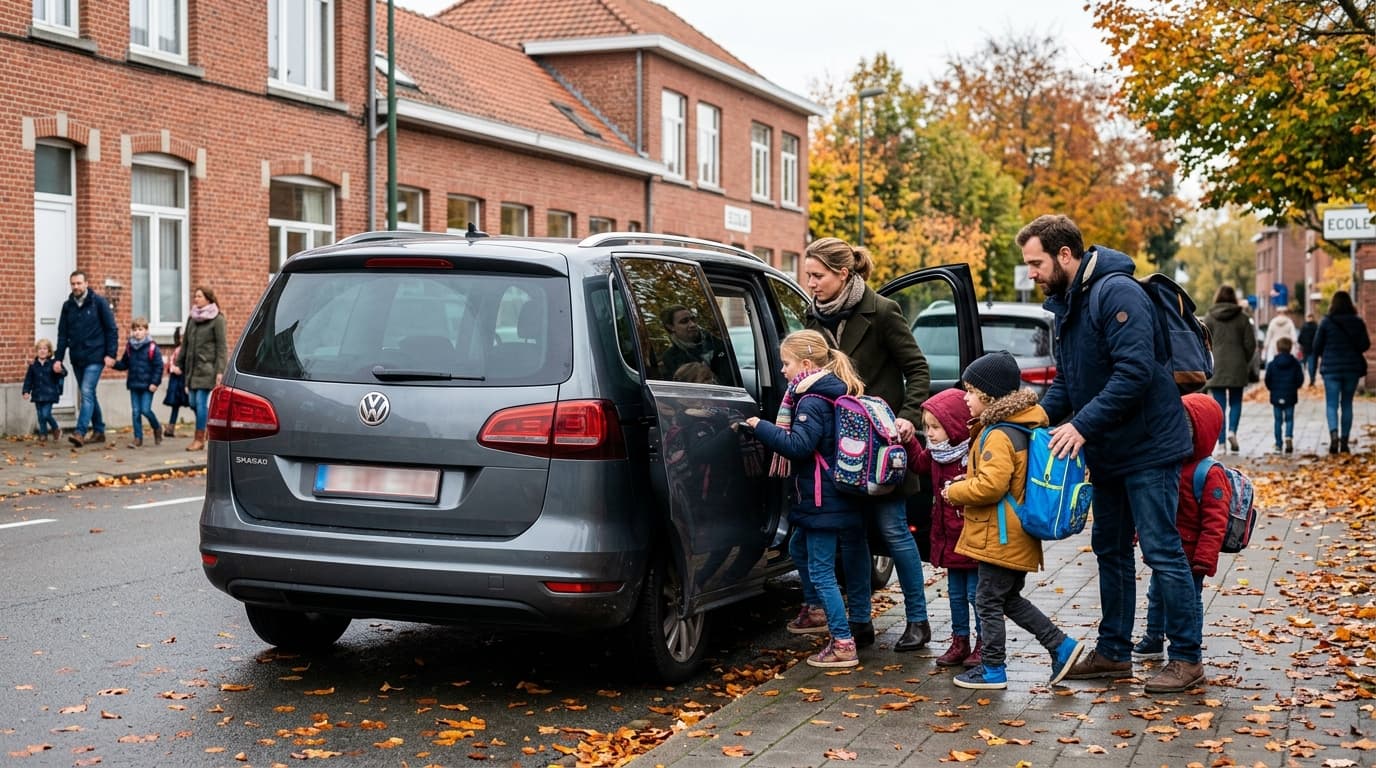
Yes, and without any extra policy.
Short answer: in Belgium, your car's compulsory motor liability insurance already covers every passenger you carry, including other families' children on a school or sports car-share. Their injuries are compensated even if you are not at fault. Two blind spots: your own injuries if you are to blame, and overcrowding.
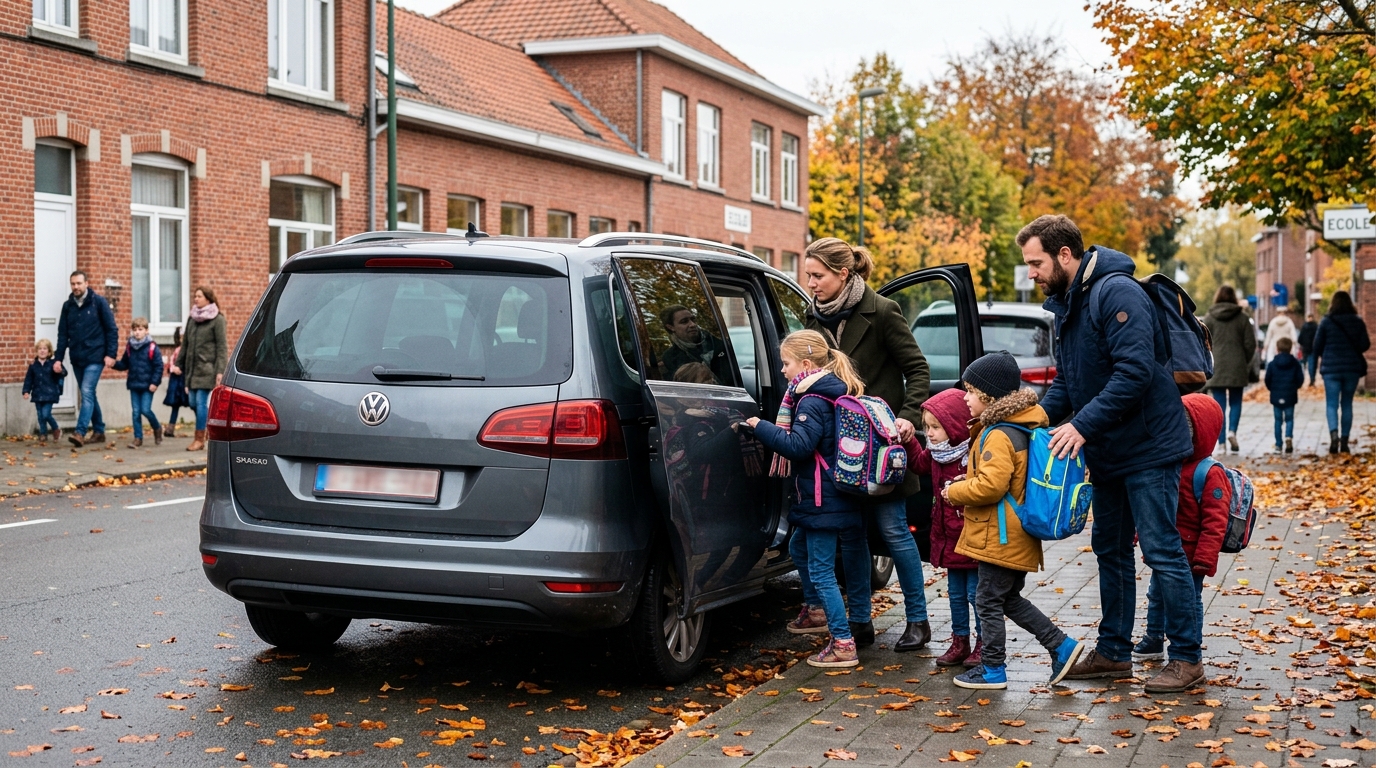
Are your passengers covered by your car insurance?
Yes, all of them. The brochure from Assuralia, the Belgian insurers' federation, explicitly lists the people in your vehicle among the third parties covered by motor liability insurance (RC auto). It adds that passengers are vulnerable road users, who are always entitled to compensation for their injuries after an accident with a motor vehicle.
For a car-share, the consequence is simple. The neighbour's child in the third row of your Peugeot 5008 does not need to prove you were at fault: as Test-Achats sums it up, the liability insurance of the vehicle they were travelling in pays their medical costs, any disability, their clothes and their glasses. If another driver caused the accident, your insurer pays first and in principle settles up afterwards with the at-fault driver's insurer.
Do you need special insurance for car-sharing?
No. I reread the Assuralia brochure and the Test-Achats passenger page with that question in mind: the word car-sharing appears in neither, which makes sense, since nothing in motor liability insurance tells your children apart from anyone else's. The "car-sharing insurance" products you hear about mostly target paid platforms, and usually come from France.
The limit is money. A parent chipping in for fuel does not make you a taxi. A driver who makes money on their trips is carrying passengers for reward, an activity each region regulates separately, and in principle steps outside the private use declared to their insurer.
And if you, the driver, are the one injured?
This is the real gap in the cover. The at-fault driver is not a third party for their own insurance, so they are not covered for the harm they suffer themselves. Assuralia says so in plain terms, and points to optional driver insurance, taken out separately, which covers your injuries even when the accident is your fault.
For a parent who drives four times a day with six children behind them, the option deserves a line in the car's annual budget. It does not protect the passengers, who are already covered: it protects the income of the family behind the wheel.
Does a child count as one seat in a car-share?
Yes, always. The police state it flatly in their page on carrying children, published on 28 August 2024: every child counts as a full person and must have a seat of their own. Two little ones on one belt, even for three hundred metres, is not a thing.
Overcrowding has a precise cost. The Royal Decree of 16 April 2018, which sets the standard motor liability policy, lets the insurer claim against the policyholder when the number of passengers exceeds the number authorised, in proportion to the passengers too many and provided it establishes a link with the accident. Do the sum on a seven-seater whose box S.1 reads 7. Six passengers authorised. You take seven, because a seventh child missed the bus and everyone "squeezes up at the back". One passenger in seven is extra, so one seventh of everything the insurer pays for passengers, which you will reimburse out of your own pocket. The victims are compensated in full. The mechanism is explained in our article on the certificate of conformity of a 7-seater.
Eight car-sharing situations, eight answers
| Situation | Covered by motor liability? | Who pays or what to do |
|---|---|---|
| Another family's child injured, you are at fault | Yes | Your liability insurer compensates the child |
| Child injured, the other driver is at fault | Yes | Your insurer pays, then claims against the at-fault driver's insurer |
| You are injured and at fault | No | Driver insurance if you took it, otherwise health insurance |
| A child opens their door on a cyclist | Yes | Your liability cover also covers a passenger's fault |
| Eight occupants in a seven-seater | Yes for the victims | Insurer's claim against you in proportion to the overcrowding |
| Child under 1.35 m without a booster | Yes in an accident | €191 fine plus €10.67 charges, in principle for the driver |
| Parents chipping in for fuel | Yes | Nothing to declare, private use |
| Trips paid above their cost | Check | Tell the insurer, regional rules on paid passenger transport |
The highway code and the motor liability insurance act are federal: this table applies identically in Liège, Brussels and Leuven.
Can you ask for a contribution to costs?
Yes, as long as it stays a contribution. The cleanest benchmark is the public mileage allowance, which Partena Professional publishes every quarter: €0.4452 per kilometre from 1 October to 31 December 2026. It is what a public employer refunds for a kilometre driven in a private car, and nobody gets rich applying it to a school run.
Take a typical back-to-school rota: one MPV, six children from three families, a school 8 km away, there and back twice a day, so 32 km daily and 160 km over five days. The week costs €71.23, or €11.87 per child. A family sending two children owes €23.74 to the one driving, or a week at the wheel in return.
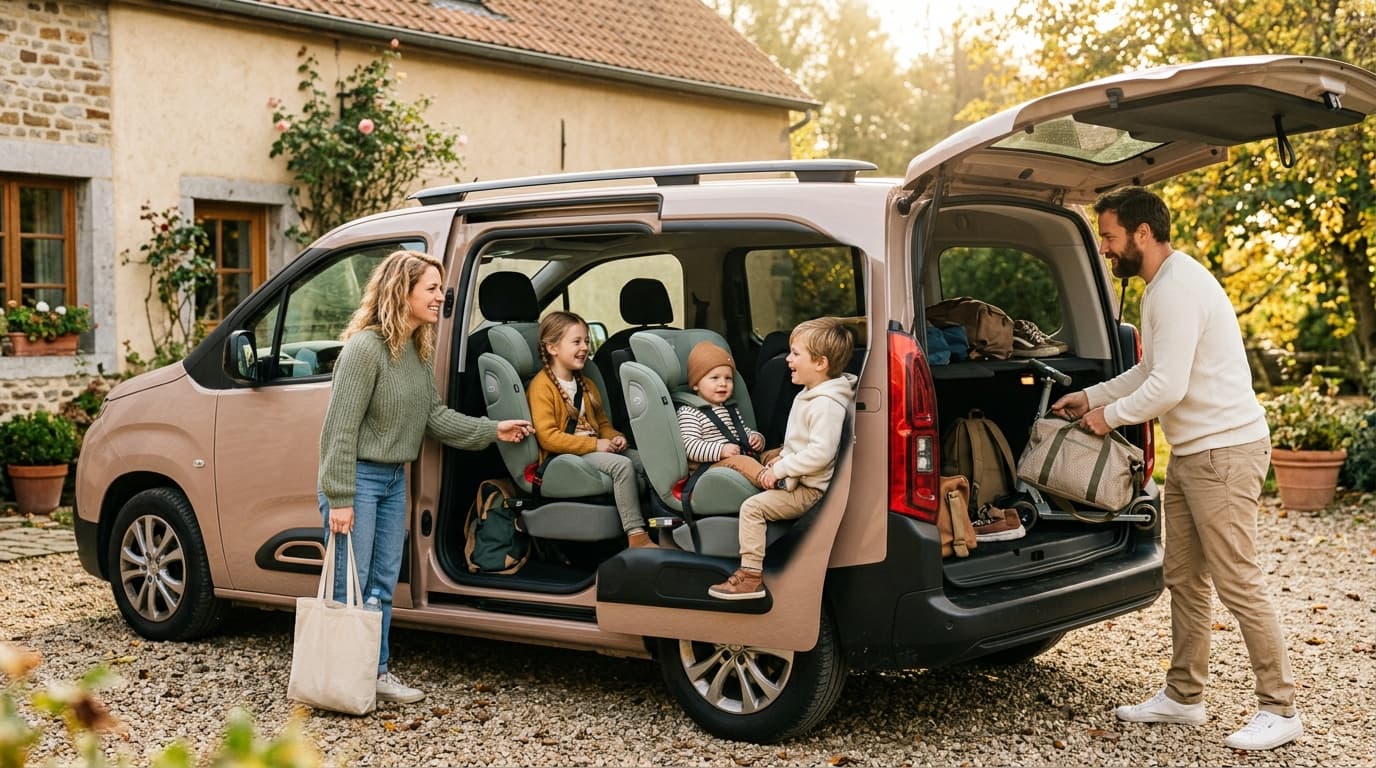
Who provides the car seat for someone else's child?
The law names nobody. It requires a child under 1.35 m to travel in a suitable restraint, on a seat with a belt, and makes the driver responsible for checking minors: so the driver risks the fine. The exceptions, including the third-child one, are in our article on Belgian child seat law in a 7-seater.
In practice, with children, the booster travels with the child, not with the car. It still has to fit: three seats across will not go into every second row, as our article on three child seats across explains.
Before the first week of car-sharing
- Count the occupants, driver included, and compare with box S.1 of your registration certificate.
- Ask each family to supply their child's booster or seat, with its instructions.
- Check that every third-row belt buckles, with buckles freed from under the cushions.
- Turn on the child locks on the rear doors, or choose a vehicle with sliding doors.
- Agree the per-kilometre rate or the driving rota in writing, so no parent feels paid.
- Check whether your policy includes driver insurance, and its ceiling.
- Keep each parent's phone number in the car, not just in your phone.
Sources: Assuralia, "L'assurance auto", undated brochure, online since April 2024 according to its address (PDF), for passengers covered as third parties, their vulnerable road user status, a passenger's liability, the exclusion of the at-fault driver and optional driver insurance; Test-Achats, "Les passagers sont-ils assurés en cas d'accident ?", updated 23/05/2025; local police, "Transport d'enfants : quelques cas particuliers", 28/08/2024; Royal Decree of 16 April 2018 setting the conditions of compulsory motor liability insurance contracts, article 47; Partena Professional, "Nouveau montant pour l'indemnité kilométrique d'octobre 2026", updated 29/09/2026 (€0.4452 per kilometre from 01/10 to 31/12/2026); 2026 fine amounts taken from our article on third-row seatbelts. Calculations of 14/10/2026. Your policy and its general terms are authoritative: this article describes the general legal framework and replaces neither your insurer nor legal advice.
Monospaces & vans comparator
Compare all monospaces & vans side by side.
Compare now →
Frequently asked questions
Sophie teste des voitures familiales depuis 2013, d’abord pour la presse auto belge, aujourd’hui en indépendante depuis le Brabant wallon. Mère de trois enfants, elle juge une 7 places sur ce qui compte vraiment au quotidien : trois sièges-auto qui rentrent de front, le coffre une fois la 3e rangée dépliée, et la hauteur de seuil quand on charge une poussette. Sa règle : un essai sans enfants à bord ne vaut rien.