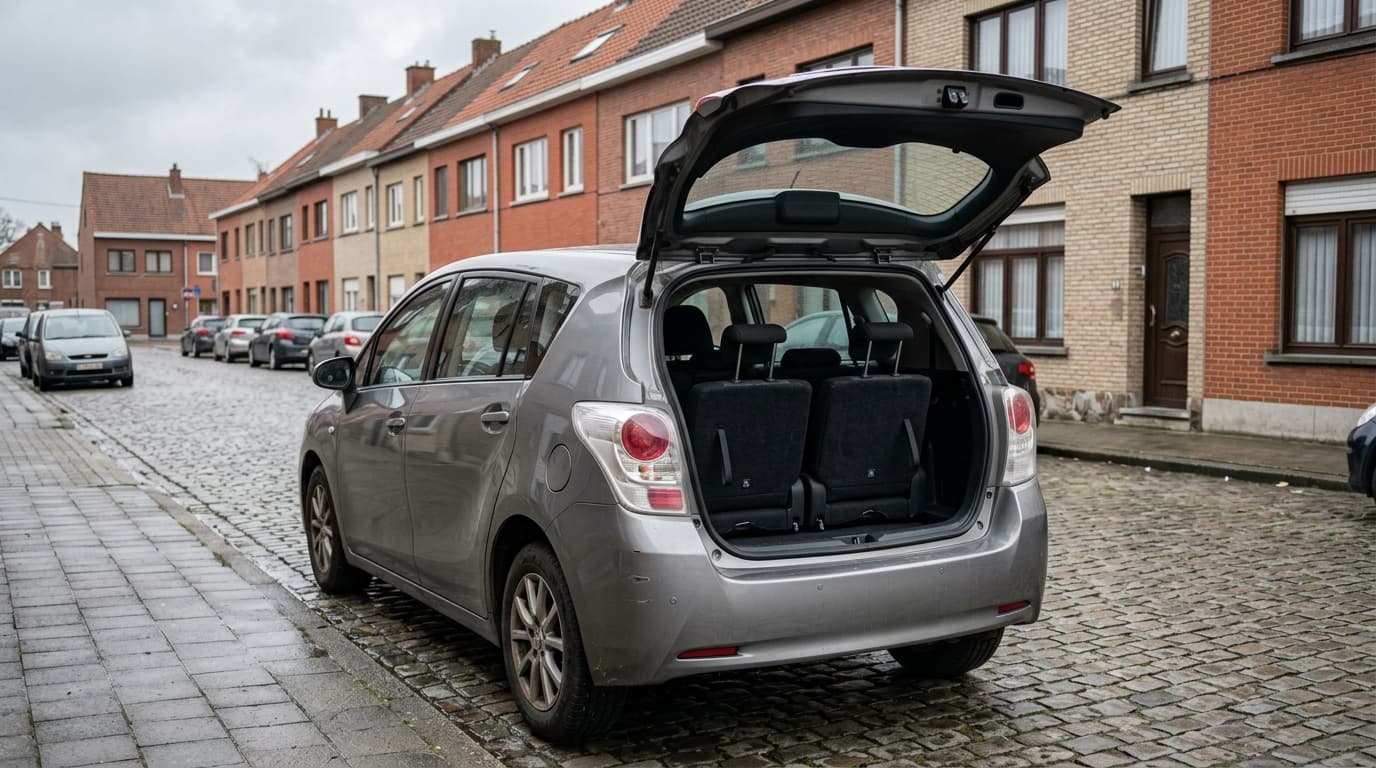
Six compact MPVs, a single verdict: they are 5+2s.
The Touran, Grand Scénic, Grand C4 Picasso, Zafira Tourer, Grand C-Max and Lodgy you find on the Belgian used market leave only 92 to 207 litres of boot once all seven seats are taken, and their third row is built for children. For a true used seven-seater, you have to step up to the Sharan, the Alhambra or the Galaxy.
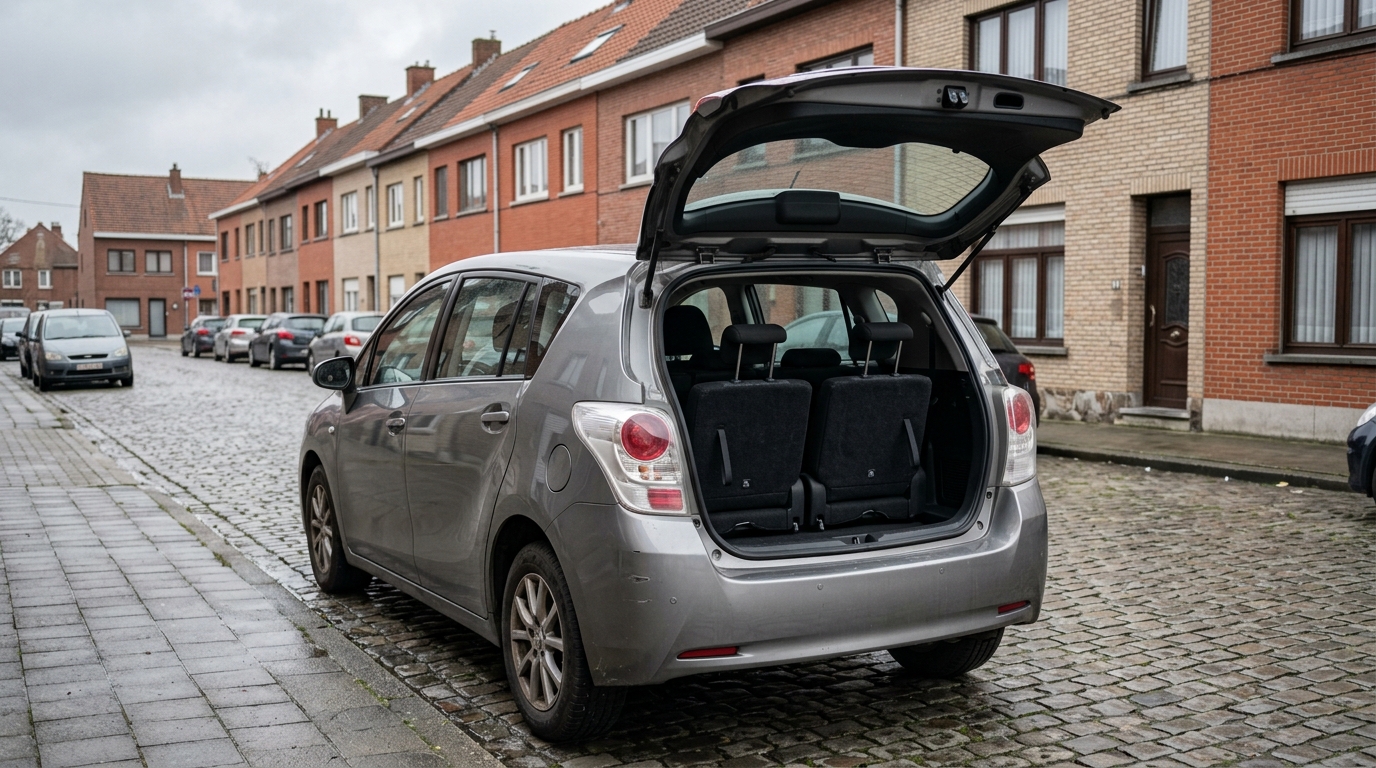
Six MPVs gone from showrooms, still everywhere second-hand
Open any Belgian classifieds site and filter on "MPV, 7 seats". The same names come back page after page: Volkswagen Touran, Renault Grand Scénic, Citroën Grand C4 Picasso (renamed Grand C4 SpaceTourer in 2018), Opel Zafira Tourer, Ford Grand C-Max, Dacia Lodgy.
They share something the silhouette hides. All were born on a compact car platform, between 4.50 and 4.66 metres long, and their third row was squeezed into a floor that was not originally designed for it. The motoring press has called that formula a 5+2 for twenty years.
Most have left the new-car ranges. The Grand C-Max and the Zafira Tourer in 2019, the Lodgy in 2021, the Grand Scénic and the Grand C4 SpaceTourer between 2022 and 2023. Only the Touran stayed on sale longer. Yet these are the cars Belgian families buy when a third child arrives and the budget tops out at 12,000 or 15,000 euros, because a seven-seat SUV of the same age costs noticeably more.
On paper, all of them are seven-seaters, and the law says nothing else: each shows a 7 in box S.1 of the registration certificate, driver included, the same figure as on its certificate of conformity. The problem does not show on the paperwork. It shows in the boot.
How much boot is left with all seven seats in use?
Between 92 and 207 litres. 158 litres on average across the six compacts.
I lined up the boot volumes of each generation found in numbers on the market, using one single measuring basis for every row so the figures stay comparable. The "five-seat" boot is the one you get with the third row folded into the floor, not removed. The last column is our own calculation: the share of the five-seat boot that survives when the two rear seats are unfolded.
| Model (generation) | Production | Length | Boot, 7 seats | Boot, 5 seats | Share kept at 7 |
|---|---|---|---|---|---|
| Ford Grand C-Max | 2010-2019 | 4,519 mm | 92 L | 475 L | 19% |
| Volkswagen Touran (2nd gen.) | since 2015 | 4,527 mm | 137 L | 633 L | 22% |
| Opel Zafira Tourer | 2011-2019 | 4,658 mm | 152 L | 710 L | 21% |
| Citroën Grand C4 Picasso / SpaceTourer | 2013-2022 | 4,602 mm | 170 L | 645 L | 26% |
| Renault Grand Scénic IV | 2016-2022 | 4,634 mm | 189 L | 533 L | 35% |
| Dacia Lodgy | 2012-2021 | 4,498 mm | 207 L | 634 L | 33% |
| Volkswagen Sharan (2nd gen.), benchmark | 2010-2022 | 4,854 mm | 300 L | 711 L | 42% |
The bottom row changes how you read the rest. We will come back to it.
Start at the top. The Grand C-Max's 92 litres are not a typo: Ford fitted two occasional seats into a 4.52-metre MPV, and behind them there is room for a sports bag lying flat. A standard cabin bag (55 × 40 × 20 cm) is 44 litres. Two fit on paper, one in practice, because a boot is never a perfect box.
The right-hand column says the same thing differently. On a Touran, unfolding the third row costs 78% of the boot. On a Grand Scénic IV, 65%. None of the six keeps more than a third of its volume, which means that in seven-seat mode the boot no longer exists in the sense a family means when leaving on holiday.
The shortest of the six has the biggest boot
That is the result I did not expect.
The Dacia Lodgy is the shortest of the group, 4,498 mm, and it keeps the largest seven-seat boot, 207 litres. The Opel Zafira Tourer is the longest, 4,658 mm, and keeps just 152. Sixteen centimetres less for 55 litres more: between these two cars, length works exactly the opposite way to what people assume.
The most plausible explanation lies in the shape of the body, not its size. The Lodgy is a tall estate with an almost vertical tail, drawn by Dacia for volume at the lowest cost, and its third-row seats can be removed. The Zafira Tourer has a more raked tailgate and stows its two rear seats in the floor, which costs depth even when they are in use. The first sacrifices elegance, the second sacrifices litres.
This matches what I found on SUVs and the Dacia Jogger in the piece on 7-seaters that really seat seven: below 4.75 metres, length is only a rough first filter, and the angle of the tailgate decides the remaining boot. Between two used compact MPVs, length tells you almost nothing. The slope of the rear window does.
Grand Scénic IV: 61 mm longer, 19 litres smaller
Same name, not the same boot.
The Renault Grand Scénic III (2009-2016) offered 208 litres with seven seats. The Grand Scénic IV that replaced it in 2016 is 61 mm longer and offers only 189. Nineteen litres lost while growing: the centimetres gained outside went somewhere other than the boot, and Renault never advertised it.
Citroën went the other way. The first Grand C4 Picasso (2006-2013) left 150 litres behind the third row; the second, launched in 2013 and renamed Grand C4 SpaceTourer in 2018 without a new body, rises to 170.
In an advert, "Grand Scénic 7 seats 2015" and "Grand Scénic 7 seats 2017" therefore do not describe the same car. Same trap with third-row Isofix anchor points, which sometimes change from one generation to the next.
Who can sit in the third row of a 5+2?
Children. Manufacturers write it themselves, more or less directly.
For the Zafira Tourer, the documentation quoted by the specialist press is unambiguous: only young children sit comfortably there, on a 2.76-metre wheelbase. Other data sheets talk about "occasional seats" or "jump seats", vocabulary that says the same thing without admitting it.
The real test is the second row. On most of these MPVs it is made of three individual sliding seats (the Lodgy keeps a split bench), and that is precisely what makes the third row usable: slide the middle seats forward a few centimetres and the knees at the back can breathe. Except that the children in the middle then lose what the ones at the back gain. In a 5+2, legroom is not created, it is moved around.
A figure from our earlier surveys: on the second-generation Touran, the third row has two Isofix positions, on top of the three in the second row. Two child seats in the back of a compact MPV is possible. Two twelve-year-olds on a Brussels-Ostend round trip is something else, and a height of 1.50 m at that age leaves little margin for the following years.
The Sharan and its cousins: 28 cm longer, almost double the boot
Back to the bottom row of the table.
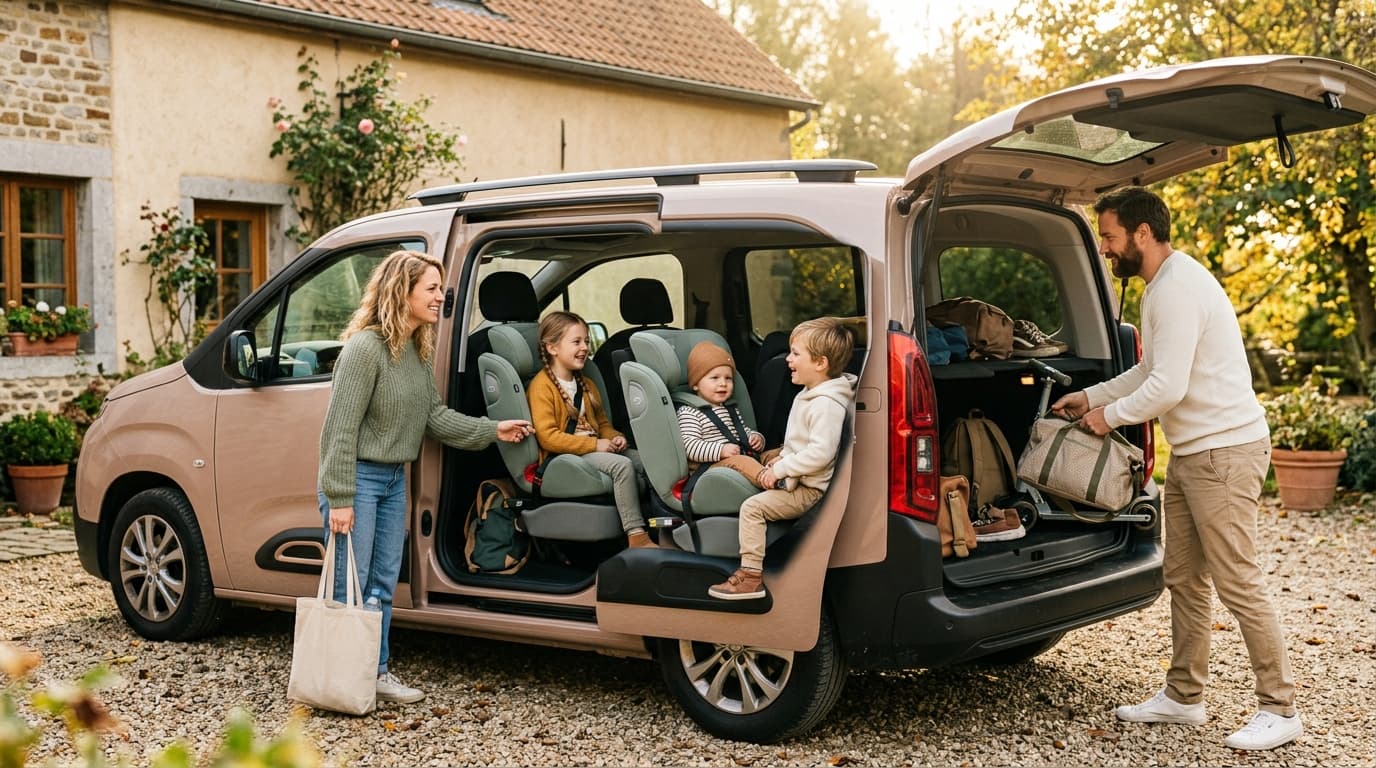
The second-generation Volkswagen Sharan measures 4,854 mm. That is 281 mm more than the average of the six compact MPVs (4,573 mm), roughly the long side of an A4 sheet. Those 28 centimetres let it keep 300 litres of boot with seven seats occupied, nearly twice the compact average, and 42% of its five-seat volume where the best compact tops out at 35%.
It also opens with sliding rear doors, which only the Grand C-Max shares among the compacts, and its third row takes teenagers on a real journey. It is a true seven-seater in the sense parents mean: seven people and bags, no roof box.
The Seat Alhambra is its twin, built in the same Portuguese factory at Palmela, and the Ford Galaxy plays in the same league. All three left the new-car ranges between 2020 and 2023. We compared the twins in our used Seat Alhambra vs VW Sharan head-to-head (in French).
The choice then comes down to one question. How many times a year will you travel with seven people and luggage? Two or three times, a Grand Scénic or a Lodgy is enough, with a roof box for the holidays. Every week, between the school run and club outings, the Sharan's 28 centimetres pay for themselves, and it is one of the rare cases where a used MPV beats a more expensive, more recent seven-seat SUV on the only criterion that matters here.
Can a 2013 diesel still enter Brussels?
No, in most cases. And it is the detail adverts most often leave out.
Euro 6 became mandatory for new cars registered from 1 September 2015. A diesel MPV put on the road before that date is therefore usually Euro 5, which covers most Grand Scénic IIIs, early Zafira Tourers and Lodgys, and the Grand C-Max and Grand C4 Picasso units from 2013 to 2015. Those are precisely the cheapest cars on the market, the ones you spot first on a tight budget.
The rule differs across the three regions.
| Region | Euro 5 diesel MPV in 2026 | What to know |
|---|---|---|
| Brussels | banned across the whole Region since 1 January 2026 | 350 euro fine after a first warning letter, day pass available |
| Flanders (Antwerp, Ghent) | still allowed | the tightening planned for 2026 was postponed by the Flemish government on 19 September 2025 |
| Wallonia | no regional restriction | the regional low emission zone project was abandoned, only municipal zones remain under discussion |
The Brussels low emission zone covers all nineteen municipalities, except the Ring, and enforcement is by camera. On the Flemish side, the city of Antwerp confirms that Euro 5 diesels remain allowed in its low emission zone in 2026. Wallonia revised its decree before its planned entry into force in 2025.
For a family living in Namur that never drives into Brussels, a 2014 Lodgy dCi remains a defensible purchase. For a family in Uccle, it is a car that cannot leave the municipality without paying. The exact standard is in box V9 of the registration certificate, or failing that on the certificate of conformity.
Seven points to check in the advert before you travel
Before driving out for a test, seven lines to read or ask the seller about:
- the exact generation, worked out from the year and the shape, since one name covers two different boots;
- box S.1 of the registration certificate, which must show 7: a third row added afterwards creates no legal seat;
- box V9, which gives the Euro standard, to set against your home region and your trips to Brussels;
- the physical presence of both third-row seats, which some owners take out, store in the garage and forget to hand over;
- the folding mechanisms, tested one by one, rear seats and middle seats;
- the number of Isofix positions row by row, counted in the car rather than read in the advert;
- the report of the pre-sale roadworthiness test, required in all three regions before a used car is re-registered, to request before the appointment.
The roadworthiness test checks seatbelts and their anchorages. It does not check that the rear seats still fold, or that the floor well that holds them has not taken on water. For that inspection, our list of third-row checks on a used 7-seater takes over.
Sources: lengths and boot volumes recorded on 28/09/2026 from automobiledimension.com, same measuring convention for every row (Renault Grand Scénic IV 4,634 mm, 189 L with 7 seats and 533 to 718 L with 5; Grand Scénic III 208 L; Citroën Grand C4 SpaceTourer 4,602 mm, 170 L and 645 L, 2011 Grand C4 Picasso 150 L; Ford Grand C-Max 4,519 mm, 92 L and 475 L; Dacia Lodgy 4,498 mm, 207 L and 634 to 827 L; 2016 Volkswagen Touran 4,527 mm, 137 L and 633 to 743 L; Volkswagen Sharan 4,854 mm, 300 L and 711 to 885 L); Opel Zafira Tourer, 4.66 m, 2.76 m wheelbase, 152 L with 7 seats and 710 L with 5, LaTribuneAuto, "Espace" review dated 19/05/2016. Touran Isofix positions: survey published on this site on 24/08/2026. Low emission zones: Brussels Fiscality, "Controls and fines" page on lez.brussels, consulted on 28/09/2026; City of Antwerp, Slim naar Antwerpen; Public Service of Wallonia, revision of the low emission zone decree. Volumes vary with trim and measuring method, and the Euro standard of a given car can only be read on its own registration certificate.
Monospaces & vans comparator
Compare all monospaces & vans side by side.
Compare now →
Frequently asked questions
Sophie teste des voitures familiales depuis 2013, d’abord pour la presse auto belge, aujourd’hui en indépendante depuis le Brabant wallon. Mère de trois enfants, elle juge une 7 places sur ce qui compte vraiment au quotidien : trois sièges-auto qui rentrent de front, le coffre une fois la 3e rangée dépliée, et la hauteur de seuil quand on charge une poussette. Sa règle : un essai sans enfants à bord ne vaut rien.