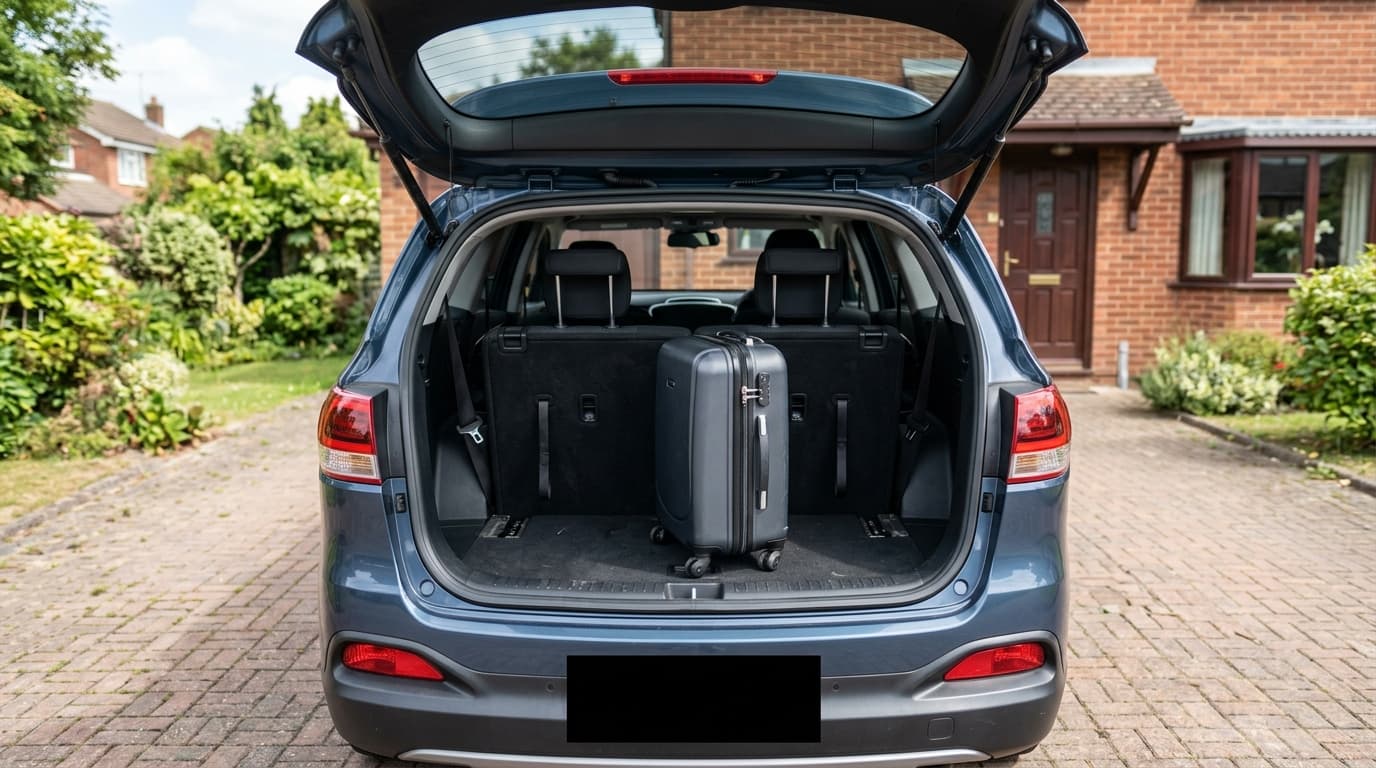
The boot of a seven-seat Peugeot 5008 holds 259 litres. Or 348. Both figures come from Peugeot.
Short answer: a 7-seater's boot volume is quoted in two units that are not equivalent. VDA dm³ counts rigid one-litre blocks, while plain "litres" measure the whole space, corners included. Behind a third row, the second figure is a third higher than the first. Always compare two cars in the same unit, preferably VDA.
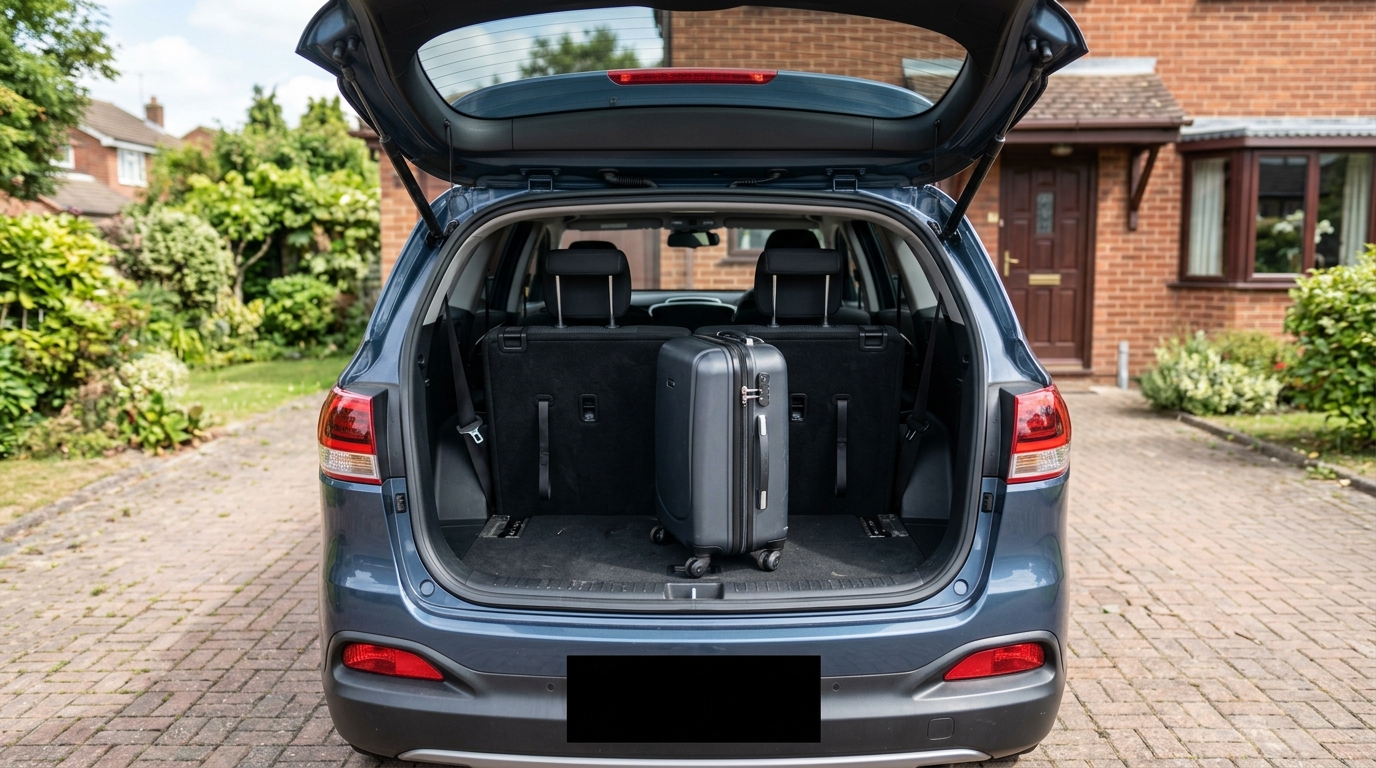
259 or 348: one 5008 boot, two units
When the 5008 was presented in June 2024, the spec sheet gave 259 VDA dm³, or 348 litres, with seven seats in place.
Yet a dm³ and a litre are the same quantity. A cube ten centimetres on each side, nothing more.
What exactly does a VDA litre measure?
A number of blocks, and the measuring method is what separates the two 5008 figures, since the unit is identical. Press articles and adverts quote one or the other without saying which: two websites can describe the same boot 89 litres apart and both be right.
The method of the VDA, the German association of the automotive industry, fills the boot with rigid blocks of 200 × 100 × 50 mm. Each takes up exactly one litre. You count the ones that fit with the tailgate shut, and that total becomes the volume.
Anything too narrow, too curved or too awkward to take a whole block drops out of the result: the hollow behind a wheel arch, the gap between two reclined seatbacks, the recess for a jack. The so-called liquid measurement counts the space as if water were poured into it. It takes everything.
There are several variants of the method depending on how high the blocks are stacked: below the parcel shelf, to the top of the seatbacks, or to the roof. That is a second source of confusion, and I come back to it below.
A third apart with seven seats, a fifth with two
I looked for 7-seaters whose maker publishes both measurements for the same layout. I found three: the Peugeot 5008, the Renault Espace and the Dacia Jogger. Here are their figures, and the gap I worked out between the two.
| Model and layout | VDA dm³ | Litres | Gap |
|---|---|---|---|
| Peugeot 5008, seven seats | 259 | 348 | + 34 % |
| Renault Espace, seven seats | 159 | 212 | + 33 % |
| Dacia Jogger, seven seats | 160 | 212 | + 33 % |
| Peugeot 5008, five seats | 748 | 916 | + 22 % |
| Dacia Jogger, third row folded | 565 | 699 | + 24 % |
| Peugeot 5008, two seats | 1,815 | 2,232 | + 23 % |
| Renault Espace 7-seat, maximum volume | 1,714 | 2,054 | + 20 % |
| Dacia Jogger 7-seat, maximum volume | 1,807 | 2,085 | + 15 % |
Three rows at the top, almost the same percentage. Across three cars from two different groups, the litre figure exceeds the VDA figure by a third as soon as the third row is in use. In absolute terms that is 89 litres on the 5008, 53 on the Espace, 52 on the Jogger.
Then the gap falls back. It sits around 22 to 24 % once the third row is stowed, and drops to 15 % on a fully emptied Jogger.
So the flattering figure flatters most where it matters most to you: with seven people on board and luggage to fit in.
Why does the gap grow as the boot shrinks?
Because a small boot is made of edges, and edges are exactly what blocks cannot fill.
Behind a third row, what remains is a slice. Peugeot gives 42 centimetres of boot length on the 5008 in that layout. Two blocks end to end make 40 centimetres: the last two centimetres, across the full width and height, count for nothing in VDA terms although water would fill them. Add the rake of the seatbacks, which draws a wedge and not a rectangle, the wheel arches and the sill. In a 40 centimetre slice those lost zones weigh heavily. In a two metre hold they become marginal, because the middle of the volume is one large box that blocks fill with nothing left over. This is my own explanation, drawn from geometry and not from a manufacturer document, but it fits all eight rows of the table.
The objection: your luggage is not made of bricks
It is a serious one. Nobody loads a boot with 20 centimetre blocks. A sports bag squashes, a coat slides along a wheel arch, a pack of nappies takes the shape of the corner left by a reclined seatback. The liquid litre would then describe a family's reality better than the VDA litre, which is too harsh.
That holds for soft luggage. A 7-seater loaded with duvets and canvas bags really does use part of the 53 litres the German method denies the Espace.
It no longer holds for rigid items, and rigid items are what cause trouble with seven on board. A cabin suitcase is about forty centimetres deep, a folded pushchair does not deform, nor does a shopping crate. In practice, with children, a holiday departure comes down to two or three hard objects that either go in or do not. For those, the VDA block is a fair approximation, and the litre figure a promise the boot will not keep.
So I keep VDA as the reference for comparisons, knowing it slightly underestimates what you can squeeze in.
How much boot does a hybrid take from a 7-seater?
It all depends on where the battery is, and the spec sheet rarely says so plainly.
On the Škoda Kodiaq it sits under the boot floor. The Belgian daily La DH reported on 5 October 2023 a volume of 745 litres for the plug-in hybrid, against 910 litres for the five-seat combustion version and 340 litres with seven seats. The AutoScout24.be road test of 23 January 2025 lists the lack of a seven-seat option among the plug-in's weak points. Here the battery does not shave off a few litres: it occupies the space of the two seats.
Kia did the opposite on the Sorento, sliding the battery under the cabin. When the plug-in was launched in August 2020, the brand quoted 175 litres behind the third row, against 179 for the regular hybrid. Four litres.
Non-plug-in hybrids, whose battery is far smaller, generally keep their third row: that is the case of the Espace E-Tech in the table. On a plug-in, ask the dealer two questions before any other: is this version available with seven seats, and is the quoted volume the one for this powertrain?
Do spec sheets at least measure to the same height?
No, and the unit does not settle everything.
ADAC, the German motoring club, measures the boots of the cars it tests itself, with foam blocks and always up to the lower edge of the load cover. In its comparison published on 27 January 2026, it points out that manufacturers' methods are neither uniform nor binding: some count the spare wheel well, others measure to the window line instead of the load cover. Its table gives 655 litres for a Škoda Kodiaq quoted at 910, and 485 litres for a Volkswagen Touran quoted at 834.
The same trap exists at the large end of the scale. The 763 litres of a long Volkswagen Multivan behind its third row are measured to the roof, as I noted when recording the remaining boot of six 7-seaters. Putting that figure next to an SUV's 340 litres is like comparing a wardrobe with a chest of drawers.
Four things to look for on the sheet before comparing
In Belgium, neither the certificate of conformity nor the registration certificate states a boot volume. The figure has no official status: it comes from the brochure, and the Belgian brochure repeats the manufacturer's. Four points are yours to check.
- The unit: "VDA dm³" or "litres". If the sheet says nothing, assume you do not know.
- The layout: seven seats in use, third row folded or removed, second row slid forward or back. On the Espace, the same boot with five occupants ranges from 520 to 782 litres depending on the sliding bench.
- The height: below the load cover or up to the roof.
- The powertrain: combustion, hybrid or plug-in, since the figure for one does not apply to another.
If the volume behind the third row stays under 200 VDA dm³, luggage for seven will not fit, whatever the unit. The rest is decided on the roof, with the weight limits I set out for a large roof box, and on the scales, with payload for seven.
Sources: La Tribune Auto, presentation of the Peugeot 5008, 18/06/2024 (259 VDA dm³ and 348 litres with seven seats, 748 and 916 with five, 1,815 and 2,232 with two); Renault, Espace dimensions page, read on 12/10/2026 (seven-seat version: 159 VDA dm³ and 212 litres minimum, 1,714 VDA dm³ and 2,054 litres maximum, 520 to 782 litres with five occupants depending on the bench); Dacia, Jogger dimensions page, read on 12/10/2026 (160 VDA dm³ and 212 litres, 565 and 699, 696 and 820, 1,807 and 2,085); fiches-auto.fr, article on boot volume and the VDA method, updated 13/06/2022 (200 × 100 × 50 mm blocks, height variants); ADAC, boot volume comparison, 27/01/2026; La DH, 05/10/2023, and AutoScout24.be, 23/01/2025, for the Škoda Kodiaq; Kia press release of August 2020 as reported by the press for the Sorento. Percentage gaps are our own calculations. I have not measured any of these boots myself. Volumes change with model year, trim and powertrain: read the figures for the exact version you are considering.
7 places hybrides comparator
Compare all 7 places hybrides side by side.
Compare now →
Frequently asked questions
Sophie teste des voitures familiales depuis 2013, d’abord pour la presse auto belge, aujourd’hui en indépendante depuis le Brabant wallon. Mère de trois enfants, elle juge une 7 places sur ce qui compte vraiment au quotidien : trois sièges-auto qui rentrent de front, le coffre une fois la 3e rangée dépliée, et la hauteur de seuil quand on charge une poussette. Sa règle : un essai sans enfants à bord ne vaut rien.